Institute of Animal Nutrition and Functional Plant Compounds, Department for Farm Animals and Veterinary Public Health, University of Veterinary Medicine Vienna, Vienna, Austria.
Vet Med Sci. 2023 May;9(3):1154-1162. doi: 10.1002/vms3.1102. Epub 2023 Mar 6.
Chewing is an essential physiological process in horses; yet, the physical form of feeds may affect their chewing and feeding behaviour with consequences for equine digestion and health.
The present study evaluated the potential of a commercial forage cubes made from alfalfa and mixed meadow grasses to maintain chewing activity when compared with a traditional long and fibre-rich hay. An additional aim was to measure the dust formation during feeding. The experiment was a crossover design with six horses (11 ± 4 years old, mean ± SD), fed with 5 kg (as-fed basis) of their feed (long hay or alfalfa cubes) overnight. Eating and chewing activity was measured using the EquiWatch system with a sensor-based halter.
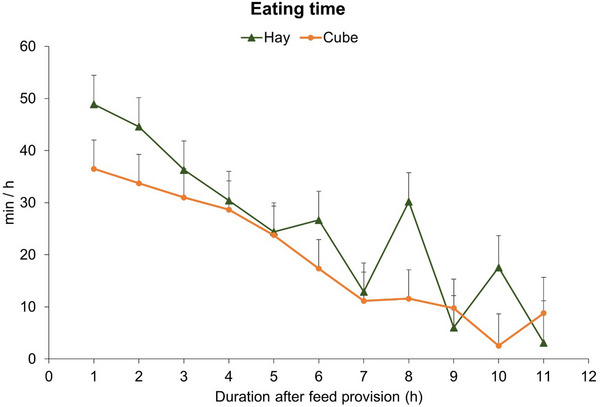
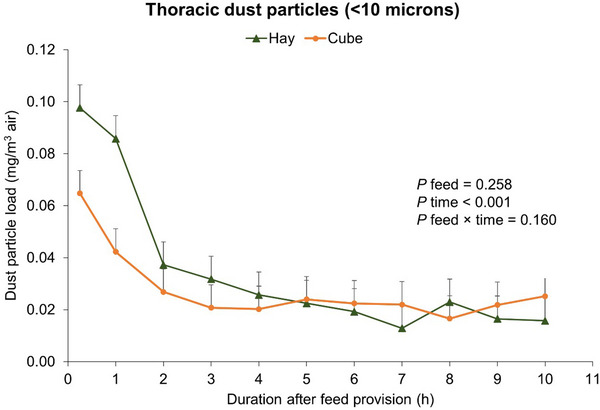
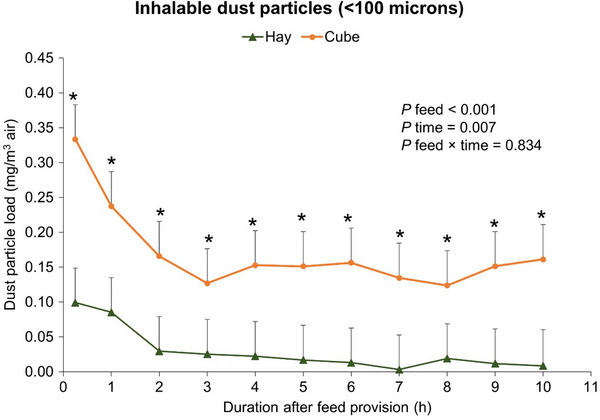
Data showed that by feeding the same amount of feed overnight, cube feeding led to 24% shorter eating time (on average 67 min less) and 26% fewer total chews compared to the long hay. On an hourly basis, horses also spent more time eating and chewing the long hay compared to the cubes. The cube feeding led to a higher dust concentration of the inhalable fraction (<100 μm), but not of the thoracic (<10 μm) fraction. Nevertheless, average dust concentrations were generally low for both cubes and hay, whereby both were of sound hygienic status.
Our data suggest that feeding alfalfa-based cubes overnight generated shorter eating time and less chews than the long hay without major differences in the thoracic dust. Therefore, because of the decreased eating time and chews, alfalfa-based cubes should not be fed a sole forage source, especially when it is to be fed without restriction.
咀嚼是马的一种基本生理过程;然而,饲料的物理形态可能会影响它们的咀嚼和进食行为,从而影响马的消化和健康。
本研究评估了一种由紫花苜蓿和混合草地草制成的商业草捆在维持咀嚼活动方面的潜力,与传统的长而富含纤维的干草相比。另一个目的是测量喂食过程中的粉尘形成。该实验采用交叉设计,有六匹马(11±4 岁,平均值±标准差),隔夜喂食 5 公斤(按实际重量计)的饲料(长干草或苜蓿草捆)。使用基于传感器的马勒的 EquiWatch 系统测量进食和咀嚼活动。
数据显示,通过隔夜喂食相同数量的饲料,与长干草相比,草捆喂养导致进食时间缩短 24%(平均少 67 分钟),总咀嚼次数减少 26%。按小时计算,与草捆相比,马也花更多的时间进食和咀嚼长干草。与长干草相比,草捆喂养会导致可吸入部分(<100μm)的粉尘浓度更高,但不会导致胸部部分(<10μm)的粉尘浓度更高。然而,两种草捆和干草的平均粉尘浓度都很低,这两种草捆和干草的卫生状况都很好。
我们的数据表明,与长干草相比,隔夜喂食苜蓿草捆会导致较短的进食时间和较少的咀嚼次数,但胸部粉尘无明显差异。因此,由于进食时间和咀嚼次数减少,苜蓿草捆不应作为单一的饲料来源,特别是当它被无限制地喂食时。