Department of Internal Medicine, Radboud University Medical Center, Nijmegen, the Netherlands.
Department for Health Evidence, Section Biostatistics, Radboud Institute for Health Sciences, Radboud University Medical Center, Nijmegen, the Netherlands.
Diabetologia. 2023 Jun;66(6):1035-1044. doi: 10.1007/s00125-023-05893-9. Epub 2023 Mar 7.
AIMS/HYPOTHESIS: It is generally recommended to reduce basal insulin doses after exercise to reduce the risk of post-exercise nocturnal hypoglycaemia. Based on its long t, it is unknown whether such adjustments are required or beneficial for insulin degludec.
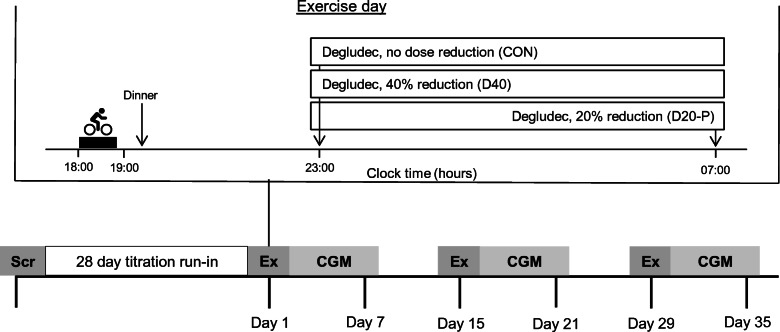
The ADREM study (Adjustment of insulin Degludec to Reduce post-Exercise (nocturnal) hypoglycaeMia in people with diabetes) was a randomised controlled, crossover study in which we compared 40% dose reduction (D40), or postponement and 20% dose reduction (D20-P), with no dose adjustment (CON) in adults with type 1 diabetes at elevated risk of hypoglycaemia, who performed a 45 min aerobic exercise test in the afternoon. All participants wore blinded continuous glucose monitors for 6 days, measuring the incidence of (nocturnal) hypoglycaemia and subsequent glucose profiles.
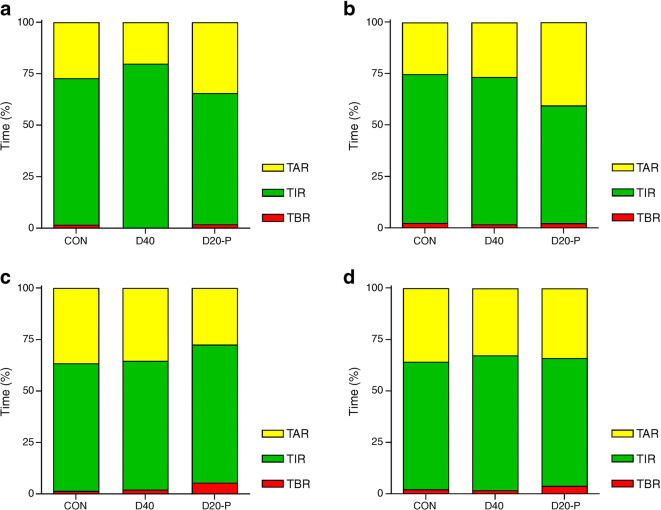
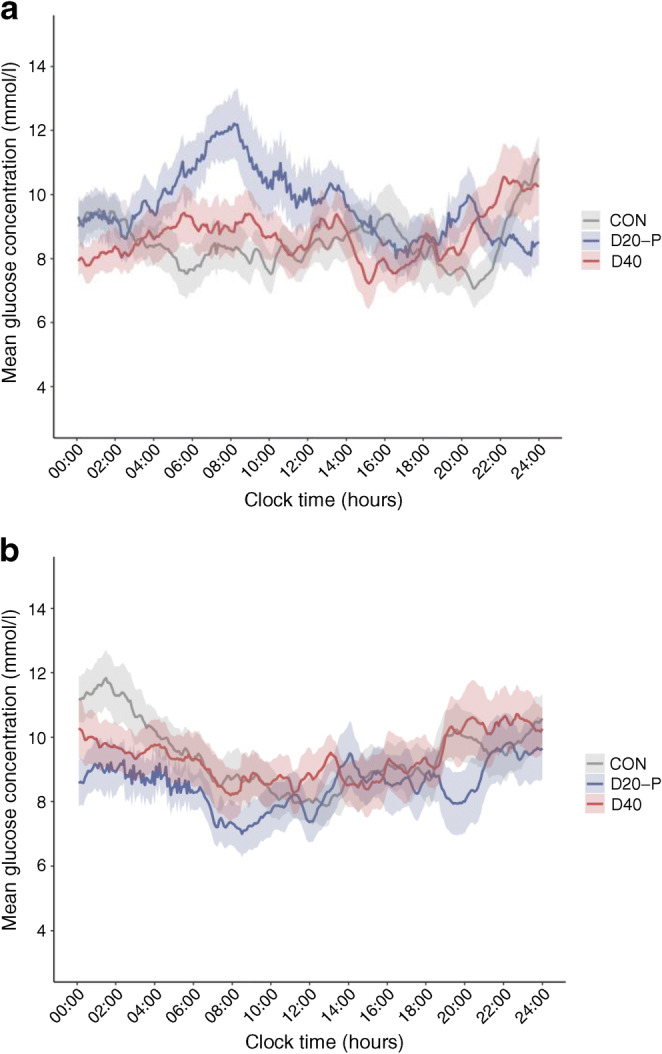
We recruited 18 participants (six women, age 38 ± 13 years, HbA 56 ± 8 mmol/mol [7.3 ± 0.8%], mean ± SD). Time below range (i.e. glucose <3.9 mmol/l) the night after the exercise test was generally low and occurrence did not differ between the treatment regimens. During the subsequent whole day, time below range was lower for D40 compared with CON (median [IQR], 0 [0-23] vs 18 [0-55] min, p=0.043), without differences in the number of hypoglycaemic events. Time above range (i.e. glucose >10 mmol/l) was greater for D20-P vs CON (mean ± SEM, 584 ± 81 vs 364 ± 66 min, p=0.001) and D40 (385 ± 72 min, p=0.003).
CONCLUSIONS/INTERPRETATION: Post-exercise adjustment of degludec does not mitigate the risk of subsequent nocturnal hypoglycaemia in people with type 1 diabetes. Although reducing degludec reduced next-day time below range, this did not translate into fewer hypoglycaemic events, while postponing degludec should be avoided because of increased time above range. Altogether, these data do not support degludec dose adjustment after a single exercise bout.
EudraCT number 2019-004222-22 FUNDING: The study was funded by an unrestricted grant from Novo Nordisk, Denmark.
目的/假设:运动后通常建议减少基础胰岛素剂量,以降低夜间运动后低血糖的风险。但鉴于其半衰期较长,尚不清楚对于德谷胰岛素是否需要或有益进行此类调整。
ADREM 研究(调整德谷胰岛素以降低糖尿病患者运动后(夜间)低血糖)是一项随机对照、交叉研究,其中我们比较了在低血糖风险升高的 1 型糖尿病成人中,在下午进行 45 分钟有氧运动测试后,40%剂量减少(D40)或推迟和 20%剂量减少(D20-P)与不调整剂量(CON)的效果。所有参与者在 6 天内佩戴盲法连续血糖监测仪,以测量夜间(夜间)低血糖的发生率和随后的血糖谱。
我们招募了 18 名参与者(6 名女性,年龄 38±13 岁,HbA1c56±8mmol/mol[7.3±0.8%],均值±标准差)。运动测试后夜间血糖低于目标范围(即血糖<3.9mmol/L)的时间一般较短,且不同治疗方案之间无差异。在随后的一整天中,D40 组的血糖低于目标范围的时间明显低于 CON 组(中位数[IQR],0[0-23]与 18[0-55]min,p=0.043),且低血糖事件数量无差异。血糖高于目标范围(即血糖>10mmol/L)的时间,D20-P 组明显长于 CON 组(平均±SEM,584±81 与 364±66min,p=0.001)和 D40 组(385±72min,p=0.003)。
结论/解释:1 型糖尿病患者运动后调整德谷胰岛素并不能降低随后夜间低血糖的风险。尽管降低德谷胰岛素可减少次日血糖低于目标范围的时间,但这并未转化为更少的低血糖事件,而推迟德谷胰岛素则因血糖高于目标范围的时间增加而应避免。总的来说,这些数据不支持单次运动后调整德谷胰岛素剂量。
EudraCT 编号 2019-004222-22。
该研究由丹麦诺和诺德公司提供的一项无限制赠款资助。