• 文献检索
  • 文档翻译
  • 深度研究
  • 学术资讯
  • Suppr Zotero 插件Zotero 插件
  • 邀请有礼
  • 套餐&价格
  • 历史记录
应用&插件
Suppr Zotero 插件Zotero 插件浏览器插件Mac 客户端Windows 客户端微信小程序
定价
高级版会员购买积分包购买API积分包
服务
文献检索文档翻译深度研究API 文档MCP 服务
关于我们
关于 Suppr公司介绍联系我们用户协议隐私条款
关注我们

Suppr 超能文献

核心技术专利:CN118964589B侵权必究
粤ICP备2023148730 号-1Suppr @ 2026

文献检索

告别复杂PubMed语法,用中文像聊天一样搜索,搜遍4000万医学文献。AI智能推荐,让科研检索更轻松。

立即免费搜索

文件翻译

保留排版,准确专业,支持PDF/Word/PPT等文件格式,支持 12+语言互译。

免费翻译文档

深度研究

AI帮你快速写综述,25分钟生成高质量综述,智能提取关键信息,辅助科研写作。

立即免费体验

肾移植受者预后的临床预测模型(KIDMO):研究方案

Clinical prediction model for prognosis in kidney transplant recipients (KIDMO): study protocol.

作者信息

Schwab Simon, Sidler Daniel, Haidar Fadi, Kuhn Christian, Schaub Stefan, Koller Michael, Mellac Katell, Stürzinger Ueli, Tischhauser Bruno, Binet Isabelle, Golshayan Déla, Müller Thomas, Elmer Andreas, Franscini Nicola, Krügel Nathalie, Fehr Thomas, Immer Franz

机构信息

Swisstransplant, Bern, Switzerland.

Department of Nephrology and Hypertension, Inselspital, Bern University Hospital, Bern, Switzerland.

出版信息

Diagn Progn Res. 2023 Mar 7;7(1):6. doi: 10.1186/s41512-022-00139-5.

DOI:10.1186/s41512-022-00139-5
PMID:36879332
原文链接:https://pmc.ncbi.nlm.nih.gov/articles/PMC9990297/
Abstract

BACKGROUND

Many potential prognostic factors for predicting kidney transplantation outcomes have been identified. However, in Switzerland, no widely accepted prognostic model or risk score for transplantation outcomes is being routinely used in clinical practice yet. We aim to develop three prediction models for the prognosis of graft survival, quality of life, and graft function following transplantation in Switzerland.

METHODS

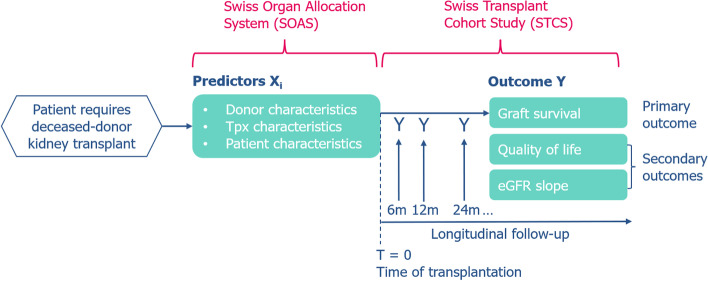
The clinical kidney prediction models (KIDMO) are developed with data from a national multi-center cohort study (Swiss Transplant Cohort Study; STCS) and the Swiss Organ Allocation System (SOAS). The primary outcome is the kidney graft survival (with death of recipient as competing risk); the secondary outcomes are the quality of life (patient-reported health status) at 12 months and estimated glomerular filtration rate (eGFR) slope. Organ donor, transplantation, and recipient-related clinical information will be used as predictors at the time of organ allocation. We will use a Fine & Gray subdistribution model and linear mixed-effects models for the primary and the two secondary outcomes, respectively. Model optimism, calibration, discrimination, and heterogeneity between transplant centres will be assessed using bootstrapping, internal-external cross-validation, and methods from meta-analysis.

DISCUSSION

Thorough evaluation of the existing risk scores for the kidney graft survival or patient-reported outcomes has been lacking in the Swiss transplant setting. In order to be useful in clinical practice, a prognostic score needs to be valid, reliable, clinically relevant, and preferably integrated into the decision-making process to improve long-term patient outcomes and support informed decisions for clinicians and their patients. The state-of-the-art methodology by taking into account competing risks and variable selection using expert knowledge is applied to data from a nationwide prospective multi-center cohort study. Ideally, healthcare providers together with patients can predetermine the risk they are willing to accept from a deceased-donor kidney, with graft survival, quality of life, and graft function estimates available for their consideration.

STUDY REGISTRATION

Open Science Framework ID: z6mvj.

摘要

背景

已确定许多用于预测肾移植结果的潜在预后因素。然而,在瑞士,临床实践中尚未常规使用被广泛接受的移植结果预后模型或风险评分。我们旨在为瑞士肾移植后的移植物存活、生活质量和移植物功能预后开发三种预测模型。

方法

临床肾脏预测模型(KIDMO)是利用来自一项全国多中心队列研究(瑞士移植队列研究;STCS)和瑞士器官分配系统(SOAS)的数据开发的。主要结局是肾移植存活(将受者死亡作为竞争风险);次要结局是12个月时的生活质量(患者报告的健康状况)和估计肾小球滤过率(eGFR)斜率。器官捐献者、移植及受者相关的临床信息将在器官分配时用作预测因素。我们将分别对主要结局和两个次要结局使用Fine & Gray亚分布模型和线性混合效应模型。将使用自抽样法、内部-外部交叉验证以及荟萃分析方法评估模型的乐观性、校准、辨别力和各移植中心之间的异质性。

讨论

瑞士移植领域缺乏对肾移植存活或患者报告结局的现有风险评分的全面评估。为了在临床实践中有用,预后评分需要有效、可靠、具有临床相关性,并且最好纳入决策过程以改善患者长期结局并为临床医生及其患者提供决策依据。通过考虑竞争风险并利用专家知识进行变量选择的先进方法应用于来自全国前瞻性多中心队列研究的数据。理想情况下,医疗服务提供者与患者可以预先确定他们愿意接受的来自 deceased-donor 肾脏的风险,并获得移植物存活、生活质量和移植物功能的估计值以供考虑。

研究注册

开放科学框架标识符:z6mvj。

https://cdn.ncbi.nlm.nih.gov/pmc/blobs/bc04/9990297/6d1acf5d49d4/41512_2022_139_Fig1_HTML.jpg

相似文献

1
Clinical prediction model for prognosis in kidney transplant recipients (KIDMO): study protocol.肾移植受者预后的临床预测模型(KIDMO):研究方案
Diagn Progn Res. 2023 Mar 7;7(1):6. doi: 10.1186/s41512-022-00139-5.
2
An external validation of the Kidney Donor Risk Index in the UK transplant population in the presence of semi-competing events.在存在半竞争事件的情况下,对英国移植人群中的肾脏供体风险指数进行外部验证。
Diagn Progn Res. 2023 Nov 21;7(1):20. doi: 10.1186/s41512-023-00159-9.
3
Kidney Transplantation Outcome Predictions (KTOP): A Risk Prediction Tool for Kidney Transplants from Brain-dead Deceased Donors Based on a Large European Cohort.肾移植结果预测(KTOP):基于大型欧洲队列的脑死亡供体肾移植风险预测工具。
Eur Urol. 2023 Feb;83(2):173-179. doi: 10.1016/j.eururo.2021.12.008. Epub 2022 Jan 7.
4
Predicting Clinical Outcome in Expanded Criteria Donor Kidney Transplantation: A Retrospective Cohort Study.扩大标准供体肾移植临床结局的预测:一项回顾性队列研究。
Can J Kidney Health Dis. 2020 Jun 24;7:2054358120924305. doi: 10.1177/2054358120924305. eCollection 2020.
5
Development and validation of a prognostic model for kidney function 1 year after combined pancreas and kidney transplantation using pre-transplant donor and recipient variables.利用移植前供体和受体变量建立并验证胰肾联合移植术后1年肾功能的预后模型。
Langenbecks Arch Surg. 2018 Nov;403(7):837-849. doi: 10.1007/s00423-018-1712-z. Epub 2018 Oct 18.
6
Development and external validation study combining existing models and recent data into an up-to-date prediction model for evaluating kidneys from older deceased donors for transplantation.将现有模型和最近的数据相结合,开发并验证了一个新的预测模型,用于评估老年死亡供者的肾脏是否适合移植。
Kidney Int. 2021 Jun;99(6):1459-1469. doi: 10.1016/j.kint.2020.11.016. Epub 2020 Dec 16.
7
Predicting 5-year risk of kidney transplant failure: a prediction instrument using data available at 1 year posttransplantation.预测肾移植失败的 5 年风险:一种使用移植后 1 年时可用数据的预测工具。
Am J Kidney Dis. 2014 Apr;63(4):643-51. doi: 10.1053/j.ajkd.2013.10.059. Epub 2013 Dec 31.
8
Risk factors for graft loss and death among kidney transplant recipients: A competing risk analysis.肾移植受者移植物丢失和死亡的风险因素:竞争风险分析。
PLoS One. 2022 Jul 14;17(7):e0269990. doi: 10.1371/journal.pone.0269990. eCollection 2022.
9
US deceased kidney transplantation: Estimated GFR, donor age and KDPI association with graft survival.美国已故者肾移植:估计的肾小球滤过率、供体年龄及肾脏供体风险指数与移植物存活的关联
EClinicalMedicine. 2021 Jun 23;37:100980. doi: 10.1016/j.eclinm.2021.100980. eCollection 2021 Jul.
10
Folic acid supplementation and malaria susceptibility and severity among people taking antifolate antimalarial drugs in endemic areas.在流行地区,服用抗叶酸抗疟药物的人群中,叶酸补充剂与疟疾易感性和严重程度的关系。
Cochrane Database Syst Rev. 2022 Feb 1;2(2022):CD014217. doi: 10.1002/14651858.CD014217.

引用本文的文献

1
Association of Kidney Graft Long-term Outcome With Recipient Cystathionine Gamma-lyase Polymorphisms and Hydrogen Sulfide Levels: A Cohort Study.肾移植长期预后与受者胱硫醚γ-裂解酶多态性及硫化氢水平的关联:一项队列研究
Transplant Direct. 2025 Apr 17;11(5):e1779. doi: 10.1097/TXD.0000000000001779. eCollection 2025 May.
2
Prediction of Renal Graft Function 1 Year After Adult Deceased-Donor Kidney Transplantation Using Variables Available Prior to Transplantation.利用移植前可用的变量预测成人尸体供肾移植后 1 年的移植肾功能。
Ann Transplant. 2024 Oct 1;29:e944603. doi: 10.12659/AOT.944603.
3
Preoperative Risk Assessment of Early Kidney Graft Loss.

本文引用的文献

1
Validation of prediction models in the presence of competing risks: a guide through modern methods.存在竞争风险时预测模型的验证:现代方法指南
BMJ. 2022 May 24;377:e069249. doi: 10.1136/bmj-2021-069249.
2
High-Throughput Metabolomics and Diabetic Kidney Disease Progression: Evidence from the Chronic Renal Insufficiency (CRIC) Study.高通量代谢组学与糖尿病肾病进展:来自慢性肾功能不全(CRIC)研究的证据。
Am J Nephrol. 2022;53(2-3):215-225. doi: 10.1159/000521940. Epub 2022 Feb 23.
3
Kidney Transplantation Outcome Predictions (KTOP): A Risk Prediction Tool for Kidney Transplants from Brain-dead Deceased Donors Based on a Large European Cohort.
早期肾移植丢失的术前风险评估
Transplant Direct. 2024 May 16;10(6):e1636. doi: 10.1097/TXD.0000000000001636. eCollection 2024 Jun.
肾移植结果预测(KTOP):基于大型欧洲队列的脑死亡供体肾移植风险预测工具。
Eur Urol. 2023 Feb;83(2):173-179. doi: 10.1016/j.eururo.2021.12.008. Epub 2022 Jan 7.
4
Cohort profile: The Swiss Transplant Cohort Study (STCS): A nationwide longitudinal cohort study of all solid organ recipients in Switzerland.队列资料简介:瑞士移植队列研究(STCS):一项针对瑞士所有实体器官受者的全国性纵向队列研究。
BMJ Open. 2021 Dec 15;11(12):e051176. doi: 10.1136/bmjopen-2021-051176.
5
Demographic, psychosocial and health disparities between living and deceased renal allograft recipients in Switzerland.瑞士活体和已故肾移植受者在人口统计学、心理社会和健康方面的差异。
Swiss Med Wkly. 2021 Aug 12;151:w20532. doi: 10.4414/smw.2021.20532. eCollection 2021 Aug 2.
6
Quality of life and mortality in the general population: a systematic review and meta-analysis.一般人群的生活质量和死亡率:系统评价和荟萃分析。
BMC Public Health. 2020 Nov 6;20(1):1596. doi: 10.1186/s12889-020-09639-9.
7
Calculating the sample size required for developing a clinical prediction model.计算开发临床预测模型所需的样本量。
BMJ. 2020 Mar 18;368:m441. doi: 10.1136/bmj.m441.
8
Prediction system for risk of allograft loss in patients receiving kidney transplants: international derivation and validation study.移植肾受者移植肾丢失风险预测系统:国际推导和验证研究。
BMJ. 2019 Sep 17;366:l4923. doi: 10.1136/bmj.l4923.
9
Factors Affecting eGFR Slope of Renal Transplant Patients During the First 2 Years.肾移植患者前两年估算肾小球滤过率(eGFR)斜率的影响因素
Transplant Proc. 2019 Sep;51(7):2318-2320. doi: 10.1016/j.transproceed.2019.01.165. Epub 2019 Aug 7.
10
Performance of GFR Slope as a Surrogate End Point for Kidney Disease Progression in Clinical Trials: A Statistical Simulation.肾小球滤过率斜率作为临床试验中肾脏疾病进展替代终点的性能:统计模拟。
J Am Soc Nephrol. 2019 Sep;30(9):1756-1769. doi: 10.1681/ASN.2019010009. Epub 2019 Jul 10.