Department of General, Visceral and Transplant Surgery, Hannover Medical School, Hannover, Germany.
Department of General, Visceral, Pediatric and Transplant Surgery, Aachen University Hospital, Aachen, Germany.
Ann Transplant. 2024 Oct 1;29:e944603. doi: 10.12659/AOT.944603.
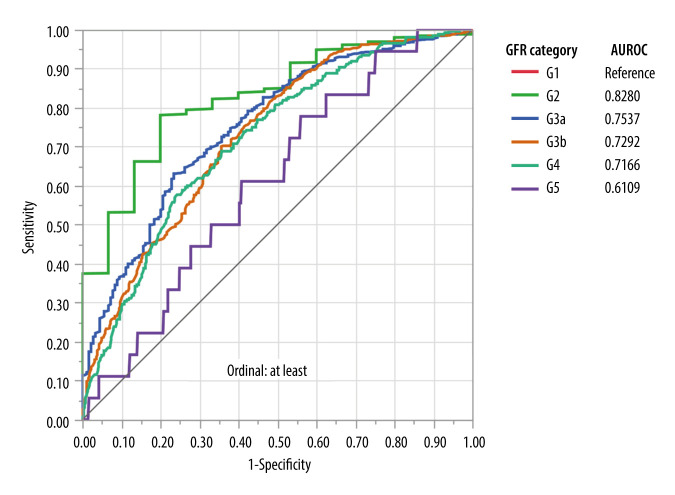
BACKGROUND Kidney transplantation is still the best therapy for patients with end-stage renal disease, but the demand for donor organs persistently surpasses the supply. A prognostic model using pre-transplant data for the prediction of renal graft function would be helpful to optimize organ allocation and avoid futile transplantations. MATERIAL AND METHODS Retrospective data of 2431 patients who underwent kidney transplantation between January 01, 2000, and December 31, 2012 with subsequent ten-year clinical follow-up in our transplant center were analyzed. Of these, 1172 patients met the inclusion criteria. Multivariable regression modelling was used to develop a prognostic model for the prediction of graft function after 1 year utilizing only pre-transplant data. The final model was assessed with the area under the receiver operating characteristic (AUROC) curve. RESULTS Donor age, donor serum creatinine, recipient body mass index, re-transplantations beyond the second kidney transplantation, and cold ischemia time had an independent, significant influence on graded renal graft function 1 year after kidney transplantation. AUROC analysis of the prognostic model was >0.700 for all GFR categories except KDIGO G5, indicating high sensitivity and specificity of prediction. CONCLUSIONS For improvement of renal graft function, organs from older donors or donors with high serum creatinine should not be used in obese recipients and for re-transplantations beyond the second one. Cold ischemia time should be as short as possible.
肾移植仍然是终末期肾病患者的最佳治疗方法,但供体器官的需求持续超过供应。使用移植前数据预测肾移植后肾功能的预后模型将有助于优化器官分配,避免无效移植。
回顾性分析了 2000 年 1 月 1 日至 2012 年 12 月 31 日在我们移植中心接受肾移植并随后进行了十年临床随访的 2431 例患者的数据,其中 1172 例符合纳入标准。使用多变量回归模型,仅利用移植前数据,建立了预测移植后 1 年移植物功能的预后模型。使用受试者工作特征曲线下面积(AUROC)评估最终模型。
供体年龄、供体血清肌酐、受者体重指数、第二次以上肾移植和冷缺血时间对肾移植后 1 年分级肾功能有独立、显著影响。除 KDIGO G5 外,该预后模型对所有肾小球滤过率(GFR)分类的 AUROC 分析均>0.700,表明预测的灵敏度和特异性较高。
为了改善移植物功能,应避免将来自年龄较大或血清肌酐较高的供体的器官用于肥胖受者和第二次以上的移植,应尽可能缩短冷缺血时间。