• 文献检索
  • 文档翻译
  • 深度研究
  • 学术资讯
  • Suppr Zotero 插件Zotero 插件
  • 邀请有礼
  • 套餐&价格
  • 历史记录
应用&插件
Suppr Zotero 插件Zotero 插件浏览器插件Mac 客户端Windows 客户端微信小程序
定价
高级版会员购买积分包购买API积分包
服务
文献检索文档翻译深度研究API 文档MCP 服务
关于我们
关于 Suppr公司介绍联系我们用户协议隐私条款
关注我们

Suppr 超能文献

核心技术专利:CN118964589B侵权必究
粤ICP备2023148730 号-1Suppr @ 2026

文献检索

告别复杂PubMed语法,用中文像聊天一样搜索,搜遍4000万医学文献。AI智能推荐,让科研检索更轻松。

立即免费搜索

文件翻译

保留排版,准确专业,支持PDF/Word/PPT等文件格式,支持 12+语言互译。

免费翻译文档

深度研究

AI帮你快速写综述,25分钟生成高质量综述,智能提取关键信息,辅助科研写作。

立即免费体验

用于预测胸腺切除术患者术后肌无力危象风险的列线图。

Nomogram for predicting the risk of postoperative myasthenic crisis in patients with thymectomy.

机构信息

Department of Neurology, Tangdu Hospital, The Fourth Military Medical University, Xi'an, China.

Department of Thoracic Surgery, Tangdu Hospital, The Fourth Military Medical University, Xi'an, China.

出版信息

Ann Clin Transl Neurol. 2023 Apr;10(4):644-655. doi: 10.1002/acn3.51752. Epub 2023 Mar 6.

DOI:10.1002/acn3.51752
PMID:36879415
原文链接:https://pmc.ncbi.nlm.nih.gov/articles/PMC10109272/
Abstract

OBJECTIVE

This study aimed to develop and validate internally a clinical predictive model, for predicting myasthenic crisis within 30 days after thymectomy in patients with myasthenia gravis.

METHODS

Eligible patients were enrolled between January 2015 and May 2019. The primary outcome measure was postoperative myasthenic crisis (POMC). A predictive model was constructed using logistic regression and presented in a nomogram. The area under the receiver operating characteristic curve (AUC) was calculated to examine the performance. The study population was divided into high- and low-risk groups according to Youden index. Calibration curves with 1000 replications bootstrap resampling were plotted to visualize the calibration of the nomogram. Decision curve analyses (DCA) with 1000 replications bootstrap resampling were performed to evaluate the clinical usefulness of the model.

RESULTS

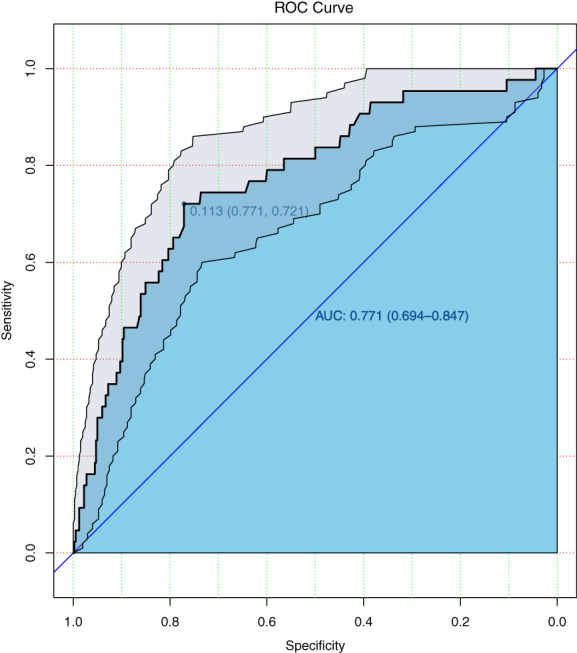
A total of 445 patients were enrolled. Five variables were screened including thymus imaging, onset age, MGFA classification, preoperative treatment regimen, and surgical approach. The model exhibited moderate discriminative ability with AUC value 0.771. The threshold probability was 0.113, which was used to differentiate between high- and low-risk groups. The sensitivity and specificity were 72.1% and 77.1%, respectively. The high-risk group had an 8.70-fold higher risk of POMC. The calibration plot showed that when the probability was between 0 and 0.5, the deviation calibration curve of the model was consistent with the ideal curve.

INTERPRETATION

This nomogram could assist in identifying patients at higher risk of POMC and determining the optimal surgical time for these patients.

摘要

目的

本研究旨在开发和验证一种内部临床预测模型,用于预测重症肌无力患者胸腺切除术后 30 天内发生肌无力危象的风险。

方法

本研究纳入了 2015 年 1 月至 2019 年 5 月间的符合条件的患者。主要结局指标为术后肌无力危象(POMC)。使用逻辑回归构建预测模型,并以列线图形式呈现。计算受试者工作特征曲线下面积(AUC)以评估模型性能。根据约登指数将研究人群分为高风险组和低风险组。绘制 1000 次 bootstrap 重采样校准曲线以直观评估列线图的校准程度。通过 1000 次 bootstrap 重采样进行决策曲线分析(DCA)以评估模型的临床实用性。

结果

共纳入 445 例患者。筛选出 5 个变量,包括胸腺影像学、发病年龄、MGFA 分类、术前治疗方案和手术方式。模型具有中等的区分能力,AUC 值为 0.771。阈值概率为 0.113,用于区分高风险组和低风险组。高风险组发生 POMC 的风险是低风险组的 8.70 倍。校准曲线显示,当概率在 0 到 0.5 之间时,模型的偏差校准曲线与理想曲线一致。

结论

该列线图有助于识别发生 POMC 风险较高的患者,并确定这些患者的最佳手术时机。

https://cdn.ncbi.nlm.nih.gov/pmc/blobs/05b9/10109272/00f6d1bb7e8e/ACN3-10-644-g002.jpg
https://cdn.ncbi.nlm.nih.gov/pmc/blobs/05b9/10109272/c2d2d08339d2/ACN3-10-644-g001.jpg
https://cdn.ncbi.nlm.nih.gov/pmc/blobs/05b9/10109272/1f51b0a9d8b6/ACN3-10-644-g005.jpg
https://cdn.ncbi.nlm.nih.gov/pmc/blobs/05b9/10109272/e5bbf74e38a1/ACN3-10-644-g004.jpg
https://cdn.ncbi.nlm.nih.gov/pmc/blobs/05b9/10109272/9f6c3e1078e9/ACN3-10-644-g003.jpg
https://cdn.ncbi.nlm.nih.gov/pmc/blobs/05b9/10109272/00f6d1bb7e8e/ACN3-10-644-g002.jpg
https://cdn.ncbi.nlm.nih.gov/pmc/blobs/05b9/10109272/c2d2d08339d2/ACN3-10-644-g001.jpg
https://cdn.ncbi.nlm.nih.gov/pmc/blobs/05b9/10109272/1f51b0a9d8b6/ACN3-10-644-g005.jpg
https://cdn.ncbi.nlm.nih.gov/pmc/blobs/05b9/10109272/e5bbf74e38a1/ACN3-10-644-g004.jpg
https://cdn.ncbi.nlm.nih.gov/pmc/blobs/05b9/10109272/9f6c3e1078e9/ACN3-10-644-g003.jpg
https://cdn.ncbi.nlm.nih.gov/pmc/blobs/05b9/10109272/00f6d1bb7e8e/ACN3-10-644-g002.jpg

相似文献

1
Nomogram for predicting the risk of postoperative myasthenic crisis in patients with thymectomy.用于预测胸腺切除术患者术后肌无力危象风险的列线图。
Ann Clin Transl Neurol. 2023 Apr;10(4):644-655. doi: 10.1002/acn3.51752. Epub 2023 Mar 6.
2
Thymectomy in myasthenia gravis: proposal for a predictive score of postoperative myasthenic crisis.重症肌无力的胸腺切除术:术后肌无力危象预测评分方案
Eur J Cardiothorac Surg. 2014 Apr;45(4):e76-88; discussion e88. doi: 10.1093/ejcts/ezt641. Epub 2014 Feb 12.
3
Predictive factors of myasthenic crisis after extended thymectomy for patients with myasthenia gravis.重症肌无力患者扩大胸腺切除术后肌无力危象的预测因素。
Eur J Cardiothorac Surg. 2015 Nov;48(5):705-9; discussion 709. doi: 10.1093/ejcts/ezu530. Epub 2015 Jan 24.
4
Risk factors of myasthenic crisis after thymectomy for thymoma patients with myasthenia gravis.胸腺瘤合并重症肌无力患者胸腺切除术后肌无力危象的危险因素。
Eur J Cardiothorac Surg. 2017 Oct 1;52(4):692-697. doi: 10.1093/ejcts/ezx163.
5
Preoperative Anxiety in Patients With Myasthenia Gravis and Risk for Myasthenic Crisis After Extended Transsternal Thymectomy: A CONSORT Study.重症肌无力患者术前焦虑与扩大经胸骨胸腺切除术后肌无力危象风险:一项CONSORT研究
Medicine (Baltimore). 2016 Mar;95(10):e2828. doi: 10.1097/MD.0000000000002828.
6
Predictive factors for postoperative myasthenic crisis in patients with myasthenia gravis.重症肌无力患者术后肌无力危象的预测因素
Interdiscip Cardiovasc Thorac Surg. 2023 Feb 6;36(2). doi: 10.1093/icvts/ivad040.
7
Risk Factors for Postoperative Myasthenic Crisis After Thymectomy in Patients With Myasthenia Gravis.重症肌无力患者胸腺切除术后肌无力危象的危险因素。
J Surg Res. 2021 Jun;262:1-5. doi: 10.1016/j.jss.2020.12.048. Epub 2021 Jan 30.
8
Clinical outcome and predictive factors of postoperative myasthenic crisis in 173 thymomatous myasthenia gravis patients.173例胸腺瘤型重症肌无力患者术后肌无力危象的临床结局及预测因素
Int J Neurosci. 2018 Feb;128(2):103-109. doi: 10.1080/00207454.2017.1366905. Epub 2017 Oct 2.
9
A clinical predictive score for postoperative myasthenic crisis.术后肌无力危象的临床预测评分。
Ann Neurol. 2017 Nov;82(5):841-849. doi: 10.1002/ana.25087. Epub 2017 Nov 10.
10
Risk factors of prolonged ventilation after thymectomy in thymoma myasthenia gravis patients.胸腺瘤肌无力患者胸腺切除术后长时间通气的危险因素。
J Cardiothorac Surg. 2021 Sep 27;16(1):275. doi: 10.1186/s13019-021-01668-8.

引用本文的文献

1
A nurse-led nomogram for predicting the risk of myasthenic crisis in patients with myasthenia gravis and bulbar weakness.一种由护士主导的列线图,用于预测重症肌无力伴延髓肌无力患者发生肌无力危象的风险。
BMC Neurol. 2025 Aug 13;25(1):332. doi: 10.1186/s12883-025-04370-7.
2
Comparison of outcomes and postoperative immunotherapy between patients with non-thymomatous and thymomatous myasthenia gravis following thymectomy.胸腺切除术后非胸腺瘤型与胸腺瘤型重症肌无力患者的预后及术后免疫治疗比较。
Ther Adv Neurol Disord. 2025 Jun 20;18:17562864251343573. doi: 10.1177/17562864251343573. eCollection 2025.

本文引用的文献

1
Poor responses and adverse outcomes of myasthenia gravis after thymectomy: Predicting factors and immunological implications.胸腺瘤切除术后重症肌无力疗效不佳和不良预后:预测因素和免疫学意义。
J Autoimmun. 2022 Oct;132:102895. doi: 10.1016/j.jaut.2022.102895. Epub 2022 Aug 27.
2
Development and Validation of a Nomogram for Predicting Generalization in Patients With Ocular Myasthenia Gravis.开发和验证一种预测眼肌型重症肌无力患者泛化的列线图。
Front Immunol. 2022 Jul 7;13:895007. doi: 10.3389/fimmu.2022.895007. eCollection 2022.
3
Association of immunosuppression treatment with generalization among patients with ocular myasthenia gravis: A propensity score analysis.
眼肌型重症肌无力患者免疫抑制治疗与病情泛化的关联:一项倾向评分分析。
Eur J Neurol. 2022 Jun;29(6):1805-1814. doi: 10.1111/ene.15292. Epub 2022 Mar 7.
4
Risk Factors for Generalization in Patients with Ocular Myasthenia Gravis: A Multicenter Retrospective Cohort Study.眼肌型重症肌无力患者病情泛化的危险因素:一项多中心回顾性队列研究。
Neurol Ther. 2022 Mar;11(1):73-86. doi: 10.1007/s40120-021-00292-x. Epub 2021 Nov 2.
5
Thymectomy and Risk of Generalization in Patients with Ocular Myasthenia Gravis: A Multicenter Retrospective Cohort Study.胸腺瘤切除术和眼肌型重症肌无力患者泛化的风险:一项多中心回顾性队列研究。
Neurotherapeutics. 2021 Oct;18(4):2449-2457. doi: 10.1007/s13311-021-01129-z. Epub 2021 Oct 8.
6
Risk Factors for Postoperative Myasthenic Crisis After Thymectomy in Patients With Myasthenia Gravis.重症肌无力患者胸腺切除术后肌无力危象的危险因素。
J Surg Res. 2021 Jun;262:1-5. doi: 10.1016/j.jss.2020.12.048. Epub 2021 Jan 30.
7
International Consensus Guidance for Management of Myasthenia Gravis: 2020 Update.国际重症肌无力管理共识指南:2020 年更新版。
Neurology. 2021 Jan 19;96(3):114-122. doi: 10.1212/WNL.0000000000011124. Epub 2020 Nov 3.
8
Assessment of the risks of a myasthenic crisis after thymectomy in patients with myasthenia gravis: a systematic review and meta-analysis of 25 studies.评估胸腺瘤切除术后重症肌无力患者发生肌无力危象的风险:25 项研究的系统评价和荟萃分析。
J Cardiothorac Surg. 2020 Sep 29;15(1):270. doi: 10.1186/s13019-020-01320-x.
9
Calculating the sample size required for developing a clinical prediction model.计算开发临床预测模型所需的样本量。
BMJ. 2020 Mar 18;368:m441. doi: 10.1136/bmj.m441.
10
Clinical and therapeutic features of myasthenia gravis in adults based on age at onset.基于发病年龄的成人重症肌无力的临床和治疗特征。
Neurology. 2020 Mar 17;94(11):e1171-e1180. doi: 10.1212/WNL.0000000000008903. Epub 2020 Feb 18.