Liu Xiaoqian, Virk Sonika, Fedorova Tatyana, Oo Win Min, Hunter David J
Rheumatology Department, Royal North Shore Hospital, Northern Clinical School, Faculty of Medicine and Health, The University of Sydney, Australia.
Sydney Musculoskeletal Health, Kolling Institute, The University of Sydney, Australia.
Osteoarthr Cartil Open. 2023 Feb 7;5(2):100343. doi: 10.1016/j.ocarto.2023.100343. eCollection 2023 Jun.
To evaluate the efficacy and safety of pentosan polysulfate sodium (PPS, Elmiron®) for dyslipidaemia and knee osteoarthritis (OA) related symptoms.
This was a single-arm, open-label, prospective, non-randomised pilot study. People with painful knee OA and a history of primary hypercholesterolemia were included. PPS was taken orally in a dosage of 10 mg/kg once every 4 days for 5 weeks for two cycles. There was 5 weeks of no medication between the cycles. The main outcomes included the change in lipidemia levels, the change in knee OA-related symptoms assessed by pain numerical rating scale (NRS) and Knee Osteoarthritis Outcome Score (KOOS), and knee MRI semi-quantitative score. The changes were analysed using paired t-tests.
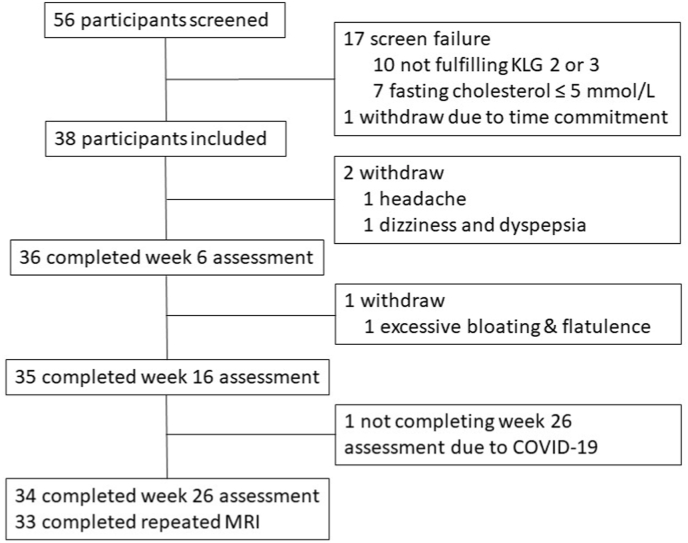
38 participants were included, with a mean age of 62.2 years. We found a statistically significant decrease in total cholesterol (from 6.23 ± 0.74 to 5.95 ± 0.77 mmol/L; = 0.01) and low-density lipoprotein (from 4.03 ± 0.61 to 3.82 ± 0.61 mmol/L; = 0.009) from baseline to week 16. Knee pain NRS was significantly reduced at weeks 6, 16 and 26 from 6.39 ± 1.33 to 4.18 ± 1.99, 3.63 ± 2.28 and 4.38 ± 2.55, respectively ( < 0.001). However, there was no significant difference in terms of the primary outcome of triglyceride levels before and after treatment. The most common AEs were positive faecal occult blood tests, followed by headache and diarrhoea.
The findings suggest that PPS has promising effects on improving dyslipidaemia and symptomatic pain relief in people with knee OA.
评估戊聚糖多硫酸钠(PPS,爱泌罗®)对血脂异常及膝骨关节炎(OA)相关症状的疗效和安全性。
这是一项单臂、开放标签、前瞻性、非随机的试点研究。纳入有膝关节疼痛性OA且有原发性高胆固醇血症病史的人群。PPS以10毫克/千克的剂量口服,每4天一次,持续5周,共两个周期。两个周期之间有5周的无药期。主要结局包括血脂水平的变化、通过疼痛数字评定量表(NRS)和膝关节骨关节炎结局评分(KOOS)评估的膝OA相关症状的变化以及膝关节MRI半定量评分。使用配对t检验分析这些变化。
纳入38名参与者,平均年龄62.2岁。我们发现从基线到第16周,总胆固醇(从6.23±0.74降至5.95±0.77毫摩尔/升;P = 0.01)和低密度脂蛋白(从4.03±0.61降至3.82±0.61毫摩尔/升;P = 0.009)有统计学意义的下降。膝关节疼痛NRS在第6、16和26周时显著降低,分别从6.39±1.33降至4.18±1.99、3.63±2.28和4.38±2.55(P < 0.001)。然而,治疗前后甘油三酯水平的主要结局无显著差异。最常见的不良事件是粪便潜血试验阳性,其次是头痛和腹泻。
研究结果表明,PPS在改善膝OA患者的血脂异常和缓解症状性疼痛方面有良好效果。