Jensen Elisa Skovgaard, Cayé-Thomasen Per, Bodilsen Jacob, Nielsen Henrik, Friis-Hansen Lennart, Christensen Thomas, Christiansen Malina, Kirchmann Malene, Brandt Christian Thomas
Department of Otorhinolaryngology, Nordsjællands Hospital, University of Copenhagen, Hillerød, Denmark.
Department of Otorhinolaryngology Head & Neck Surgery and Audiology, University Hospital Copenhagen Rigshospitalet, Copenhagen, Denmark.
Open Forum Infect Dis. 2023 Feb 4;10(3):ofad056. doi: 10.1093/ofid/ofad056. eCollection 2023 Mar.
Hearing loss and deafness are well-known sequelae from bacterial meningitis (ABM) and may result in social dysfunction and learning difficulties. Yet, the timely development of hearing loss and restitution is poorly studied, especially among adults. Hearing loss was revisited using otoacoustic emissions (OAEs) to determine the occurrence, magnitude, and development of hearing loss among adults with ABM.
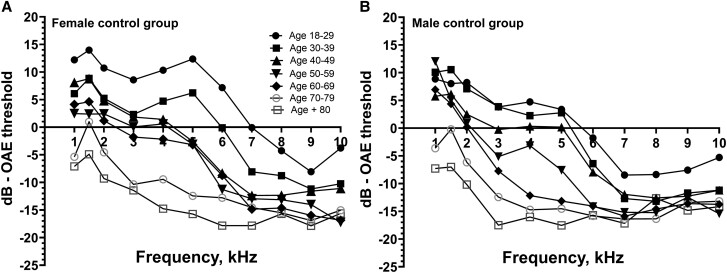
Distortion product OAEs were measured in patients with ABM the day of admission and days 2, 3, 5-7, and 10-14 and at follow-up 30-60 days after discharge. Frequencies were categorized as low (1, 1.5, 2 kHz), mid (3, 4, 5 kHz), mid-high (6, 7, 8 kHz), and high (9, 10 kHz). Audiometry was performed on discharge and 60 days after. Results were compared with 158 healthy controls.
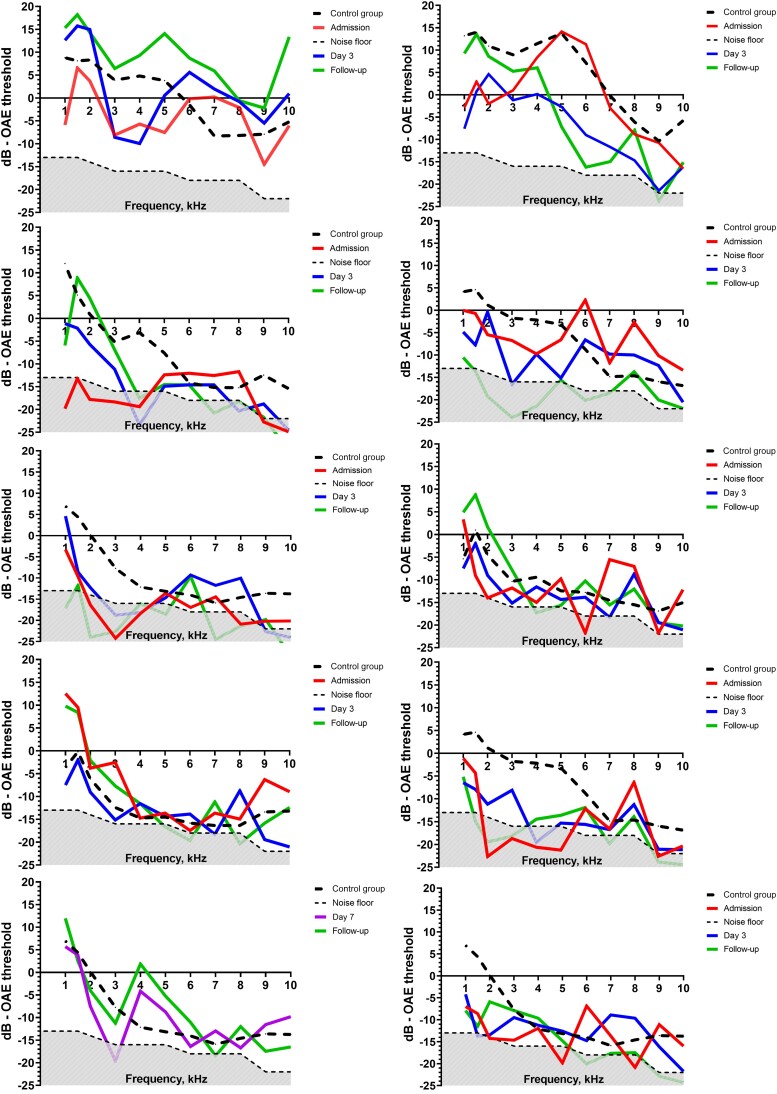
OAE was obtained in 32 patients. ABM was due to in 12 patients (38%). All patients were treated with dexamethasone. OAE emission threshold levels (ETLs) were significantly decreased upon admission and at follow-up in all frequencies compared with healthy controls. A substantial and significant decrease in ETLs was found in meningitis. Sensorineural hearing loss (SNHL) >20 dB was present in 13 of 23 (57%) at discharge and in 11 of 18 patients (61%) 60 days after discharge. Hearing recovery decreased from day 3.
Hearing loss in ABM still affects >60% of patients despite treatment with dexamethasone. In meningitis, SNHL is profound and permanent. A window of opportunity for systemic or local treatments aiming to preserve cochlear function is proposed.
听力损失和耳聋是细菌性脑膜炎(ABM)的常见后遗症,可能导致社交功能障碍和学习困难。然而,听力损失的及时发生和恢复情况研究较少,尤其是在成年人中。本研究使用耳声发射(OAE)重新评估ABM成年患者听力损失的发生、程度和发展情况。
对ABM患者在入院当天、第2天、第3天、第5 - 7天、第10 - 14天以及出院后30 - 60天进行畸变产物耳声发射测量。频率分为低(1、1.5、2 kHz)、中(3、4、5 kHz)、中高(6、7、8 kHz)和高(9、10 kHz)。出院时和出院60天后进行听力测定。结果与158名健康对照者进行比较。
32例患者获得了耳声发射数据。12例患者(38%)的ABM病因是[此处原文缺失病因相关内容]。所有患者均接受地塞米松治疗。与健康对照者相比,所有频率的耳声发射阈值水平(ETL)在入院时和随访时均显著降低。在[此处原文缺失相关脑膜炎类型内容]脑膜炎中发现ETL有显著大幅下降。23例患者中有13例(57%)在出院时出现感音神经性听力损失(SNHL)>20 dB,18例患者中有11例(61%)在出院60天后出现。听力恢复从第3天开始下降。
尽管使用地塞米松治疗,ABM患者的听力损失仍影响超过60%的患者。在[此处原文缺失相关脑膜炎类型内容]脑膜炎中,SNHL严重且为永久性。提出了旨在保留耳蜗功能的全身或局部治疗的机会窗口。