Department of Pediatrics, College of Medicine University of Ibadan & University College Hospital, Ibadan, Oyo State, Nigeria.
Department of Paediatrics, Federal Medical Centre, Kastina, Kastina State, Nigeria.
PLoS One. 2023 Mar 9;18(3):e0281704. doi: 10.1371/journal.pone.0281704. eCollection 2023.
Several studies have shown that the impact of maternal mental health disorders on newborns' well-being in low and middle-income countries (LMIC) are underreported, multi-dimensional and varies over time and differs from what is reported in high-income countries. We present the prevalence and risk factors associated with common mental disorders (CMDs) among breastfeeding mothers whose infants were admitted to Nigerian tertiary care facilities.
This was a national cross-sectional study involving mothers of hospitalised babies from eleven Nigerian tertiary hospitals. We used the WHO self-reporting Questionnaire 20 and an adapted WHO/UNICEF ten-step breastfeeding support package to assess mothers' mental health and breastfeeding support.
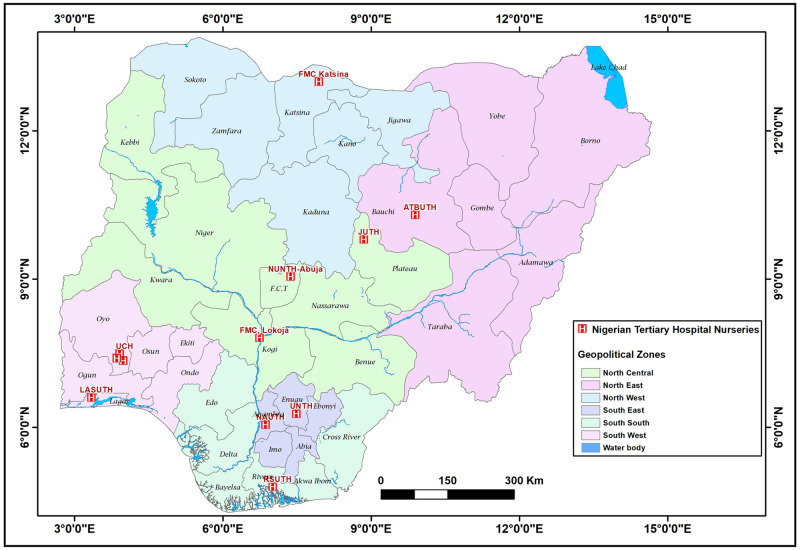
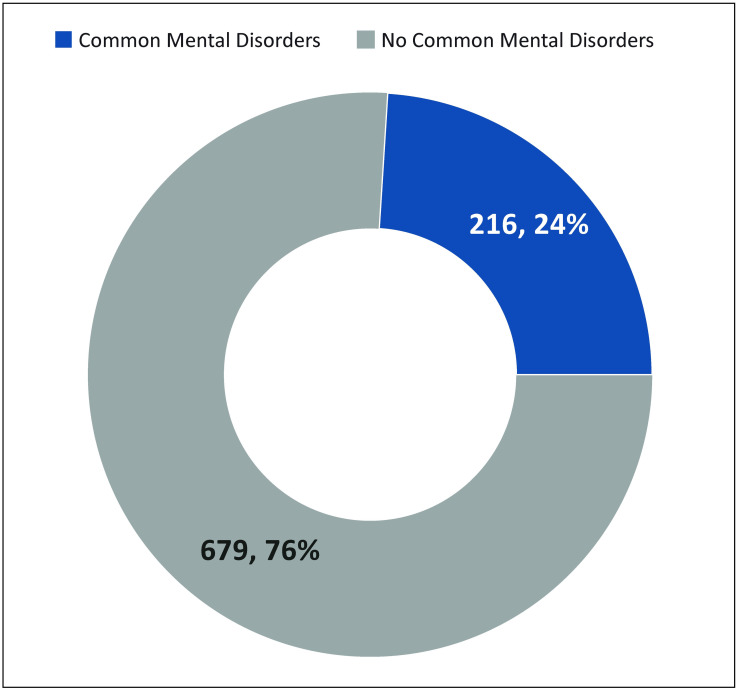
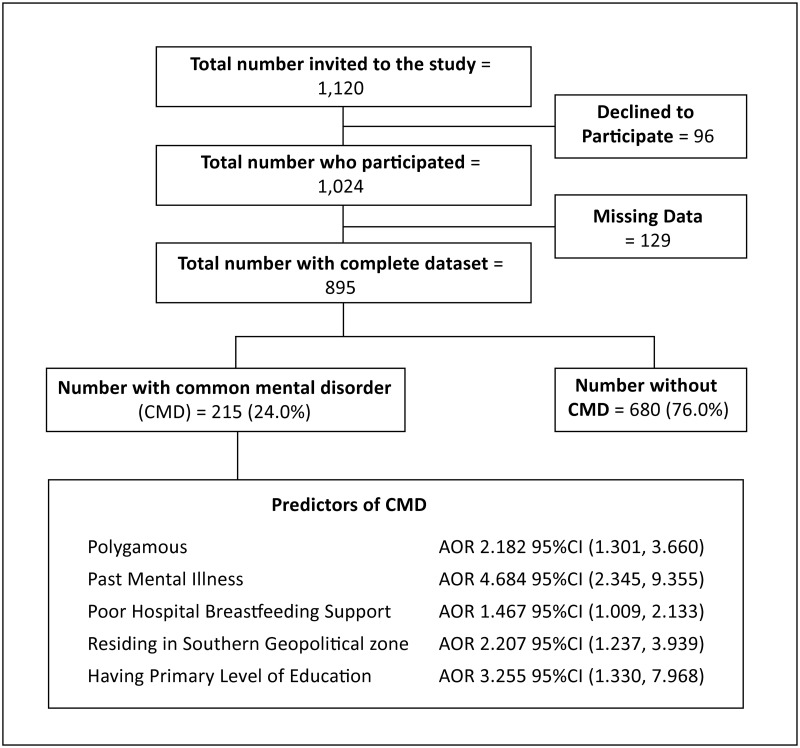
Only 895 of the 1,120 mothers recruited from eleven tertiary healthcare nurseries in six geopolitical zones of Nigeria had complete datasets for analysis. The participants' mean age was 29.9 ± 6.2 years. One in four had CMDs; 24.0% (95% CI: 21.235, 26.937%). The ages of mothers, parity, gestational age at delivery, and length of hospital stay were comparable between mothers with and those without CMDs. Antenatal care at primary healthcare facilities (adjusted odds ratio [aOR:13], primary education [aOR:3.255] living in the south-southern region of the country [aOR 2.207], poor breastfeeding support [aOR:1.467], polygamous family settings [aOR:2.182], and a previous history of mental health disorders [aOR:4.684] were significantly associated with CMDs. In contrast, those from the middle and lower socioeconomic classes were less likely to develop CMDs, with [aOR:0.532] and [aOR:0.493], respectively.
In Nigeria, the prevalence of CMDs is relatively high among breastfeeding mothers with infants admitted to a tertiary care facility. Prior history of mental illness, polygamous households, mothers living in the southern region and low or no educational attainment have a greater risk of developing CMDs. This study provides evidence for assessing and tailoring interventions to CMDs among breastfeeding mothers in neonatal nurseries in LMIC.
多项研究表明,在中低收入国家(LMIC),母亲心理健康障碍对新生儿健康的影响报告不足,具有多维性且随时间变化,与高收入国家报告的情况不同。我们介绍了在尼日利亚三级保健机构住院婴儿的母乳喂养母亲中常见精神障碍(CMD)的患病率和相关危险因素。
这是一项全国性的横断面研究,涉及来自尼日利亚 11 家三级医院的住院婴儿的母亲。我们使用世界卫生组织自我报告问卷 20 并采用经改编的世界卫生组织/儿基会 10 步母乳喂养支持方案评估母亲的心理健康和母乳喂养支持情况。
在从尼日利亚六个地缘政治区域的 11 家三级医疗保健托儿所招募的 1120 位母亲中,仅有 895 位母亲完成了完整的数据集分析。参与者的平均年龄为 29.9 ± 6.2 岁。四分之一的母亲患有 CMD;24.0%(95%CI:21.235,26.937%)。患有 CMD 的母亲与不患有 CMD 的母亲的年龄、产次、分娩时的胎龄和住院时间相似。在初级保健设施进行的产前保健(调整后的优势比[OR]:13)、小学教育(OR:3.255)、居住在该国南部地区(OR:2.207)、母乳喂养支持不佳(OR:1.467)、一夫多妻家庭(OR:2.182)和先前的心理健康障碍史(OR:4.684)与 CMD 显著相关。相比之下,来自中低社会经济阶层的母亲发生 CMD 的可能性较小,分别为[OR:0.532]和[OR:0.493]。
在尼日利亚,在三级保健机构住院的母乳喂养母亲中,CMD 的患病率相对较高。先前的精神疾病史、一夫多妻家庭、居住在南部地区的母亲和低教育程度或未接受教育的母亲发生 CMD 的风险更高。本研究为在中低收入国家的新生儿监护室评估和调整针对母乳喂养母亲的 CMD 干预措施提供了证据。