Division of Geriatric Medicine, Department of Internal Medicine, Saint Louis University School of Medicine, St. Louis, Missouri, United States of America.
Department of Pharmacology and Physiology, Saint Louis University School of Medicine, St. Louis, Missouri, United States of America.
PLoS One. 2023 Mar 9;18(3):e0282822. doi: 10.1371/journal.pone.0282822. eCollection 2023.
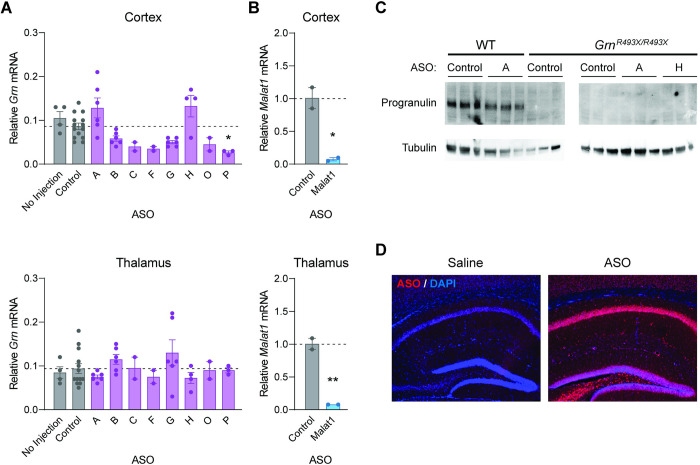
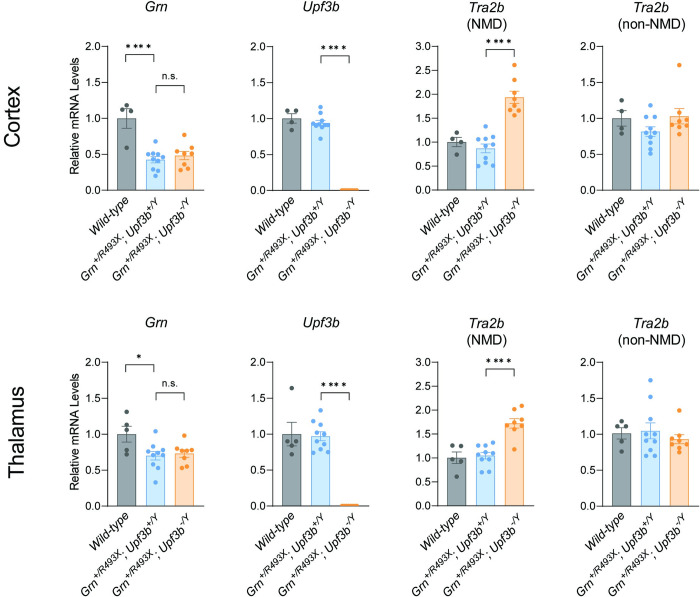
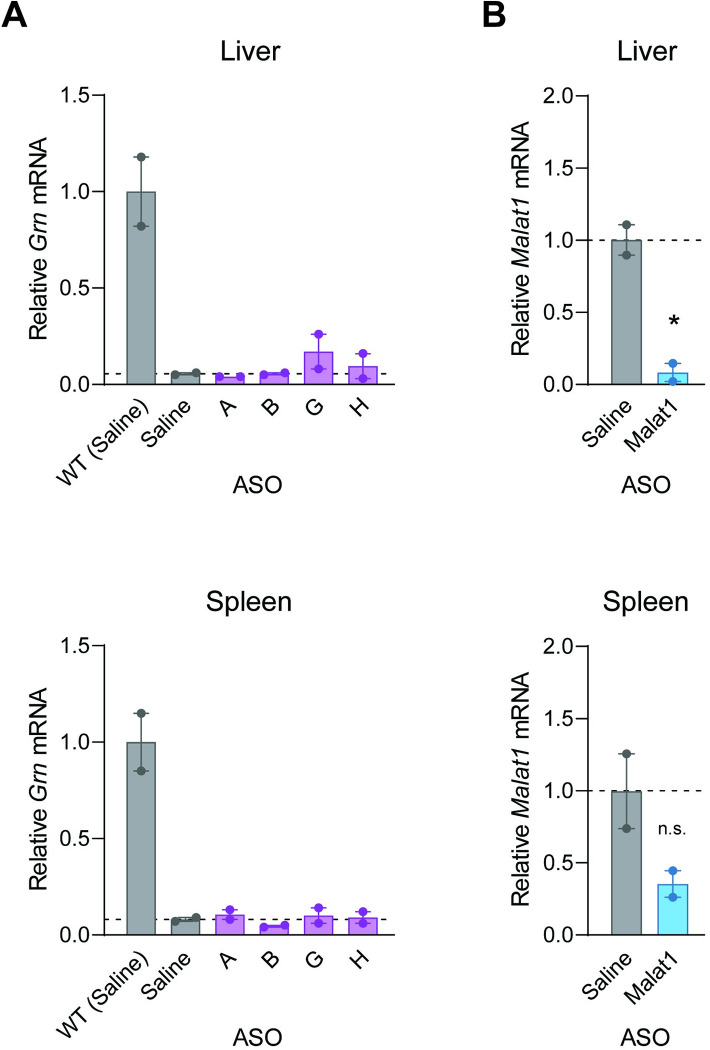
A common cause of frontotemporal dementia (FTD) are nonsense mutations in the progranulin (GRN) gene. Because nonsense mutations activate the nonsense-mediated RNA decay (NMD) pathway, we sought to inhibit this RNA turnover pathway as a means to increase progranulin levels. Using a knock-in mouse model harboring a common patient mutation, we tested whether either pharmacological or genetic inhibition of NMD upregulates progranulin in these GrnR493X mice. We first examined antisense oligonucleotides (ASOs) targeting an exonic region in GrnR493X mRNA predicted to block its degradation by NMD. As we previously reported, these ASOs effectively increased GrnR493X mRNA levels in fibroblasts in vitro. However, following CNS delivery, we found that none of the 8 ASOs we tested increased Grn mRNA levels in the brains of GrnR493X mice. This result was obtained despite broad ASO distribution in the brain. An ASO targeting a different mRNA was effective when administered in parallel to wild-type mice. As an independent approach to inhibit NMD, we examined the effect of loss of an NMD factor not required for embryonic viability: UPF3b. We found that while Upf3b deletion effectively perturbed NMD, it did not increase Grn mRNA levels in Grn+/R493X mouse brains. Together, our results suggest that the NMD-inhibition approaches that we used are likely not viable for increasing progranulin levels in individuals with FTD caused by nonsense GRN mutations. Thus, alternative approaches should be pursued.
额颞叶痴呆(FTD)的一个常见病因是颗粒蛋白前体(GRN)基因的无义突变。由于无义突变激活了无义介导的 RNA 降解(NMD)途径,我们试图抑制这种 RNA 周转途径,以增加颗粒蛋白水平。使用携带常见患者突变的基因敲入小鼠模型,我们测试了 NMD 的药理学或遗传抑制是否能增加这些 GrnR493X 小鼠中的颗粒蛋白水平。我们首先检查了靶向 GrnR493X mRNA 外显子区域的反义寡核苷酸(ASO),该区域预测可阻止其被 NMD 降解。正如我们之前报道的,这些 ASO 可有效增加体外成纤维细胞中 GrnR493X mRNA 的水平。然而,在 CNS 给药后,我们发现我们测试的 8 种 ASO 中没有一种能增加 GrnR493X 小鼠大脑中的 Grn mRNA 水平。尽管在大脑中广泛分布 ASO,但得到了这个结果。当与野生型小鼠同时给予靶向不同 mRNA 的 ASO 时,该 ASO 是有效的。作为抑制 NMD 的另一种方法,我们研究了缺失一种对胚胎存活不是必需的 NMD 因子的影响:UPF3b。我们发现,虽然 Upf3b 缺失有效扰乱了 NMD,但它不能增加 Grn+/R493X 小鼠大脑中的 Grn mRNA 水平。总之,我们的结果表明,我们使用的 NMD 抑制方法不太可能增加由 GRN 无义突变引起的 FTD 患者的颗粒蛋白水平。因此,应该寻求替代方法。