Nader Wren O, Brown Kaylan S, Boyle Nicholas R, Kaplelach Azariah K, Abdelaziz Shaimaa M, Davis Skylar E, Aljabi Qays, Hakim Ahmad R, Davidson Amelia G, Vollmer Giacynta A, Wright Leah C, Echols J Bailey, Saad Joelle, Pena Nicholas S, Arrant Andrew E
Killion Center for Neurodegeneration and Experimental Therapeutics, Alzheimer's Disease Center, Evelyn F. McKnight Brain Institute, Department of Neurology, University of Alabama at Birmingham, Birmingham, AL, USA.
Sci Rep. 2025 Jul 19;15(1):26217. doi: 10.1038/s41598-025-12268-0.
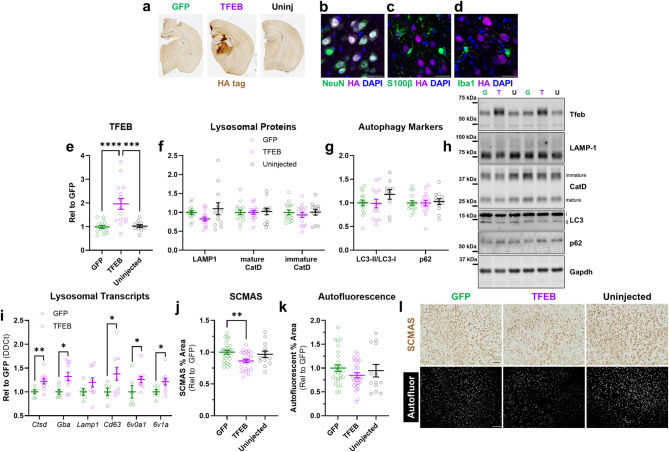
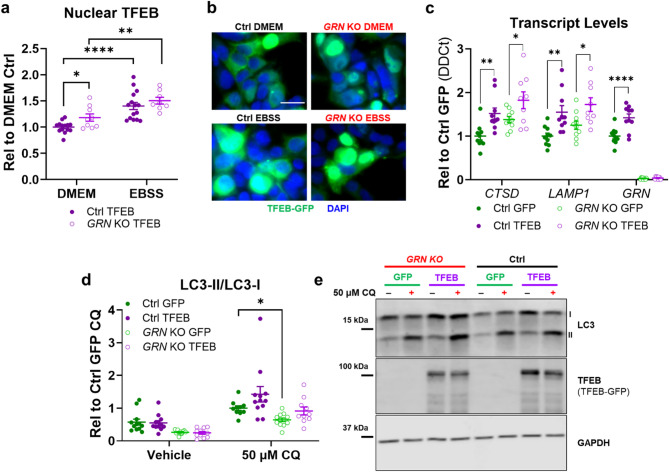
Progranulin is a pro-protein that is necessary for maintaining lysosomal function. Loss-of-function progranulin (GRN) mutations are a dominant cause of frontotemporal dementia (FTD). Brains of people with FTD due to GRN mutations accumulate lysosomal storage material and exhibit increased expression of lysosomal transcripts, which may be driven by TFEB and related transcription factors. While this may be a compensatory response to lysosomal impairment, overproduction of lysosomal proteins may also contribute to FTD pathogenesis. To investigate how TFEB may contribute to disease in people with GRN mutations, we analyzed the effects of TFEB overexpression in progranulin-insufficient cells and mice. We generated GRN knockout HEK-293 cells (GRN KO cells), which exhibited increased nuclear localization of TFEB and expression of lysosomal transcripts, but impaired autophagy. TFEB overexpression in GRN KO cells further increased lysosomal transcripts and partially normalized autophagy. We next injected an AAV vector expressing mouse Tfeb (AAV-TFEB) into the thalamus of Grn mice, which accumulates lysosomal storage material. AAV-TFEB increased lysosomal transcripts and reduced immunoreactivity for SCMAS, a marker of lysosomal storage material, in Grn thalamus. These data show that TFEB activity alleviates some autophagy-lysosomal deficits caused by progranulin insufficiency, suggesting potential utility of lysosome-based therapies for GRN-associated diseases.
颗粒蛋白前体是一种维持溶酶体功能所必需的前体蛋白。功能丧失型颗粒蛋白前体(GRN)突变是额颞叶痴呆(FTD)的主要病因。因GRN突变导致FTD的患者大脑中积累了溶酶体储存物质,并表现出溶酶体转录本表达增加,这可能是由转录因子EB(TFEB)及相关转录因子驱动的。虽然这可能是对溶酶体损伤的一种代偿反应,但溶酶体蛋白的过度产生也可能导致FTD的发病机制。为了研究TFEB如何导致GRN突变患者发病,我们分析了TFEB过表达对颗粒蛋白前体不足的细胞和小鼠的影响。我们构建了GRN基因敲除的人胚肾293细胞(GRN KO细胞),这些细胞表现出TFEB核定位增加和溶酶体转录本表达增加,但自噬受损。在GRN KO细胞中过表达TFEB进一步增加了溶酶体转录本,并使自噬部分恢复正常。接下来,我们将表达小鼠Tfeb的腺相关病毒载体(AAV-TFEB)注射到积累溶酶体储存物质的Grn小鼠丘脑。AAV-TFEB增加了Grn小鼠丘脑中溶酶体转录本,并降低了溶酶体储存物质标志物SCMAS的免疫反应性。这些数据表明,TFEB活性减轻了颗粒蛋白前体不足引起自噬-溶酶体缺陷,提示基于溶酶体的疗法对GRN相关疾病具有潜在应用价值。