Troen B R, Gal S, Gottesman M M
Laboratory of Molecular Biology, National Cancer Institute, Bethesda, MD 20892.
Biochem J. 1987 Sep 15;246(3):731-5. doi: 10.1042/bj2460731.
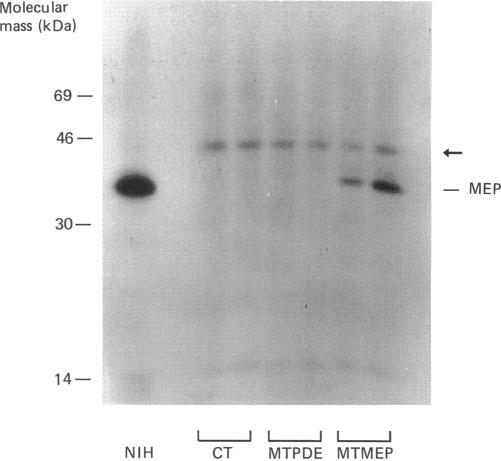
The major excreted protein (MEP) of malignantly transformed mouse fibroblasts is a secreted thiol proteinase. Sequencing of the MEP cDNA shows the coding region for the protein to be identical with the sequence for a mouse cysteine proteinase isolated from macrophages, but the MEP cDNA is polyadenylated at a different site in the 3' non-coding region. Strong homology of MEP with human cathepsin L suggests that MEP is the mouse analogue of cathepsin L. Amino acid sequencing of the N-terminus of the secreted form of MEP indicates that, during secretion, the polypeptide is cleaved between amino acids 17 and 18. We have placed the MEP cDNA in a eukaryotic expression vector and demonstrated the production of the 39 kDa polypeptide form of mouse MEP in monkey CV-1 cells.
恶性转化的小鼠成纤维细胞的主要分泌蛋白(MEP)是一种分泌型巯基蛋白酶。MEP cDNA的测序表明,该蛋白的编码区与从巨噬细胞中分离出的小鼠半胱氨酸蛋白酶的序列相同,但MEP cDNA在3'非编码区的不同位点进行了多聚腺苷酸化。MEP与人组织蛋白酶L有很强的同源性,表明MEP是组织蛋白酶L的小鼠类似物。分泌形式的MEP N端的氨基酸测序表明,在分泌过程中,该多肽在第17和18个氨基酸之间被切割。我们已将MEP cDNA置于真核表达载体中,并证明在猴CV-1细胞中产生了39 kDa的小鼠MEP多肽形式。