Medina R, Wing S S, Goldberg A L
Department of Cell Biology, Harvard Medical School, Boston, MA 02115, USA.
Biochem J. 1995 May 1;307 ( Pt 3)(Pt 3):631-7. doi: 10.1042/bj3070631.
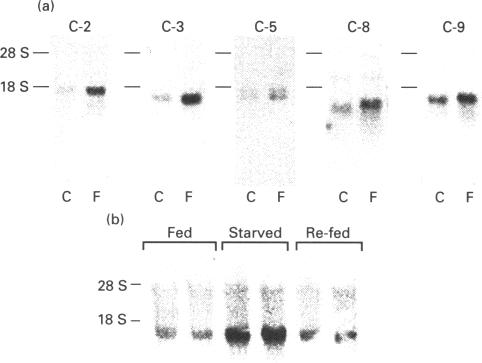
Most of the increased protein degradation in muscle atrophy caused by starvation and denervation is due to activation of a non-lysosomal ATP-dependent proteolytic process. To determine whether expression of the ubiquitin-proteasome-dependent pathway is activated in atrophying muscles, we measured the levels of mRNA for ubiquitin (Ub) and proteasome subunits, and Ub content. After rats had been deprived of food for 1 or 2 days, the concentration of the two polyubiquitin (polyUb) transcripts increased 2-4-fold in the pale extensor digitorum longus muscle and 1-2.5-fold in the red soleus, whereas total muscle RNA and total mRNA content fell by 50%. After denervation of the soleus, there was a progressive 2-3-fold increase in polyUb mRNA for 1-3 days, whereas total RNA content fell. On starvation or denervation, Ub concentration in the muscles also rose by 60-90%. During starvation, polyUb mRNA levels also increased in heart, but not in liver, kidney, spleen, fat, brain or testes. Although the polyUb gene is a heat-shock gene that is induced in muscles under certain stressful conditions, the muscles of starving rats or after denervation did not express other heat-shock genes. On starvation or denervation, mRNA for several proteasome subunits (C-1, C-3, C-5, C-8 and C-9) also increased 2-4-fold in the atrophying muscles. When the food-deprived animals were re-fed, levels of Ub and proteasome mRNA in their muscles returned to control values within 1 day. In contrast, no change occurred in the levels of muscle mRNAs encoding cathepsin L, cathepsin D and calpain 1 on denervation or food deprivation. Thus polyUb and proteasome mRNAs increased in atrophying muscles in co-ordination with activation of the ATP-dependent proteolytic process.
饥饿和去神经支配所致肌肉萎缩中蛋白质降解增加,大多是由于一种非溶酶体的ATP依赖性蛋白水解过程被激活。为确定泛素-蛋白酶体依赖性途径的表达在萎缩肌肉中是否被激活,我们检测了泛素(Ub)和蛋白酶体亚基的mRNA水平以及Ub含量。大鼠禁食1或2天后,在苍白的趾长伸肌中,两种多聚泛素(polyUb)转录本的浓度增加了2至4倍,在红色的比目鱼肌中增加了1至2.5倍,而肌肉总RNA和总mRNA含量下降了50%。比目鱼肌去神经支配后,polyUb mRNA在1至3天内逐渐增加了2至3倍,而总RNA含量下降。在饥饿或去神经支配时,肌肉中的Ub浓度也升高了60%至90%。饥饿期间,心脏中的polyUb mRNA水平也升高,但肝脏、肾脏、脾脏、脂肪、大脑或睾丸中则没有。虽然多聚泛素基因是一种热休克基因,在某些应激条件下会在肌肉中被诱导,但饥饿大鼠或去神经支配后的肌肉并未表达其他热休克基因。在饥饿或去神经支配时,几种蛋白酶体亚基(C-1、C-3、C-5、C-8和C-9)的mRNA在萎缩肌肉中也增加了2至4倍。当饥饿的动物重新进食后,其肌肉中Ub和蛋白酶体mRNA水平在1天内恢复到对照值。相比之下,去神经支配或饥饿时,编码组织蛋白酶L、组织蛋白酶D和钙蛋白酶1的肌肉mRNA水平没有变化。因此,在萎缩肌肉中,多聚泛素和蛋白酶体mRNA的增加与ATP依赖性蛋白水解过程的激活是协同的。