School of Life Sciences, Beijing University of Chinese Medicine, Beijing, People's Republic of China.
School of Chinese Materia, Beijing University of Chinese Medicine, Beijing, People's Republic of China.
Sci Rep. 2023 Mar 9;13(1):3933. doi: 10.1038/s41598-023-30922-3.
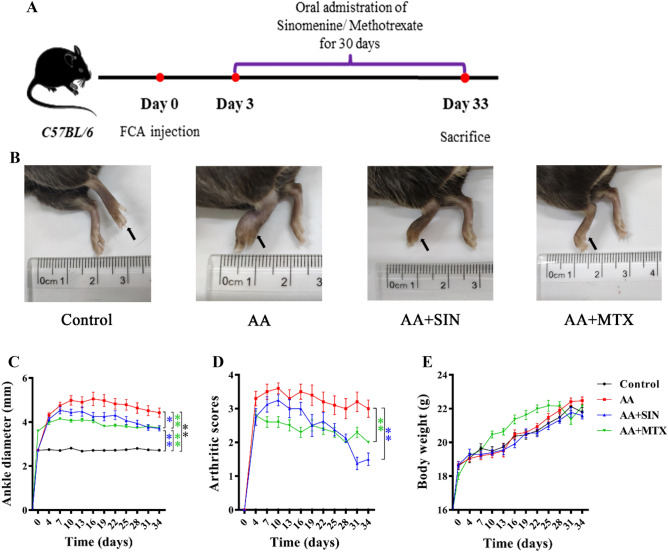
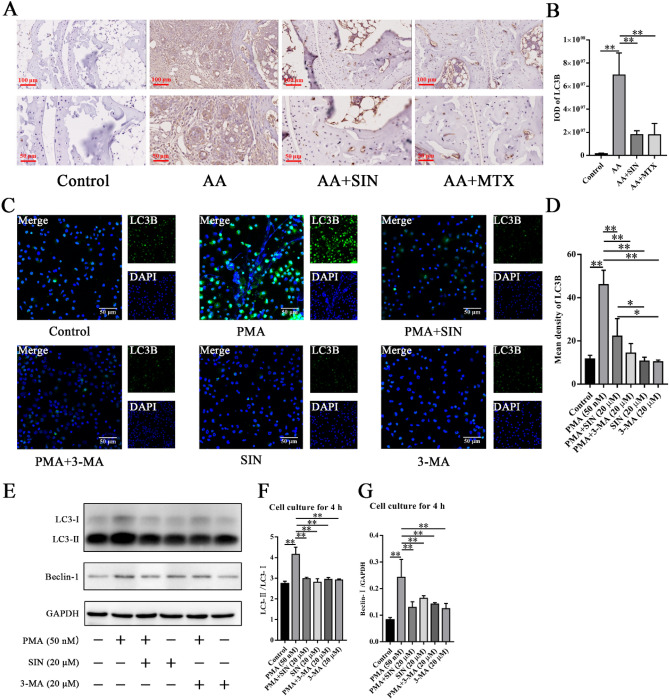
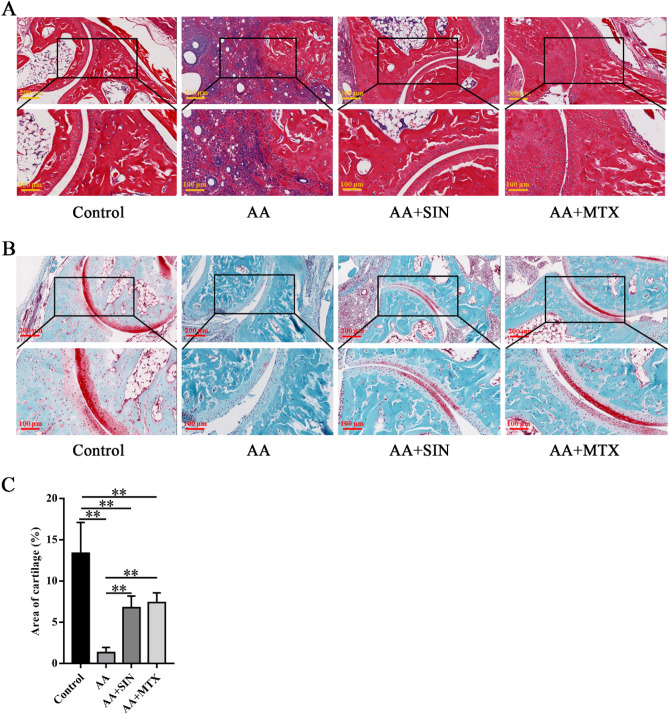
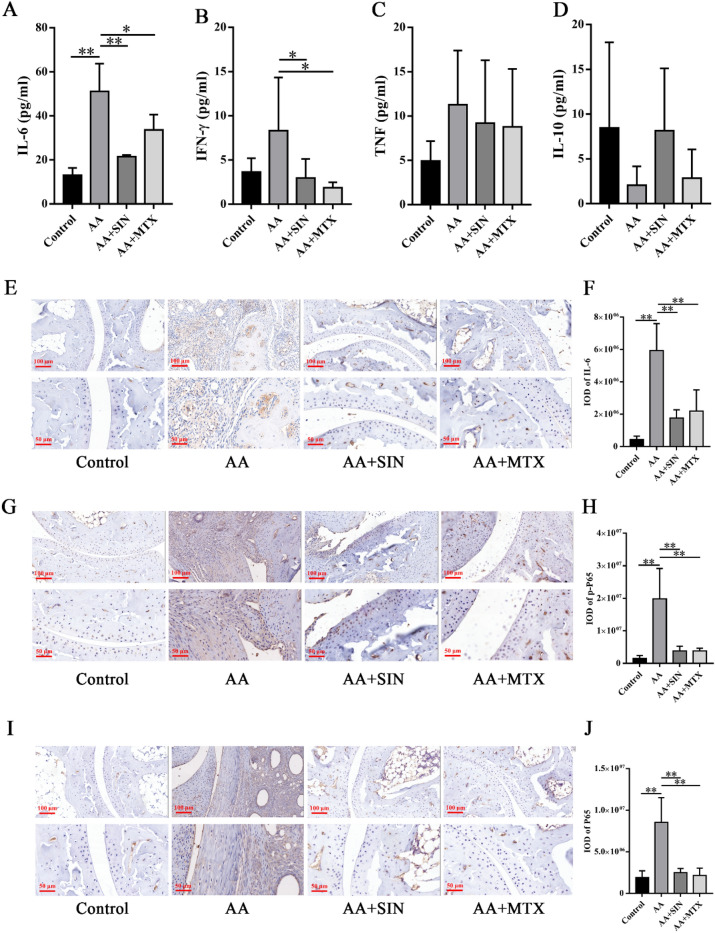
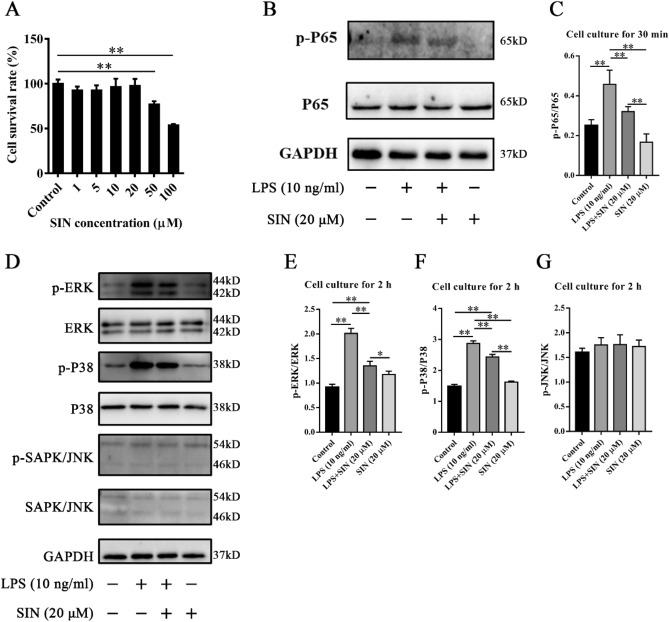
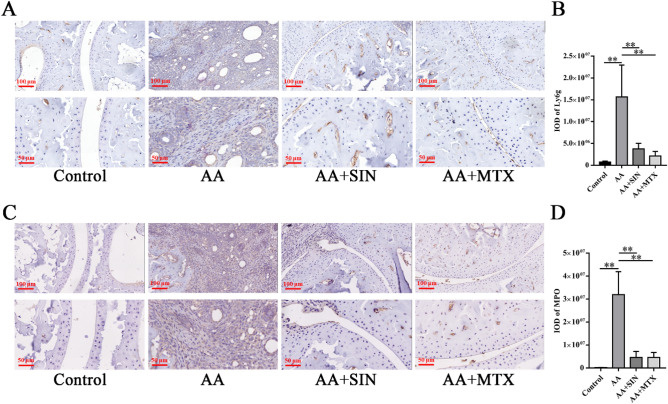
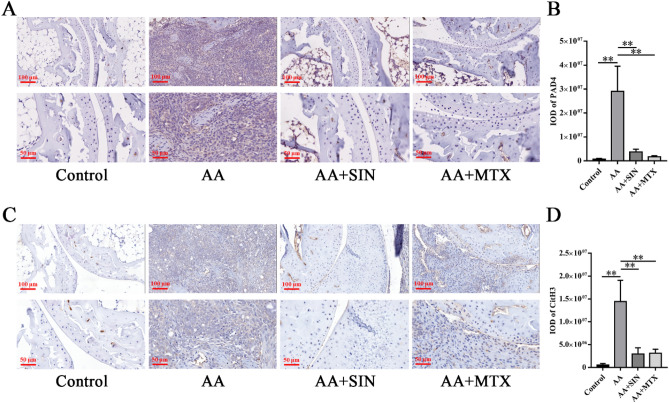
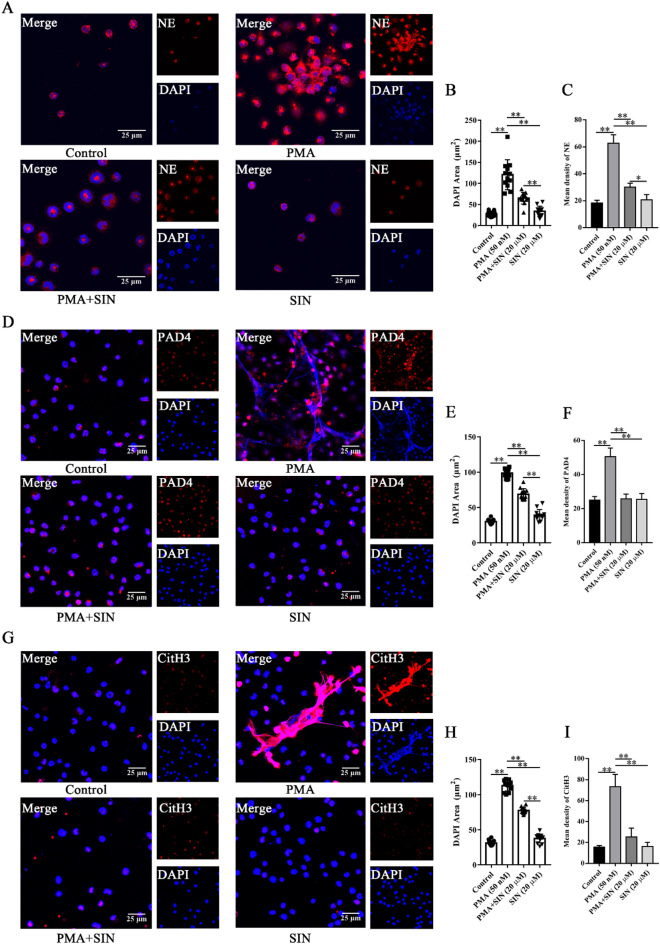
Studies have found that neutrophil extracellular traps (NETs) which are the specific dying form of neutrophil upon activation have fundamental role in the rheumatoid arthritis onset and progression. The purpose of this study was to explore the therapeutic effect of Sinomenine on adjuvant-induced arthritis in mice, and the neutrophil activities regulated by Sinomenine. The rheumatoid arthritis model was established by local injection of adjuvant and the Sinomenine treatment was administered orally for 30 days, during which, arthritic scores were evaluated and the joint diameter was measured to determine disease progression. The joint tissues and serum were acquired for further tests after sacrifice. Cytometric beads assay was performed to measure the concentration of cytokines. For paraffin-embedded ankle tissues, hematoxylin and erosin staining and Safranin O-fast staining were adopted to monitor the tissue changes of joint. In order to analyze the inflammation, NETs and autophagy of neutrophils in vivo, immunohistochemistry assays were applied to detect the protein expression levels in the local joints. To describe the effect brought by Sinomenine on inflammation, autophagy and NETs in vitro, the western blotting and the immunofluorescence assays were performed. The joint symptoms of the adjuvant induced arthritis were alleviated by the Sinomenine treatment significantly in terms of the ankle diameter and scores. The improvement of local histopathology changes and decrease of inflammatory cytokines in the serum also confirmed the efficacy. The expression levels of interleukin-6, P65 and p-P65 in the ankle areas of mice were remarkably reduced by Sinomenine. Compared with the model group, the decreased expression levels of lymphocyte antigen 6 complex and myeloperoxidase in the Sinomenine treating group showed the inhibitory effect of Sinomenine on the neutrophil migration. The expression of protein arginine deiminase type 4 (PAD4), ctrullinated histone H3 (CitH3) and microtubule-associated protein 1 light chain 3B (LC3B) had the similar tendency. Upon activation of lipopolysaccharide (LPS) in vitro, Sinomenine suppressed the phosphorylation of P65, extracellular signal-regulated kinase (ERK) and P38 of neutrophil. Meanwhile, Sinomenine inhibited NETs formation induced by phorbol 12-myristate 13-acetate (PMA), which were demonstrated by the decreased expression of neutrophil elastase (NE), PAD4 and CitH3. Sinomenine also inhibited PMA-induced autophagy in vitro based on the changes of Beclin-1 and LC3B. Sinomenine has good efficacy in treating adjuvant induced arthritis via regulating neutrophil activities. Apart from inhibiting activation of nuclear factor kappa-B (NF-κB) and mitogen-activated protein kinase (MAPK) pathways, the mechanism includes suppression of NETs formation via autophagy inhibition.
研究发现,中性粒细胞细胞外陷阱(NETs)是中性粒细胞活化时的特异性死亡形式,在类风湿关节炎的发病和进展中起着重要作用。本研究旨在探讨青藤碱对佐剂诱导关节炎小鼠的治疗作用,以及青藤碱调节中性粒细胞活性的作用。通过局部注射佐剂建立类风湿关节炎模型,并给予青藤碱口服治疗 30 天,在此期间评估关节炎评分并测量关节直径以确定疾病进展。处死动物后获取关节组织和血清进行进一步检测。采用流式细胞术检测细胞因子浓度。对石蜡包埋的踝关节组织进行苏木精和伊红染色和番红 O 快速染色,以监测关节组织变化。为了分析体内中性粒细胞炎症、NETs 和自噬的变化,采用免疫组织化学法检测局部关节的蛋白表达水平。为了描述青藤碱在体外对炎症、自噬和 NETs 的影响,进行了 Western blot 和免疫荧光分析。青藤碱治疗显著缓解了佐剂诱导关节炎的关节症状,表现在踝关节直径和评分方面。血清中局部组织病理学变化的改善和炎症细胞因子的减少也证实了其疗效。青藤碱明显降低了关节炎小鼠踝关节部位白细胞介素 6、P65 和 p-P65 的表达水平。与模型组相比,青藤碱治疗组淋巴细胞抗原 6 复合物和髓过氧化物酶的表达水平降低,表明青藤碱抑制了中性粒细胞的迁移。蛋白精氨酸脱亚氨酶 4(PAD4)、瓜氨酸化组蛋白 H3(CitH3)和微管相关蛋白 1 轻链 3B(LC3B)的表达也有类似的趋势。在体外脂多糖(LPS)激活时,青藤碱抑制中性粒细胞 P65、细胞外信号调节激酶(ERK)和 P38 的磷酸化。同时,青藤碱抑制佛波醇 12-肉豆蔻酸 13-乙酸酯(PMA)诱导的 NETs 形成,这表现在中性粒细胞弹性蛋白酶(NE)、PAD4 和 CitH3 的表达降低。青藤碱还抑制了 PMA 诱导的自噬,表现在 Beclin-1 和 LC3B 的变化。青藤碱通过调节中性粒细胞活性,对佐剂诱导关节炎有良好的疗效。除了抑制核因子 kappa-B(NF-κB)和丝裂原活化蛋白激酶(MAPK)通路的激活外,其机制还包括通过抑制自噬来抑制 NETs 的形成。