Tuan Alyssa W, Syed Nauroz, Panganiban Ronaldo P, Lee Roland Y, Dalessio Shannon, Pradhan Sandeep, Zhu Junjia, Ouyang Ann
Department of Medicine, Pennsylvania State University College of Medicine, Hershey, PA 17033, USA.
Department of Public Health Sciences, Pennsylvania State University College of Medicine, Hershey, PA 17033, USA.
Gastroenterology Res. 2023 Feb;16(1):37-49. doi: 10.14740/gr1563. Epub 2023 Feb 28.
The Chicago Classification version 4.0 (CCv4.0) of ineffective esophageal motility (IEM) is more stringent than the Chicago Classification version 3.0 (CCv3.0) definition. We aimed to compare the clinical and manometric features of patients meeting CCv4.0 IEM criteria (group 1) versus patients meeting CCv3.0 IEM but not CCv4.0 criteria (group 2).
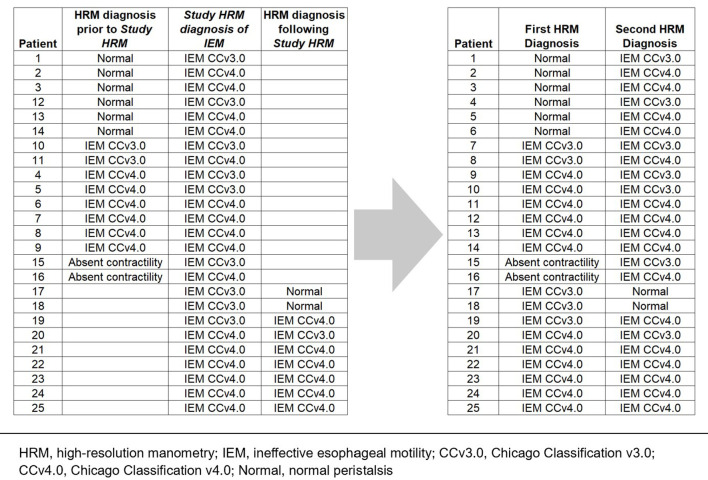
We collected retrospective clinical, manometric, endoscopic, and radiographic data on 174 adults diagnosed with IEM from 2011 to 2019. Complete bolus clearance was defined as evidence of exit of the bolus by impedance measurement at all distal recording sites. Barium studies included barium swallow, modified barium swallow, and barium upper gastrointestinal series studies, and collected data from these reports include abnormal motility and delay in the passage of liquid barium or barium tablet. These data along with other clinical and manometric data were analyzed using comparison and correlation tests. All records were reviewed for repeated studies and the stability of the manometric diagnoses.
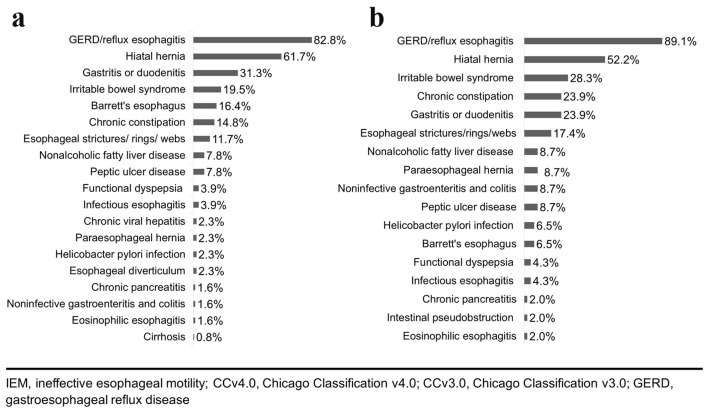
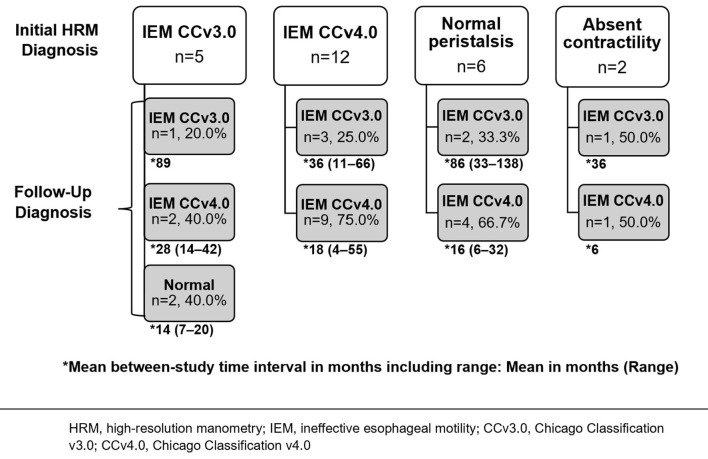
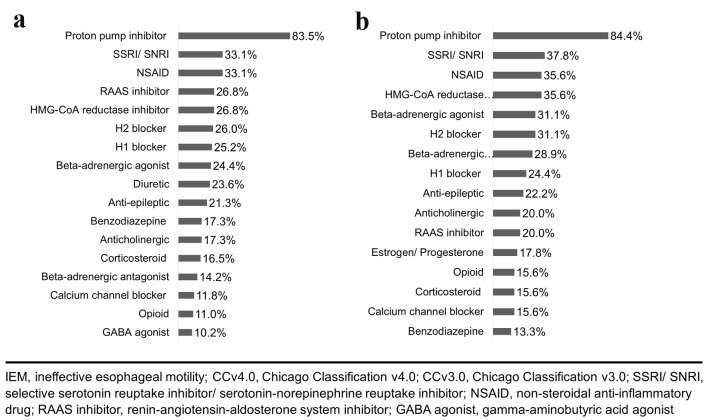
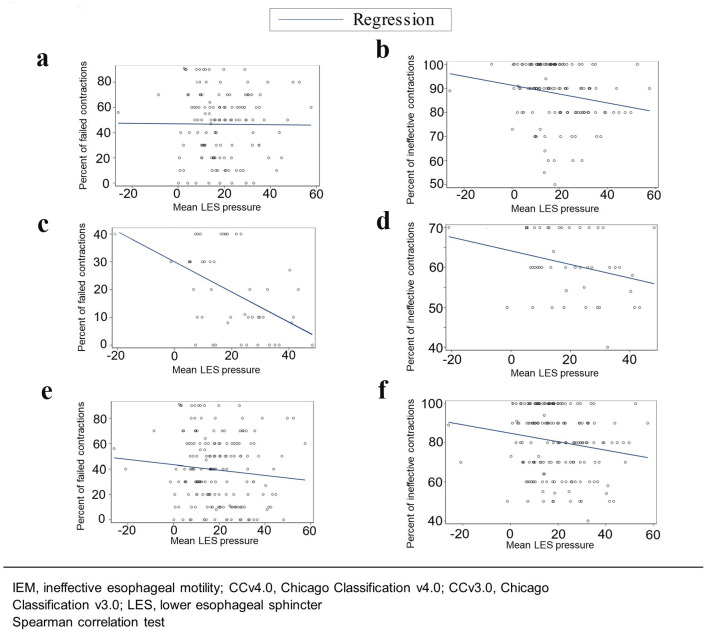
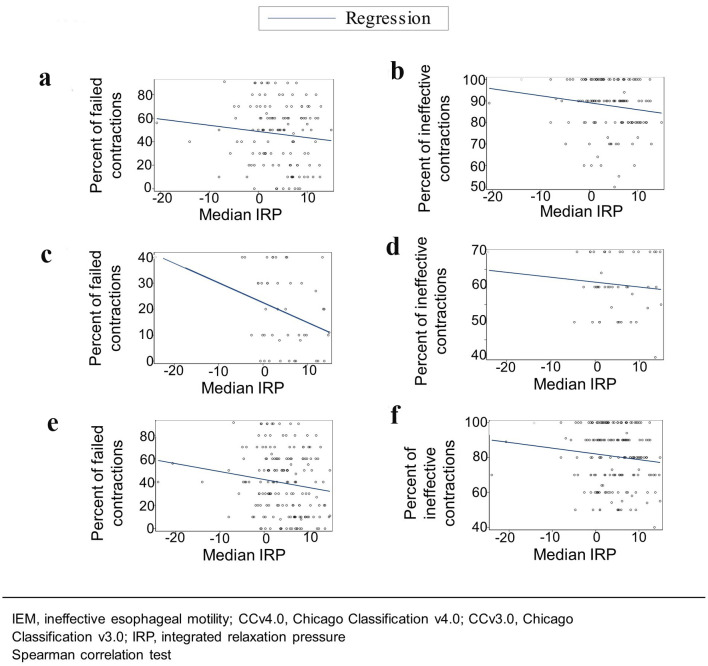
Most demographic and clinical variables were not different between the groups. A lower mean lower esophageal sphincter pressure was correlated with greater percent of ineffective swallows in group 1 (n = 128) (r = -0.2495, P = 0.0050) and not in group 2. In group 1, increased percent of failed contractions on manometry was associated with increased incomplete bolus clearance (r = 0.3689, P = 0.0001). No such association was observed in group 2. A lower median integrated relaxation pressure was correlated with greater percent of ineffective contractions in group 1 (r = -0.1825, P = 0.0407) and not group 2. Symptom of dysphagia was more prevalent (51.6% versus 69.6%, P = 0.0347) in group 2. Dysphagia was not associated with intrabolus pressure, bolus clearance, barium delay, or weak or failed contractions in either group. In the small number of subjects with repeated studies, a CCv4.0 diagnosis appeared more stable over time.
CCv4.0 IEM was associated with worse esophageal function indicated by reduced bolus clearance. Most other features studied did not differ. Symptom presentation cannot predict if patients are likely to have IEM by CCv4.0. Dysphagia was not associated with worse motility, suggesting it may not be primarily dependent on bolus transit.
芝加哥分类第4.0版(CCv4.0)中无效食管动力(IEM)的定义比芝加哥分类第3.0版(CCv3.0)更为严格。我们旨在比较符合CCv4.0 IEM标准的患者(第1组)与符合CCv3.0 IEM但不符合CCv4.0标准的患者(第2组)的临床和测压特征。
我们收集了2011年至2019年期间174例诊断为IEM的成年患者的回顾性临床、测压、内镜和影像学数据。完全团块清除定义为通过在所有远端记录部位进行阻抗测量证明团块排出。钡剂检查包括吞钡、改良吞钡和上消化道钡剂造影系列检查,从这些报告中收集的数据包括异常动力以及液体钡剂或钡剂片剂通过延迟。这些数据与其他临床和测压数据一起使用比较和相关性检验进行分析。对所有记录进行复查以进行重复研究和测压诊断的稳定性评估。
两组之间大多数人口统计学和临床变量无差异。较低的平均食管下括约肌压力与第1组(n = 128)中无效吞咽的百分比更高相关(r = -0.2495,P = 0.0050),而在第2组中无此相关性。在第1组中,测压时失败收缩百分比增加与不完全团块清除增加相关(r = 0.3689,P = 0.0001)。在第2组中未观察到这种相关性。较低的中位综合松弛压力与第1组中无效收缩的百分比更高相关(r = -0.1825,P = 0.0407),而第2组无此相关性。吞咽困难症状在第2组中更为普遍(51.6%对69.6%,P = 0.0347)。在两组中,吞咽困难均与团块内压力、团块清除、钡剂延迟或无力或失败收缩无关。在少数进行重复研究的受试者中,CCv4.0诊断随时间推移显得更稳定。
CCv4.0 IEM与团块清除减少所表明的更差食管功能相关。研究的大多数其他特征无差异。症状表现无法预测患者是否可能符合CCv4.0的IEM标准。吞咽困难与更差的动力无关,提示其可能不主要依赖于团块运输。