Brosolo Gabriele, Da Porto Andrea, Bulfone Luca, Vacca Antonio, Bertin Nicole, Vivarelli Cinzia, Sechi Leonardo A, Catena Cristiana
Internal Medicine and European Hypertension Excellence Center, Department of Medicine, University of Udine, Udine, Italy.
Diabetes and Metabolism Unit, Department of Medicine, University of Udine, Udine, Italy.
Front Cardiovasc Med. 2023 Feb 21;10:1119516. doi: 10.3389/fcvm.2023.1119516. eCollection 2023.
Past studies reported a significant contribution of a prothrombotic state to the development and progression of target organ damage in hypertensive patients. Stiffening of arterial vessels is associated with aging and hypertension, and additional factors could contribute to this process. This study was designed to examine the relationships between arterial stiffening and the hemostatic and fibrinolytic system.
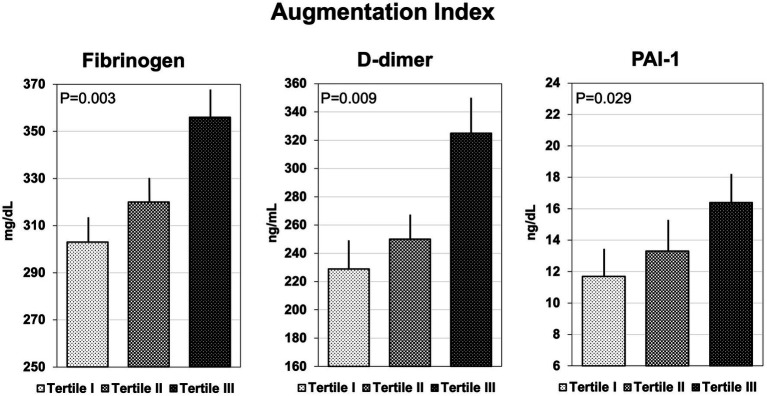
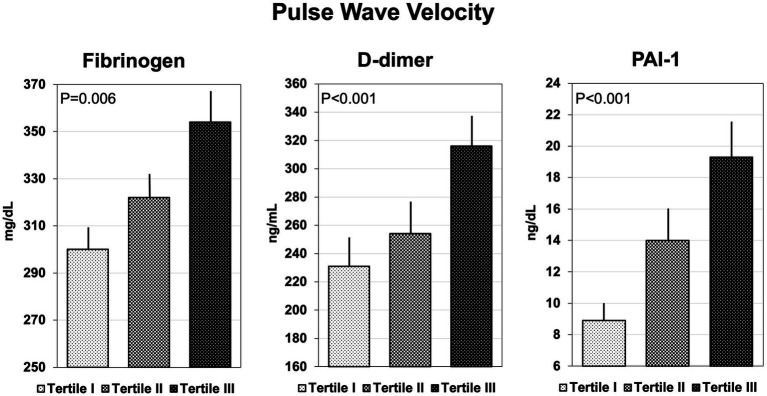
In 128 middle-aged, nondiabetic, essential hypertensive patients without major cardiovascular and renal complications, we measured coagulation markers that express the spontaneous activation of the hemostatic and fibrinolytic system and assessed stiffness of the arterial tree by measurement of the carotid/femoral pulse wave velocity (cfPWV) and pulse wave analysis with calculation of the brachial augmentation index (AIx).
Levels of fibrinogen (FBG), D-dimer (D-d), and plasminogen activator-inhibitor 1 (PAI-1) were significantly higher in patients with PWV and AIx above the median of the distribution. FBG, D-d, and PAI-1 were significantly and directly related with both cfPWV and AIx, and multivariate regression analysis indicated that the relationships of D-d and PAI-1 with both cfPWV and AIx and of FBG with AIx, were independent of age, body mass index, severity and duration of hypertension, use of antihypertensive drugs, blood glucose, and plasma lipids.
In middle-aged, uncomplicated, nondiabetic patients with essential hypertension, spontaneous activation of plasma hemostatic cascade and impaired fibrinolysis is significantly and independently associated with stiffening of the arterial tree.
既往研究报道,血栓前状态对高血压患者靶器官损害的发生和发展有显著影响。动脉血管硬化与衰老和高血压相关,其他因素也可能促成这一过程。本研究旨在探讨动脉硬化与止血和纤溶系统之间的关系。
在128例无重大心血管和肾脏并发症的中年、非糖尿病原发性高血压患者中,我们测量了表达止血和纤溶系统自发激活的凝血标志物,并通过测量颈动脉/股动脉脉搏波速度(cfPWV)和计算肱动脉增强指数(AIx)的脉搏波分析来评估动脉树的硬度。
PWV和AIx高于分布中位数的患者中,纤维蛋白原(FBG)、D-二聚体(D-d)和纤溶酶原激活物抑制剂1(PAI-1)水平显著更高。FBG、D-d和PAI-1与cfPWV和AIx均显著且直接相关,多因素回归分析表明,D-d和PAI-1与cfPWV和AIx的关系以及FBG与AIx的关系,独立于年龄、体重指数、高血压的严重程度和病程、降压药物的使用、血糖和血脂。
在中年、无并发症、非糖尿病的原发性高血压患者中,血浆止血级联的自发激活和纤溶功能受损与动脉树硬化显著且独立相关。