Choi Sun Ah, Hwang Junho, Lim Byung Chan, Chae Soo Ahn
Department of Pediatrics, Ewha Womans University Mokdong Hospital, Ewha Womans University College of Medicine, Seoul, Republic of Korea.
Department of Pediatrics, Chung-Ang University Hospital, Chung-Ang University College of Medicine, Seoul, Republic of Korea.
Front Neurol. 2023 Feb 21;14:1125455. doi: 10.3389/fneur.2023.1125455. eCollection 2023.
Guillain-Barré syndrome (GBS) is an immune-mediated polyradiculoneuropathy, often triggered by infection. We aimed to investigate how the incidence of GBS changed in the early stages of the coronavirus 2019 (COVID-19) pandemic when nationwide infections declined due to non-pharmaceutical interventions.
We conducted a nationwide population-based retrospective GBS cohort study using data from the Health Insurance Review and Assessment Service of Korea. Patients with new-onset GBS were defined as those who were first hospitalized between 1 January 2016 and 31 December 2020 with an International Classification of Disease, 10th Revision code, for GBS (G61.0) as a primary diagnosis. The incidence of GBS in the pre-pandemic years (2016-2019) was compared with that in the first pandemic year (2020). Nationwide epidemiological data for infections were collected from the national infectious disease surveillance system. A correlation analysis was performed to determine the incidence of GBS and nationwide trends of various infections.
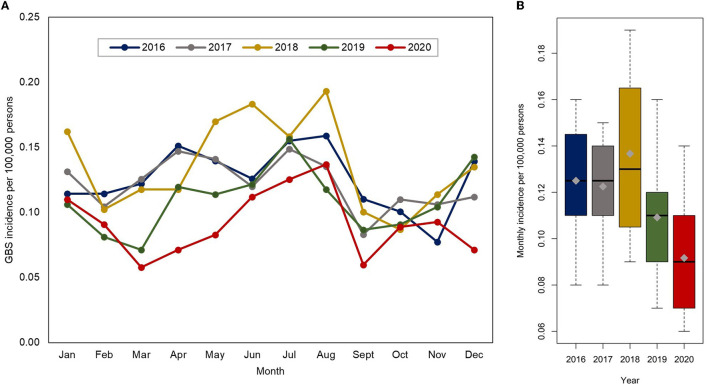
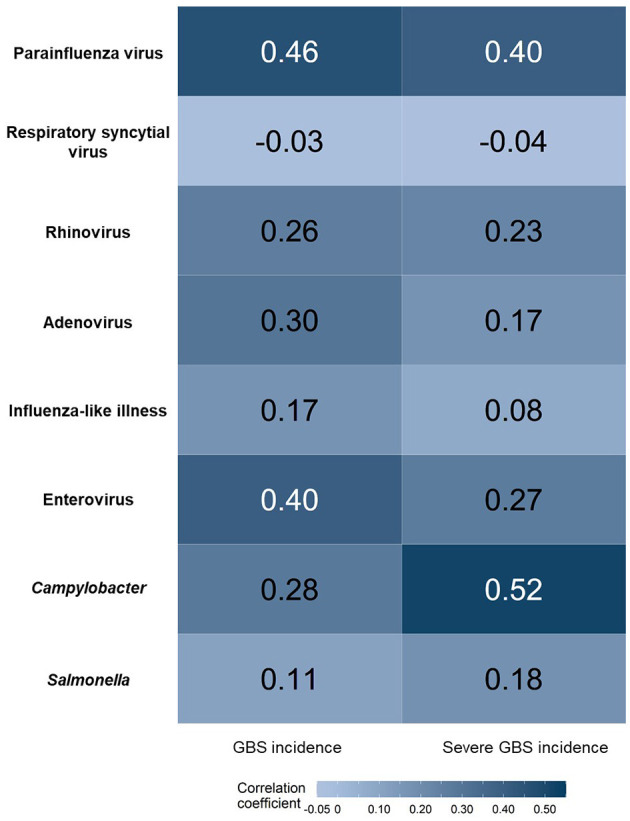
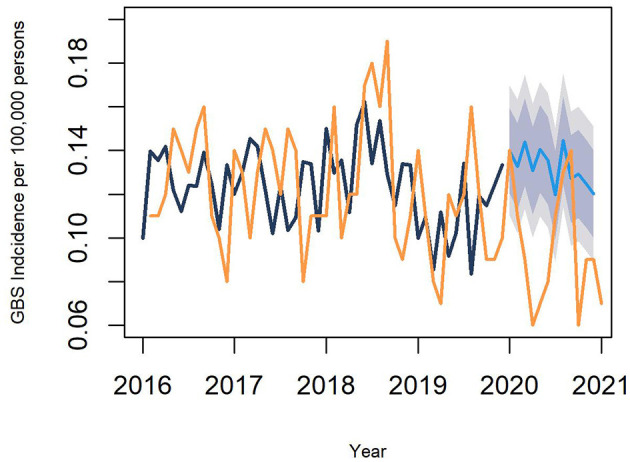
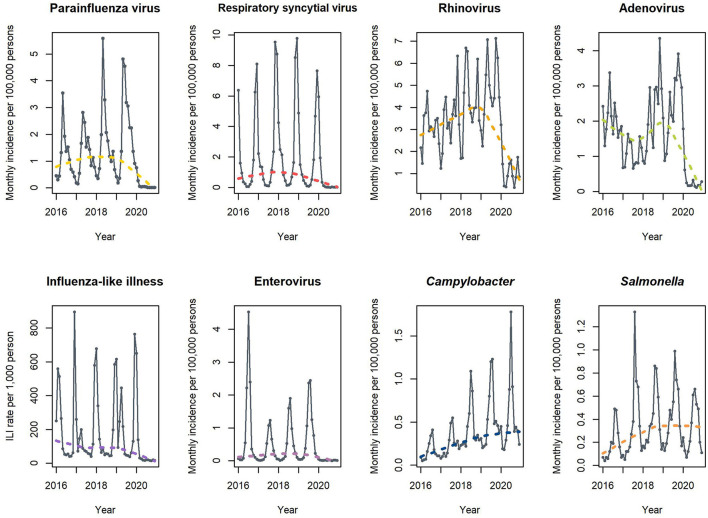
Overall, 3,637 new-onset GBS cases were identified. The age-standardized incidence of GBS in the first pandemic year was 1.10 (95% confidence interval, 1.01-1.19) per 100,000 persons. Compared to the first pandemic year, the incidence of GBS during the pre-pandemic years (1.33-1.68/100,000 persons/year) was significantly higher, with incidence rate ratios of 1.21-1.53 ( < 0.001). Nationwide cases of upper respiratory viral infections were significantly reduced in the first pandemic year; however, infections peaked in the summer of the pandemic. The nationwide epidemiology of parainfluenza virus, enterovirus, and infections correlated positively with GBS incidence.
The overall GBS incidence decreased in the early stages of the COVID-19 pandemic, which can be attributed to the dramatic reduction in viral illnesses due to public measures.
吉兰 - 巴雷综合征(GBS)是一种免疫介导的多发性神经根神经病,常由感染引发。我们旨在调查在2019年冠状病毒病(COVID - 19)大流行早期,由于非药物干预导致全国感染人数下降时,GBS的发病率是如何变化的。
我们利用韩国健康保险审查与评估服务的数据进行了一项基于全国人群的GBS回顾性队列研究。新发GBS患者定义为2016年1月1日至2020年12月31日期间首次因国际疾病分类第10版编码为GBS(G61.0)作为主要诊断而住院的患者。将大流行前几年(2016 - 2019年)的GBS发病率与大流行第一年(2020年)的发病率进行比较。从国家传染病监测系统收集全国感染的流行病学数据。进行相关性分析以确定GBS发病率与全国各种感染趋势之间的关系。
总体上,共确定了3637例新发GBS病例。大流行第一年GBS的年龄标准化发病率为每10万人1.10(95%置信区间,1.01 - 1.19)。与大流行第一年相比,大流行前几年的GBS发病率(每年每10万人1.33 - 1.68)显著更高,发病率比为1.21 - 1.53(<0.001)。大流行第一年全国上呼吸道病毒感染病例显著减少;然而,某些感染在大流行夏季达到峰值。副流感病毒、肠道病毒和某些感染的全国流行病学与GBS发病率呈正相关。
在COVID - 19大流行早期,GBS总体发病率下降,这可归因于公共措施导致的病毒性疾病大幅减少。