Health Economics and Value Assessment Business Partner-Rare Diseases, Sanofi, Thames Valley Park, Reading, UK.
Evidera, Bethesda, MD, USA.
Adv Ther. 2023 May;40(5):2234-2248. doi: 10.1007/s12325-023-02453-w. Epub 2023 Mar 10.
Acid sphingomyelinase deficiency (ASMD) is a rare lysosomal storage disease. Patients with ASMD type B experience multiple morbidities, potentially leading to early mortality. Before the 2022 approval of olipudase alfa for non-neuronopathic ASMD manifestations, only symptom management was offered. Data on healthcare services used by patients with ASMD type B are limited. This analysis used medical claims data to evaluate real-world healthcare service use by patients with ASMD type B in the United States of America (USA).
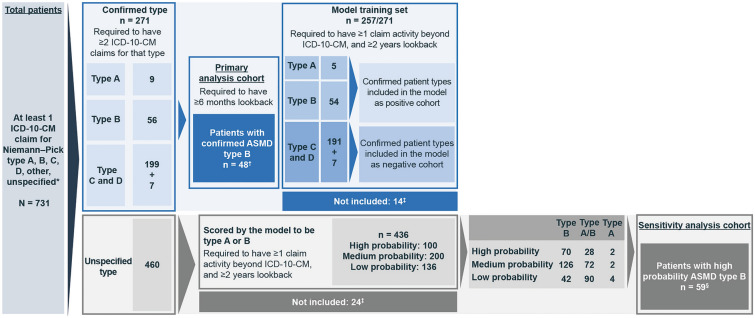
The IQVIA Open Claims patient-level database (2010-2019) was cross-examined. Two patient cohorts were identified: the primary analysis cohort, which included patients with at least two claims associated with ASMD type B (ICD-10 code E75.241) and more total claims with ASMD type B than any other ASMD types, and the sensitivity analysis cohort, which included patients with a high probability of having ASMD type B identified using a validated machine-learning algorithm. Claims for ASMD-associated healthcare services were recorded, including outpatient visits, emergency department (ED) visits, and inpatient hospitalizations.
The primary analysis cohort included 47 patients; a further 59 patients made up the sensitivity analysis cohort. Patient characteristics and healthcare service use were similar in both cohorts and were consistent with established characteristics of ASMD type B. Overall, 70% of the primary analysis cohort from this study were aged < 18 years, and the liver, spleen, and lungs were the most frequently affected organs. Cognitive, developmental, and/or emotional problems and respiratory/lung disorders caused most outpatient visits; respiratory/lung disorders accounted for most ED visits and hospitalizations.
This retrospective analysis of medical claims data identified patients with ASMD type B who had characteristics typical of this condition. A machine-learning algorithm detected further cases with a high probability of having ASMD type B. High use of ASMD-related healthcare services and medications was observed in both cohorts.
酸性鞘磷脂酶缺乏症(ASMD)是一种罕见的溶酶体贮积病。ASMD 型 B 的患者患有多种疾病,可能导致早期死亡。在 2022 年批准olipudase alfa 用于治疗非神经病变性 ASMD 表现之前,仅提供症状管理。关于 ASMD 型 B 患者使用的医疗保健服务的数据有限。本分析使用医疗索赔数据评估了美国 ASMD 型 B 患者的真实世界医疗保健服务使用情况。
对 IQVIA Open Claims 患者级数据库(2010-2019 年)进行了交叉检查。确定了两个患者队列:主要分析队列,包括至少有两次与 ASMD 型 B(ICD-10 代码 E75.241)相关的索赔和比任何其他 ASMD 类型更多的 ASMD 型 B 总索赔的患者;和敏感性分析队列,其中包括使用经过验证的机器学习算法确定患有 ASMD 型 B 高概率的患者。记录了与 ASMD 相关的医疗保健服务的索赔,包括门诊、急诊就诊和住院治疗。
主要分析队列包括 47 名患者;进一步的 59 名患者组成了敏感性分析队列。两个队列的患者特征和医疗保健服务使用情况相似,与 ASMD 型 B 的既定特征一致。总体而言,本研究主要分析队列中 70%的患者年龄<18 岁,肝脏、脾脏和肺部是最常受影响的器官。认知、发育和/或情绪问题和呼吸/肺部疾病导致大多数门诊就诊;呼吸/肺部疾病占大多数急诊就诊和住院治疗。
本回顾性医疗索赔数据分析确定了具有 ASMD 型 B 特征的患者。机器学习算法检测到具有 ASMD 型 B 高概率的进一步病例。两个队列都观察到 ASMD 相关医疗保健服务和药物的高使用率。