Ahmadi Yasin, Fard Javad Khalili, Ghafoor Dlzar, Eid Ali H, Sahebkar Amirhossein
College of Science, Department of Medical Laboratory Sciences, Komar University of Science and Technology, 46001, Sulaymania, Iraq.
Department of Pharmacology and Toxicology, Faculty of Pharmacy, Tabriz University of Medical Sciences, Tabriz, Iran.
Cancer Cell Int. 2023 Mar 10;23(1):43. doi: 10.1186/s12935-023-02890-1.
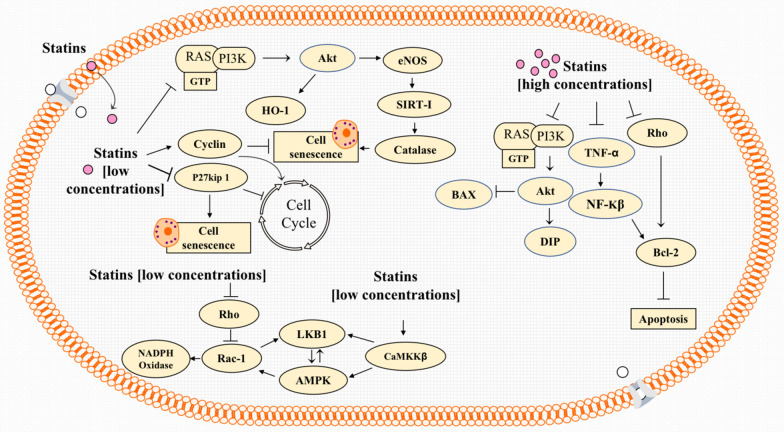
In addition to their lipid-lowering functions, statins elicit additional pleiotropic effects on apoptosis, angiogenesis, inflammation, senescence, and oxidative stress. Many of these effects have been reported in cancerous and noncancerous cells like endothelial cells (ECs), endothelial progenitor cells (EPCs) and human umbilical vein cells (HUVCs). Not surprisingly, statins' effects appear to vary largely depending on the cell context, especially as pertains to modulation of cell cycle, senescence, and apoptotic processes. Perhaps the most critical reason for this discordance is the bias in selecting the applied doses in various cells. While lower (nanomolar) concentrations of statins impose anti-senescence, and antiapoptotic effects, higher concentrations (micromolar) appear to precipitate opposite effects. Indeed, most studies performed in cancer cells utilized high concentrations, where statin-induced cytotoxic and cytostatic effects were noted. Some studies report that even at low concentrations, statins induce senescence or cytostatic impacts but not cytotoxic effects. However, the literature appears to be relatively consistent that in cancer cells, statins, in both low or higher concentrations, induce apoptosis or cell cycle arrest, anti-proliferative effects, and cause senescence. However, statins' effects on ECs depend on the concentrations; at micromolar concentrations statins cause cell senescence and apoptosis, while at nonomolar concentrations statins act reversely.
除了其降脂功能外,他汀类药物还对细胞凋亡、血管生成、炎症、衰老和氧化应激产生额外的多效性作用。许多这些作用已在癌细胞和非癌细胞中报道,如内皮细胞(ECs)、内皮祖细胞(EPCs)和人脐静脉细胞(HUVCs)。不出所料,他汀类药物的作用似乎在很大程度上取决于细胞环境,尤其是在细胞周期、衰老和凋亡过程的调节方面。造成这种不一致的最关键原因可能是在各种细胞中选择应用剂量时存在偏差。虽然较低(纳摩尔)浓度的他汀类药物具有抗衰老和抗凋亡作用,但较高浓度(微摩尔)似乎会产生相反的效果。事实上,大多数在癌细胞中进行的研究使用的是高浓度,在这些研究中观察到了他汀类药物诱导的细胞毒性和细胞生长抑制作用。一些研究报告称,即使在低浓度下,他汀类药物也会诱导衰老或细胞生长抑制作用,但不会产生细胞毒性作用。然而,文献似乎相对一致地认为,在癌细胞中,低浓度或高浓度的他汀类药物都会诱导细胞凋亡或细胞周期停滞、产生抗增殖作用并导致衰老。然而,他汀类药物对内皮细胞的作用取决于浓度;在微摩尔浓度下,他汀类药物会导致细胞衰老和凋亡,而在纳摩尔浓度下,他汀类药物的作用则相反。