Figiel Chester R
United States Fish and Wildlife Service, Warm Springs Fish Technology Center, Warm Springs, GA 31830, USA.
Animals (Basel). 2023 Feb 28;13(5):874. doi: 10.3390/ani13050874.
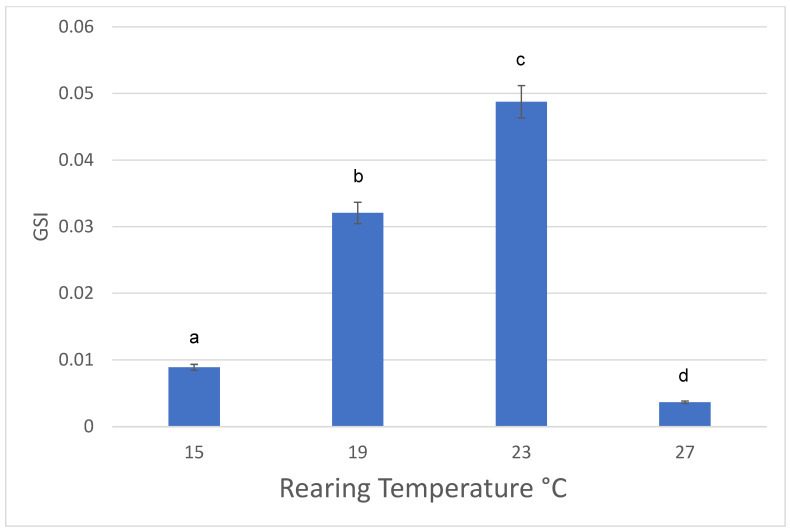
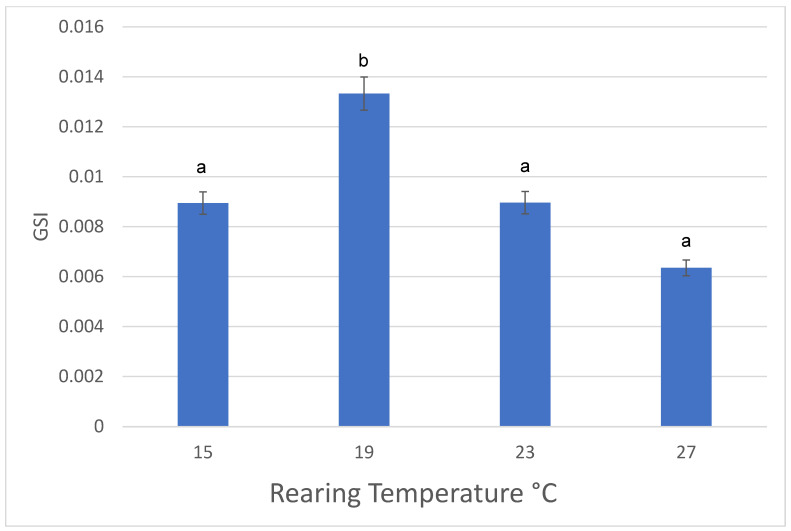
The thermal environment is a major factor influencing amphibians. For example, amphibian reproduction occurs in specific temperatures, and minor changes in this aspect could have negative impacts on this biological process. Understanding the potential effects of temperature on reproductive output is important from both an ecological and captive breeding colony point of view. I examined temperature effects on reproduction in axolotl reared from egg to adult at 4 temperatures (15 °C, 19 °C, 23 °C, and 27 °C) These adult axolotls ( = 174) were measured and weighed, dissected, and their gonads were removed and weighed to obtain an individual's reproductive allocation. Female axolotls reared at 23 °C had a greater Gonadosomatic Index (GSI) compared to axolotl reared at each of the other temperatures with axolotls reared at 27 °C having the lowest reproductive output. Moreover, all GSI pair-wise comparisons in the four temperature treatments were significantly different from each other (ANOVA, F (3, 66) = 61.681, < 0.0001). Additionally male rearing temperature significantly influenced GSI (ANOVA, F (3, 89) = 10.441, < 0.0001). Male axolotls reared at 19 °C had significantly greater GSI compared to males reared at the three other temperatures. There were no statistical differences among each of the other pair-wise comparisons. As seen in this experiment, axolotls may be especially sensitive to climate-driven warming due to their highly permeable skin and paedomorphic life history. Understanding how axolotls and other amphibian species adjust to the challenges of climate change is important in the management of this imperiled taxa.
热环境是影响两栖动物的一个主要因素。例如,两栖动物的繁殖发生在特定温度下,这方面的微小变化可能会对这一生物过程产生负面影响。从生态和圈养繁殖群体的角度来看,了解温度对繁殖产出的潜在影响都很重要。我在4个温度(15℃、19℃、23℃和27℃)下研究了从卵到成体阶段饲养的美西螈的温度对繁殖的影响。对这些成年美西螈(n = 174)进行测量、称重、解剖,并取出其性腺称重,以获得个体的繁殖分配情况。与在其他温度下饲养的美西螈相比,在23℃下饲养的雌性美西螈具有更高的性腺指数(GSI),而在27℃下饲养的美西螈繁殖产出最低。此外,四种温度处理下所有GSI的两两比较均存在显著差异(方差分析,F(3, 66) = 61.681,P < 0.0001)。此外,雄性饲养温度对GSI有显著影响(方差分析,F(3, 89) = 10.441,P < 0.0001)。与在其他三种温度下饲养的雄性美西螈相比,在19℃下饲养的雄性美西螈GSI显著更高。其他两两比较之间均无统计学差异。从该实验可以看出,由于美西螈皮肤高度可渗透以及幼态延续的生活史,它们可能对气候驱动的变暖特别敏感。了解美西螈和其他两栖动物物种如何应对气候变化的挑战对于管理这一濒危类群很重要。