Qin Ziliang, Nai Zida, Li Gang, He Xinmiao, Wang Wentao, Xia Jiqiao, Chao Wang, Li Lu, Jiang Xinpeng, Liu Di
College of Animal Science and Technology, Northeast Agricultural University, Harbin 150030, China.
Key Laboratory of Combining Farming and Animal Husbandry, Ministry of Agriculture, Animal Husbandry Research Institute, Heilongjiang Academy of Agricultural Sciences, No. 368 Xuefu Road, Harbin 150086, China.
Animals (Basel). 2023 Feb 28;13(5):889. doi: 10.3390/ani13050889.
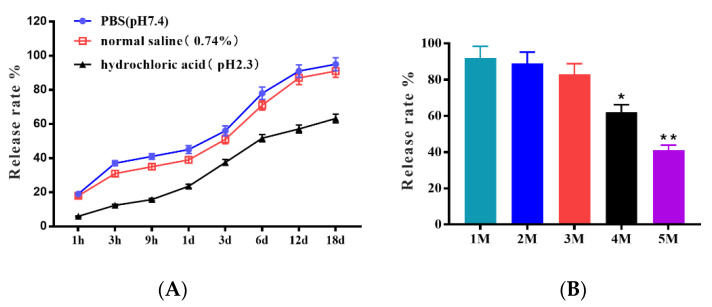
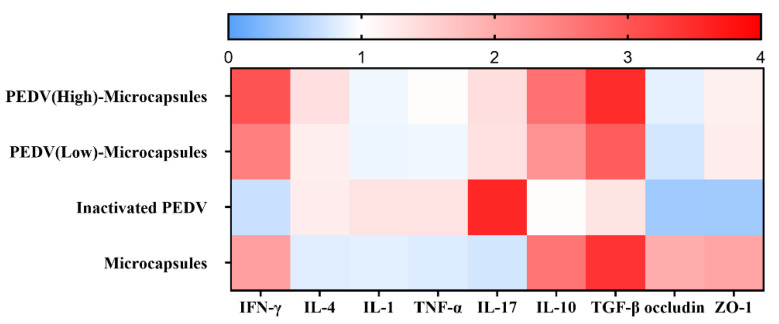
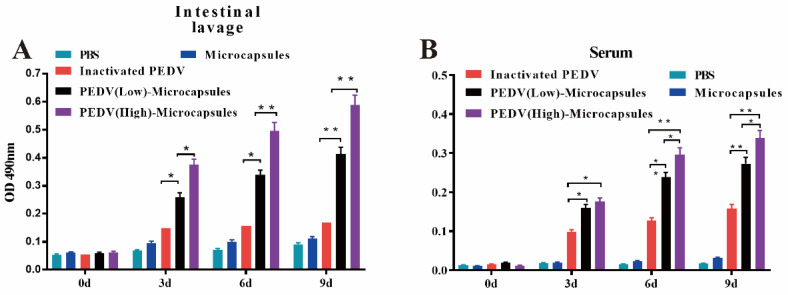
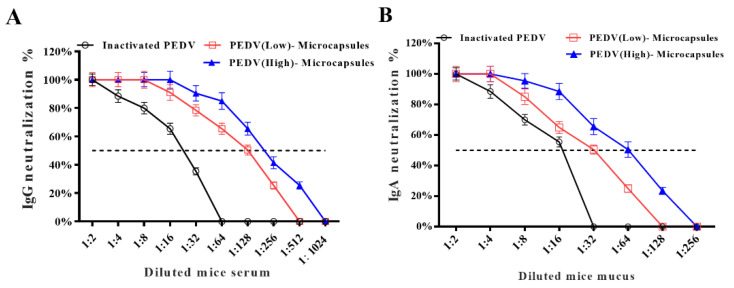
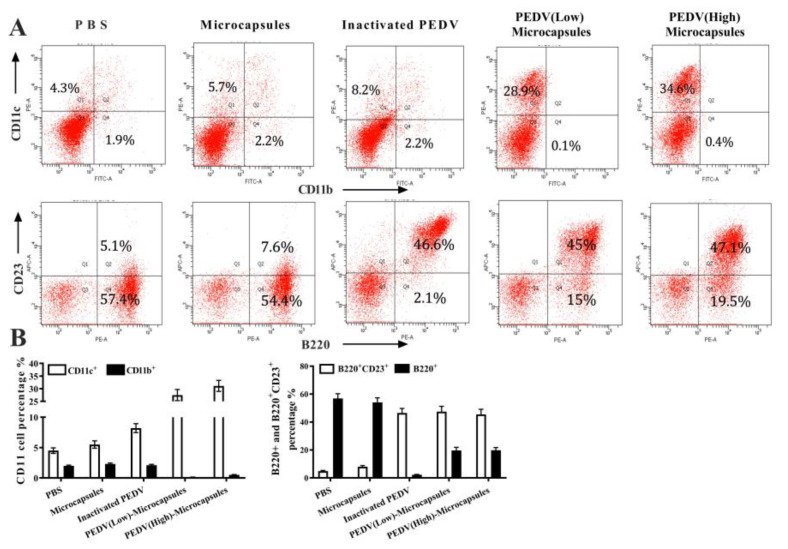
The porcine epidemic diarrhea virus, PEDV, which causes diarrhea, vomiting and death in piglets, causes huge economic losses. Therefore, understanding how to induce mucosal immune responses in piglets is essential in the mechanism and application against PEDV infection with mucosal immunity. A method of treatment in our research was used to make an oral vaccine that packaged the inactive PEDV with microencapsulation, which consisted of sodium alginate and chitosan, and adapted the condition of the gut in mice. The in vitro release experiment of microcapsules showed that inactive PEDV was not only easily released in saline and acid solutions but also had an excellent storage tolerance, and was suitable for use as an oral vaccine. Interestingly, both experimental groups with different doses of inactive virus enhanced the secretion of specific antibodies in the serum and intestinal mucus, which caused the effective neutralization against PEDV in the Vero cell by both IgG and IgA, respectively. Moreover, the microencapsulation could stimulate the differentiation of CD11b+ and CD11c+ dendritic cells, which means that the microencapsulation was also identified as an oral adjuvant to help phagocytosis of dendritic cells in mice. Flow cytometry revealed that the B220 and CD23 of the B cells could significantly increase antibody production with the stimulation from the antigens' PEDV groups, and the microencapsulation could also increase the cell viability of B cells, stimulating the secretion of antibodies such as IgG and IgA in mice. In addition, the microencapsulation promoted the expression of anti-inflammatory cytokines, such as IL-10 and TGF-β. Moreover, proinflammatory cytokines, such as IL-1, TNF-α, and IL-17, were inhibited by alginate and chitosan in the microencapsulation groups compared with the inactivated PEDV group. Taken together, our results demonstrate that the microparticle could play the role of mucosal adjuvant, and release inactivated PEDV in the gut, which can effectively stimulate mucosal and systemic immune responses in mice.
猪流行性腹泻病毒(PEDV)可导致仔猪腹泻、呕吐和死亡,造成巨大经济损失。因此,了解如何在仔猪中诱导黏膜免疫反应对于利用黏膜免疫机制对抗PEDV感染及其应用至关重要。我们研究中的一种治疗方法是制备一种口服疫苗,该疫苗用由海藻酸钠和壳聚糖组成的微囊包裹灭活的PEDV,并适应小鼠肠道环境。微囊的体外释放实验表明,灭活的PEDV不仅易于在生理盐水和酸性溶液中释放,而且具有出色的储存耐受性,适合用作口服疫苗。有趣的是,两个不同剂量灭活病毒的实验组均增强了血清和肠道黏液中特异性抗体的分泌,分别导致IgG和IgA对Vero细胞中的PEDV进行有效中和。此外,微囊化可刺激CD11b +和CD11c +树突状细胞的分化,这意味着微囊化也被确定为一种口服佐剂,有助于小鼠树突状细胞的吞噬作用。流式细胞术显示,在PEDV抗原组的刺激下,B细胞的B220和CD23可显著增加抗体产生,并且微囊化还可提高B细胞的细胞活力,刺激小鼠分泌IgG和IgA等抗体。此外,微囊化促进了抗炎细胞因子如IL-10和TGF-β的表达。而且,与灭活PEDV组相比,微囊化组中的海藻酸钠和壳聚糖抑制了促炎细胞因子如IL-1、TNF-α和IL-17。综上所述,我们的结果表明,该微粒可发挥黏膜佐剂的作用,并在肠道中释放灭活的PEDV,从而有效刺激小鼠的黏膜和全身免疫反应。