
一种用于超稳定锂离子存储的蛋黄壳结构硫化锌@碳材料的选择性氧化策略
A Selective Oxidation Strategy towards the Yolk-Shell Structured ZnS@C Material for Ultra-Stable Li-Ion Storage.
作者信息
Liao Wenhua, Hu Qianqian, Lin Xiaoshan, Yan Ruibo, Zhan Guanghao, Wu Xiaohui, Huang Xiaoying
机构信息
State Key Laboratory of Structural Chemistry, Fujian Institute of Research on the Structure of Matter, The Chinese Academy of Sciences, Fuzhou 350002, China.
College of Chemistry and Materials Science, Fujian Normal University, Fuzhou 350007, China.
出版信息
Materials (Basel). 2023 Mar 4;16(5):2097. doi: 10.3390/ma16052097.
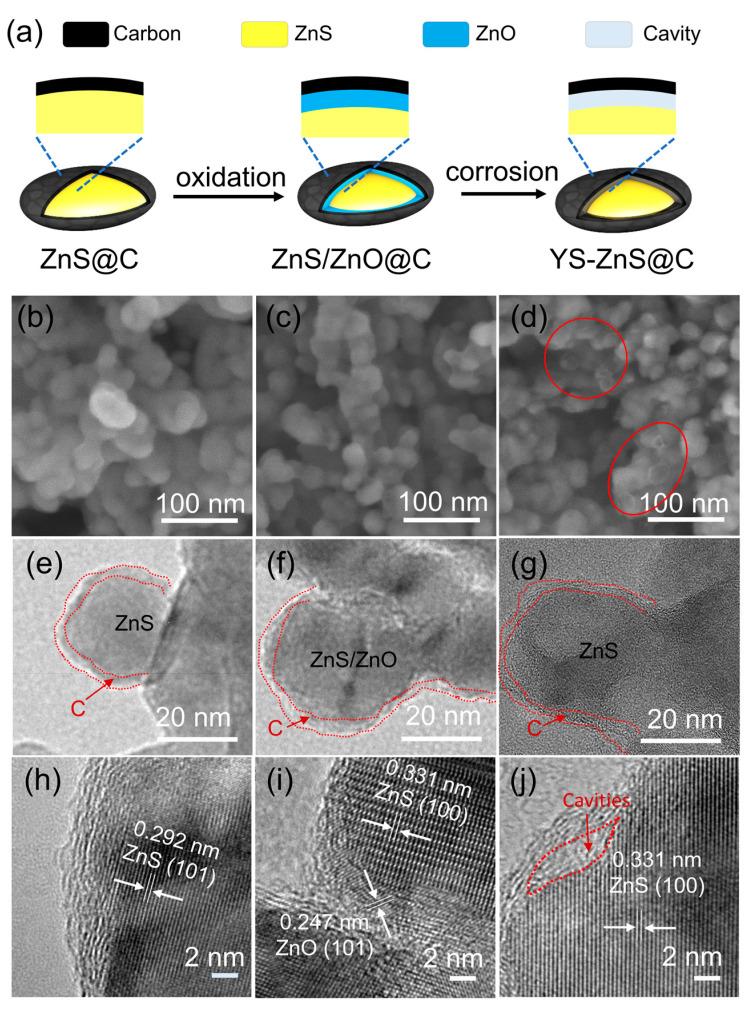
Metal chalcogenides are attractive anode materials for lithium-ion batteries (LIBs) due to their high theoretical capacities. With the advantages of low cost and abundance reserves, ZnS is regarded as the prime candidate anode material for future generations, but its practical application is hindered by the large volume expansion during repeated cycling processes and inherent poor conductivity. Rational design of the microstructure with large pore volume and high specific surface area is of great significance to solve these problems. Here, a carbon-coated ZnS yolk-shell structure (YS-ZnS@C) has been prepared by selective partial oxidation of a core-shell structured ZnS@C precursor in air and subsequent acid etching. Studies show that the carbon wrapping and proper etching to bring cavities can not only improve the material's electrical conductivity, but can also effectively alleviate the volume expansion problem of ZnS during its cycles. As a LIB anode material, the YS-ZnS@C exhibits an obvious superiority in capacity and cycle life compared to ZnS@C. The YS-ZnS@C composite shows a discharge capacity of 910 mA h g at the current density of 100 mA g after 65 cycles, compared to only 604 mA h g for ZnS@C after 65 cycles. Notably, at a large current density of 3000 mA g, a capacity of 206 mA h g can still be maintained after 1000 cycles (over three times of the capacity for ZnS@C). It is expected that the synthetic strategy developed here is applicable to designing various high-performance metal chalcogenide-based anode materials for LIBs.
金属硫族化合物因其高理论容量而成为锂离子电池(LIBs)颇具吸引力的负极材料。硫化锌(ZnS)具有成本低和储量丰富的优势,被视为下一代主要的负极候选材料,但其实际应用受到反复循环过程中体积大幅膨胀以及固有导电性差的阻碍。合理设计具有大孔体积和高比表面积的微观结构对于解决这些问题具有重要意义。在此,通过在空气中对核壳结构的ZnS@C前驱体进行选择性部分氧化并随后进行酸蚀刻,制备了一种碳包覆的ZnS蛋黄壳结构(YS-ZnS@C)。研究表明,碳包覆以及适当蚀刻形成空腔不仅可以提高材料的电导率,还能有效缓解ZnS在循环过程中的体积膨胀问题。作为LIB负极材料,与ZnS@C相比,YS-ZnS@C在容量和循环寿命方面表现出明显优势。在65次循环后,YS-ZnS@C复合材料在100 mA g的电流密度下放电容量为910 mA h g,而ZnS@C在65次循环后仅为604 mA h g。值得注意的是,在3000 mA g的大电流密度下,1000次循环后仍可保持206 mA h g的容量(是ZnS@C容量的三倍多)。预计此处开发的合成策略适用于设计各种用于LIBs的高性能金属硫族化合物基负极材料。



 Zotero 插件