Maternal, Child and Adolescent Health Program, Burnet Institute, Melbourne, VIC, Australia.
Melbourne School of Population and Global Health, University of Melbourne, Melbourne, Australia.
BMC Womens Health. 2023 Mar 11;23(1):102. doi: 10.1186/s12905-023-02197-3.
Reusable menstrual products have expanded the choices available for menstrual care and can offer long-term cost and environmental benefits. Yet, in high-income settings, efforts to support period product access focus on disposable products. There is limited research to understand young people's product use and preferences in Australia.
Quantitative and open-text qualitative data were collected through an annual cross-sectional survey of young people (aged 15-29) in Victoria, Australia. The convenience sample was recruited through targeted social media advertisements. Young people who reported menstruating in the past 6 months (n = 596) were asked questions about their menstrual product use, use of reusable materials, product priorities and preferences.
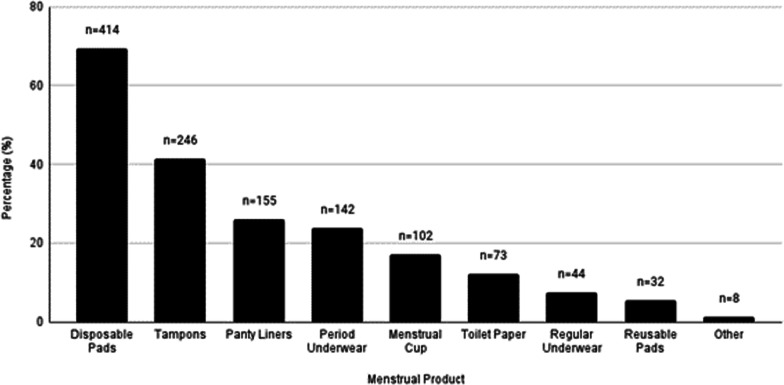
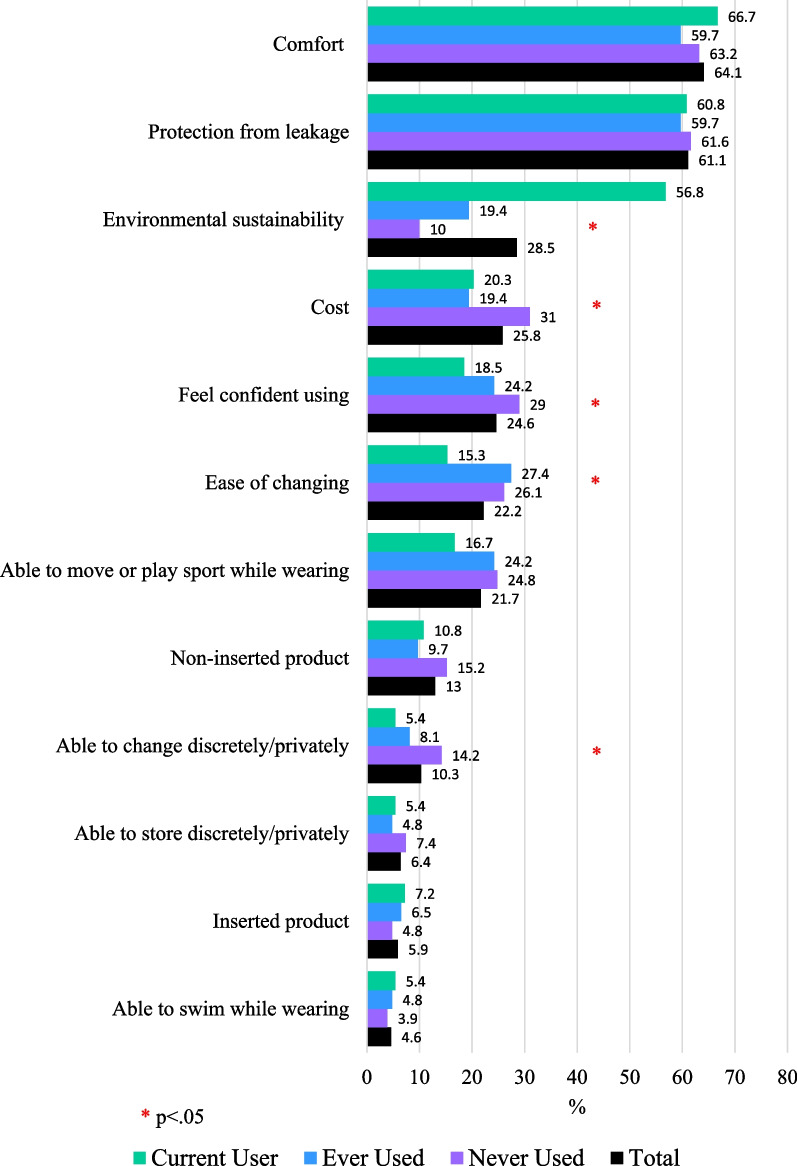
Among participants, 37% had used a reusable product during their last menstrual period (24% period underwear, 17% menstrual cup, 5% reusable pads), and a further 11% had tried using a reusable product in the past. Reusable product use was associated with older age (age 25-29 PR = 3.35 95%CI = 2.09-5.37), being born in Australia (PR = 1.74 95%CI = 1.05-2.87), and having greater discretionary income (PR = 1.53 95%CI = 1.01-2.32). Participants nominated comfort, protection from leakage and environmental sustainability as the most important features of menstrual products, followed by cost. Overall, 37% of participants reported not having enough information about reusable products. Having enough information was less common among younger participants (age 25-29 PR = 1.42 95%CI = 1.20-1.68) and high school students (PR = 0.68 95%CI = 0.52-0.88). Respondents highlighted the need for earlier and better information, challenges navigating the upfront cost and availability of reusables, positive experiences with reusables, and challenges for use, including cleaning reusables and changing them outside the home.
Many young people are using reusable products, with environmental impacts an important motivator. Educators should incorporate better menstrual care information in puberty education and advocates should raise awareness of how bathroom facilities may support product choice.
可重复使用的经期产品扩大了经期护理产品的选择范围,并能带来长期的成本和环境效益。然而,在高收入环境中,支持经期产品获取的努力主要集中在一次性产品上。目前,关于澳大利亚年轻人产品使用和偏好的研究有限。
通过对澳大利亚维多利亚州 15-29 岁年轻人进行年度横断面调查,收集定量和开放文本定性数据。通过有针对性的社交媒体广告招募便利样本。报告过去 6 个月内有月经的年轻人(n=596)被问及他们的经期产品使用情况、可重复使用材料的使用情况、产品优先事项和偏好。
在参与者中,37%的人在最近一次月经期间使用过可重复使用的产品(24%使用经期内裤,17%使用月经杯,5%使用可重复使用的护垫),另有 11%的人过去曾尝试使用过可重复使用的产品。可重复使用产品的使用与年龄较大(25-29 岁 PR=3.35 95%CI=2.09-5.37)、在澳大利亚出生(PR=1.74 95%CI=1.05-2.87)和可自由支配收入较高(PR=1.53 95%CI=1.01-2.32)有关。参与者将舒适性、防漏和环境可持续性列为经期产品最重要的特征,其次是成本。总体而言,37%的参与者表示对可重复使用产品的信息了解不足。较年轻的参与者(25-29 岁 PR=1.42 95%CI=1.20-1.68)和高中生(PR=0.68 95%CI=0.52-0.88)获得足够信息的情况较少。受访者强调需要更早、更好地了解信息,需要克服可重复使用产品前期成本和供应的挑战,需要提高对可重复使用产品的正面体验,并需要解决使用中的挑战,包括清洁可重复使用产品和在户外更换它们。
许多年轻人正在使用可重复使用的产品,而环境影响是一个重要的动机。教育者应在青春期教育中纳入更好的经期护理信息,倡导者应提高对浴室设施如何支持产品选择的认识。