Department of Health Policy and Management, Milken Institute School of Public Health, The George Washington University, Washington, District of Columbia.
Department of Biostatistics and Bioinformatics, Milken Institute School of Public Health, The George Washington University, Washington, District of Columbia.
Am J Prev Med. 2023 Jul;65(1):92-100. doi: 10.1016/j.amepre.2023.02.005. Epub 2023 Mar 11.
Little attention has been paid to the influence of individually measured social determinants of health on cancer screening tests in the Medicaid population.
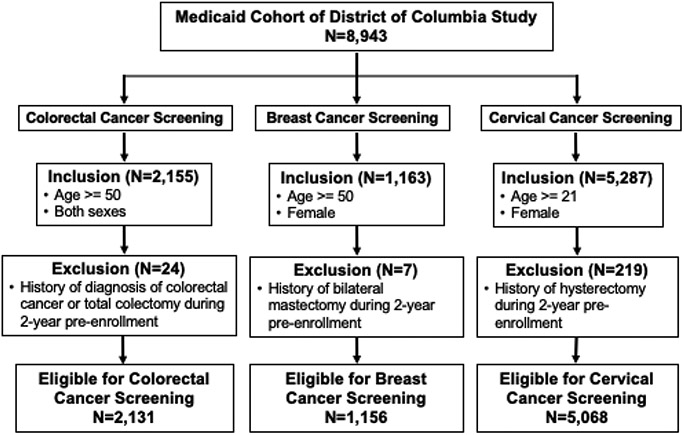
Analysis was conducted on 2015-2020 claims data from a subgroup of Medicaid enrollees from the District of Columbia Medicaid Cohort Study (N=8,943) who were eligible for colorectal (n=2,131), breast (n=1,156), and cervical cancer (n= 5,068) screening. Participants were grouped into four distinct social determinants of health groups on the basis of their responses to social determinants of health questionnaire. This study estimated the influence of the four social determinants of health groups on the receipt of each screening test using log-binomial regression adjusted for demographics, illness severity, and neighborhood-level deprivation.
The receipt of cancer screening tests was 42%, 58%, and 66% for colorectal, cervical, and breast cancer, respectively. Those in the most disadvantaged social determinants of health group were less likely to receive a colonoscopy/sigmoidoscopy than those in the least disadvantaged one (adjusted RR=0.70, 95% CI=0.54, 0.92). The pattern for mammograms and Pap smears was similar (adjusted RR=0.94, 95% CI=0.80, 1.11 and adjusted RR=0.90, 95% CI=0.81, 1.00, respectively). In contrast, participants in the most disadvantaged social determinants of health group were more likely to receive fecal occult blood test than those in the least disadvantaged one (adjusted RR=1.52, 95% CI=1.09, 2.12).
Severe social determinants of health measured at the individual level are associated with lower cancer preventive screening. A targeted approach that addresses the social and economic adversities that affect cancer screening could result in higher preventive screening rates in this Medicaid population.
在医疗补助人群中,很少有人关注个别测量的健康社会决定因素对癌症筛查测试的影响。
对哥伦比亚特区医疗补助队列研究中医疗补助受保人的一个亚组(N=8943)2015 年至 2020 年的索赔数据进行了分析,这些人有资格接受结直肠癌(n=2131)、乳腺癌(n=1156)和宫颈癌(n=5068)筛查。根据他们对健康社会决定因素问卷的回答,参与者被分为四个不同的健康社会决定因素组。本研究使用对数二项式回归,根据人口统计学、疾病严重程度和社区剥夺程度对每个筛查测试的接受情况进行了调整,估计了四个健康社会决定因素组对接受每种筛查测试的影响。
结直肠癌、宫颈癌和乳腺癌的筛查接受率分别为 42%、58%和 66%。处于最不利健康社会决定因素组的人接受结肠镜检查/乙状结肠镜检查的可能性低于处于最有利健康社会决定因素组的人(调整后的 RR=0.70,95%CI=0.54,0.92)。乳房 X 光检查和巴氏涂片检查的模式相似(调整后的 RR=0.94,95%CI=0.80,1.11 和调整后的 RR=0.90,95%CI=0.81,1.00)。相比之下,处于最不利健康社会决定因素组的参与者接受粪便潜血试验的可能性高于处于最有利健康社会决定因素组的参与者(调整后的 RR=1.52,95%CI=1.09,2.12)。
在个体层面上测量的严重健康社会决定因素与较低的癌症预防筛查有关。采取有针对性的方法来解决影响癌症筛查的社会和经济逆境,可能会导致该医疗补助人群中预防性筛查率的提高。