Barnard Mollie E, Qin Bo, Emerson Marc A, Holder Etienne X, Dunn Matthew R, Sarkar Shromona, Xu Nuo N, Li Yutong, Ambrosone Christine B, Bandera Elisa V, Palmer Julie R, Troester Melissa A, Hyslop Terry
Slone Epidemiology Center, Boston University Chobanian & Avedisian School of Medicine, Boston, MA, USA.
Rutgers Cancer Institute, New Brunswick, NJ, USA.
NPJ Breast Cancer. 2025 Aug 6;11(1):85. doi: 10.1038/s41523-025-00804-0.
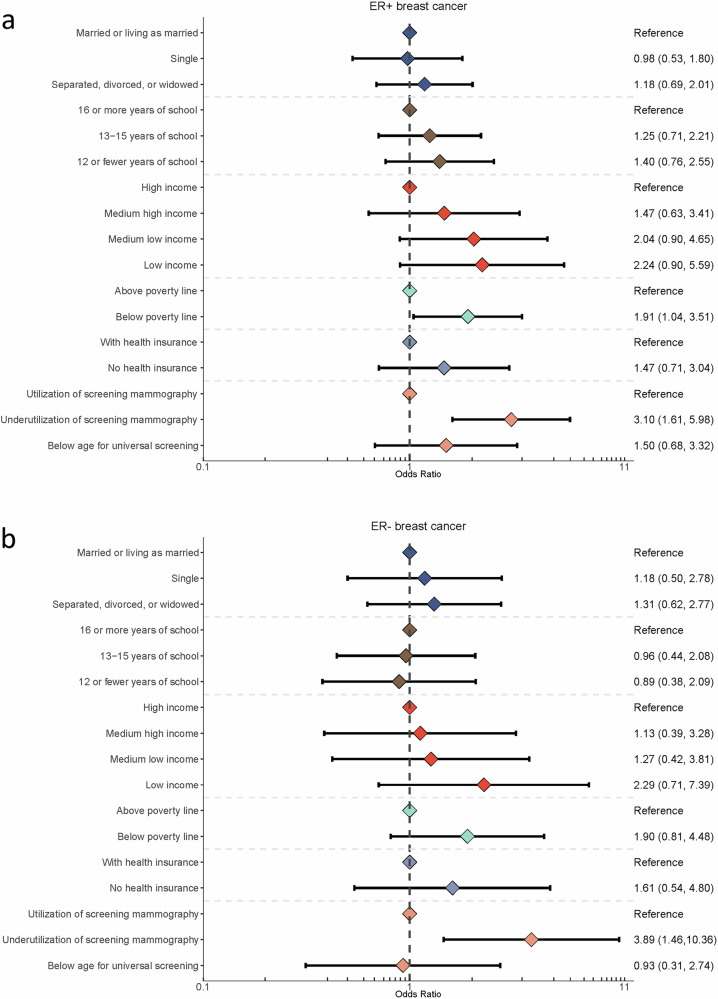
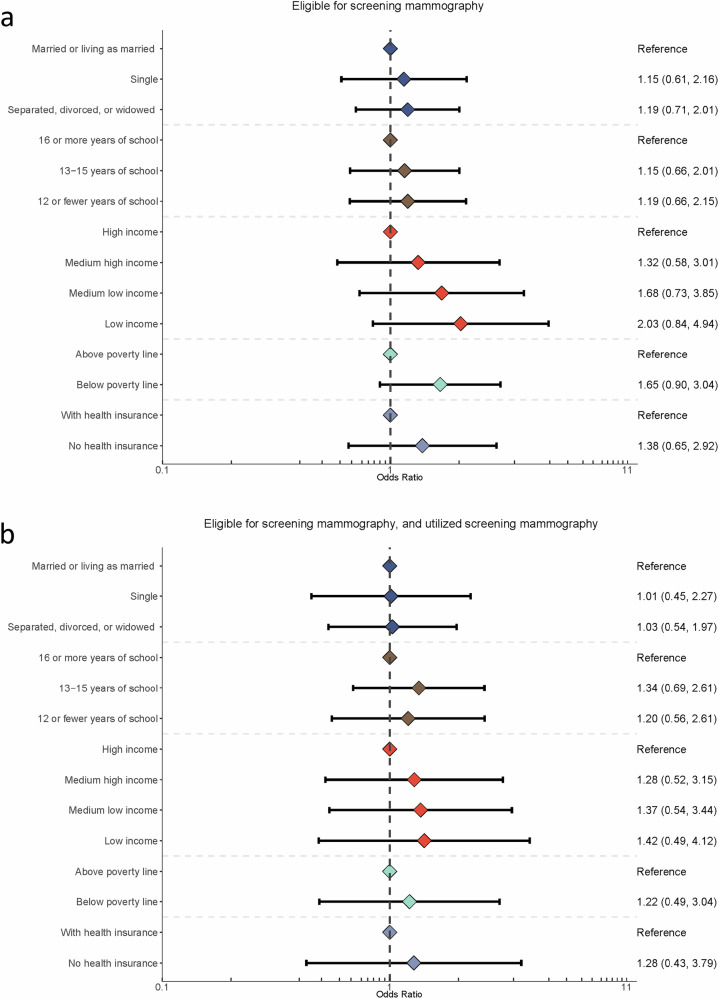
U.S. Black women have disproportionately high breast cancer mortality, partly due to later-stage diagnoses. We examined how social drivers of health (SDOH) relate to stage at diagnosis by analyzing data from 4,995 breast cancer survivors in the Black Women's Health Study, Carolina Breast Cancer Study, and Women's Circle of Health Studies. SDOH were self-reported and stage was ascertained from medical records. We used polytomous logistic regression to estimate odds ratios (ORs) for diagnosis at stages III/IV or II versus stage I (referent), adjusting for age, insurance status, and income. Meta-analyzed results indicated that underutilization of screening mammography (OR = 3.21, 95% CI 1.90-5.43) and income below the federal poverty line (OR = 1.91, 95% CI 1.17-3.10) were significantly associated with later stage diagnosis (III/IV). ORs for lack of insurance and lower education were above 1.0, but not consistently statistically significant. These findings substantiate the importance of the affordability and utilization of breast cancer screening.
美国黑人女性的乳腺癌死亡率高得不成比例,部分原因是诊断时已处于晚期。我们通过分析黑人女性健康研究、卡罗来纳乳腺癌研究和女性健康研究圈中4995名乳腺癌幸存者的数据,研究了健康的社会驱动因素(SDOH)与诊断分期之间的关系。SDOH通过自我报告获得,分期则从医疗记录中确定。我们使用多分类逻辑回归来估计III/IV期或II期与I期(参照组)诊断的比值比(OR),并对年龄、保险状况和收入进行了调整。荟萃分析结果表明,乳腺钼靶筛查利用率不足(OR = 3.21,95% CI 1.90 - 5.43)以及收入低于联邦贫困线(OR = 1.91,95% CI 1.17 - 3.10)与晚期诊断(III/IV期)显著相关。未参保和受教育程度较低的OR高于1.0,但在统计学上并不一致显著。这些发现证实了乳腺癌筛查的可负担性和利用率的重要性。