
阿尔茨海默病患者视网膜结构与脑多模态磁共振成像之间的相关性
Correlation between retinal structure and brain multimodal magnetic resonance imaging in patients with Alzheimer's disease.
作者信息
Hao Xiaoli, Zhang Weiwei, Jiao Bin, Yang Qijie, Zhang Xinyue, Chen Ruiting, Wang Xin, Xiao Xuewen, Zhu Yuan, Liao Weihua, Wang Dongcui, Shen Lu
机构信息
Department of Neurology, Xiangya Hospital of Central South University, Changsha, China.
Department of Radiology, Xiangya Hospital of Central South University, Changsha, China.
出版信息
Front Aging Neurosci. 2023 Feb 22;15:1088829. doi: 10.3389/fnagi.2023.1088829. eCollection 2023.
BACKGROUND
The retina imaging and brain magnetic resonance imaging (MRI) can both reflect early changes in Alzheimer's disease (AD) and may serve as potential biomarker for early diagnosis, but their correlation and the internal mechanism of retinal structural changes remain unclear. This study aimed to explore the possible correlation between retinal structure and visual pathway, brain structure, intrinsic activity changes in AD patients, as well as to build a classification model to identify AD patients.
METHODS
In the study, 49 AD patients and 48 healthy controls (HCs) were enrolled. Retinal images were obtained by optical coherence tomography (OCT). Multimodal MRI sequences of all subjects were collected. Spearman correlation analysis and multiple linear regression models were used to assess the correlation between OCT parameters and multimodal MRI findings. The diagnostic value of combination of retinal imaging and brain multimodal MRI was assessed by performing a receiver operating characteristic (ROC) curve.
RESULTS
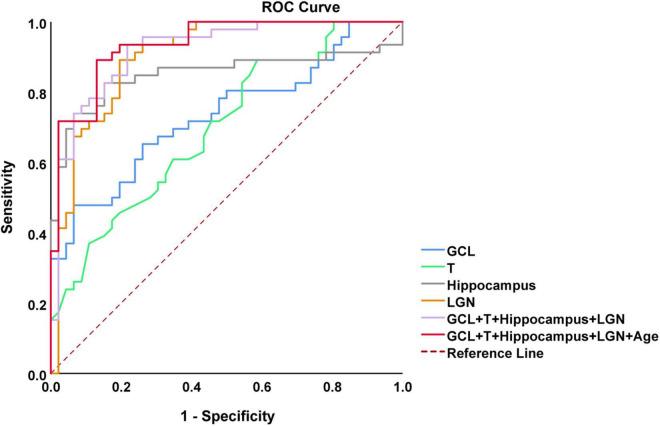
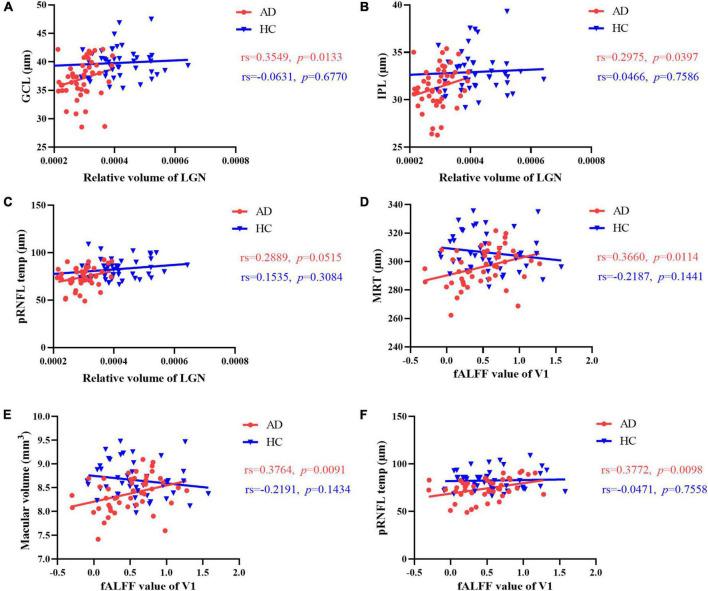
Compared with HCs, retinal thickness and multimodal MRI findings of AD patients were significantly altered ( < 0.05). Significant correlations were presented between the fractional anisotropy (FA) value of optic tract and mean retinal thickness, macular volume, macular ganglion cell layer (GCL) thickness, inner plexiform layer (IPL) thickness in AD patients ( < 0.01). The fractional amplitude of low frequency fluctuations (fALFF) value of primary visual cortex (V1) was correlated with temporal quadrant peripapillary retinal nerve fiber layer (pRNFL) thickness ( < 0.05). The model combining thickness of GCL and temporal quadrant pRNFL, volume of hippocampus and lateral geniculate nucleus, and age showed the best performance to identify AD patients [area under the curve (AUC) = 0.936, sensitivity = 89.1%, specificity = 87.0%].
CONCLUSION
Our study demonstrated that retinal structure change was related to the loss of integrity of white matter fiber tracts in the visual pathway and the decreased LGN volume and functional metabolism of V1 in AD patients. Trans-synaptic axonal retrograde lesions may be the underlying mechanism. Combining retinal imaging and multimodal MRI may provide new insight into the mechanism of retinal structural changes in AD and may serve as new target for early auxiliary diagnosis of AD.
背景
视网膜成像和脑磁共振成像(MRI)均能反映阿尔茨海默病(AD)的早期变化,可能作为早期诊断的潜在生物标志物,但其相关性以及视网膜结构变化的内在机制尚不清楚。本研究旨在探讨AD患者视网膜结构与视觉通路、脑结构、内在活动变化之间的可能相关性,并建立一个用于识别AD患者的分类模型。
方法
本研究纳入了49例AD患者和48例健康对照(HCs)。通过光学相干断层扫描(OCT)获取视网膜图像。收集所有受试者的多模态MRI序列。采用Spearman相关性分析和多元线性回归模型评估OCT参数与多模态MRI结果之间的相关性。通过绘制受试者工作特征(ROC)曲线评估视网膜成像与脑多模态MRI联合的诊断价值。
结果
与HCs相比,AD患者的视网膜厚度和多模态MRI结果有显著改变(<0.05)。AD患者中,视束的各向异性分数(FA)值与平均视网膜厚度、黄斑体积、黄斑神经节细胞层(GCL)厚度、内层神经纤维层(IPL)厚度之间存在显著相关性(<0.01)。初级视觉皮层(V1)的低频波动分数振幅(fALFF)值与颞侧象限视乳头周围视网膜神经纤维层(pRNFL)厚度相关(<0.05)。联合GCL厚度和颞侧象限pRNFL、海马体和外侧膝状体体积以及年龄的模型在识别AD患者方面表现最佳[曲线下面积(AUC)=0.936,灵敏度=89.1%,特异性=87.0%]。
结论
我们的研究表明,AD患者视网膜结构变化与视觉通路中白质纤维束完整性丧失以及外侧膝状体体积减小和V1功能代谢降低有关。跨突触轴突逆行性损伤可能是其潜在机制。联合视网膜成像和多模态MRI可能为AD患者视网膜结构变化机制提供新的见解,并可能作为AD早期辅助诊断的新靶点。


 Zotero 插件