Parra Sandra, Saballs Mireia, DiNubile Mark, Feliu Mireia, Iftimie Simona, Revuelta Laia, Pavón Raul, Àvila Alba, Levinson Susan, Castro Antoni
Internal Medicine Department, "Sant Joan" University Hospital (Reus-Spain), Institut Investigació Sanitaria Pere Virgili (IISPV), Universitat Rovira I Virgili, Reus, Spain.
Internal Medicine Department, Hospital Quiron Salud, Barcelona, Spain.
Atheroscler Plus. 2023 Jun;52:1-8. doi: 10.1016/j.athplu.2023.01.002. Epub 2023 Mar 6.
HDL particles may act to buffer host cells from excessive inflammatory mediators. The aim of this study is to investigate if the lipid profile provides a prognostic biomarker for COVID-19 outcomes.
This was a prospective study of the characteristics of 125 adult COVID-19 patients with a lipid profile performed on the day of admission analyzed with regard to clinical outcomes.
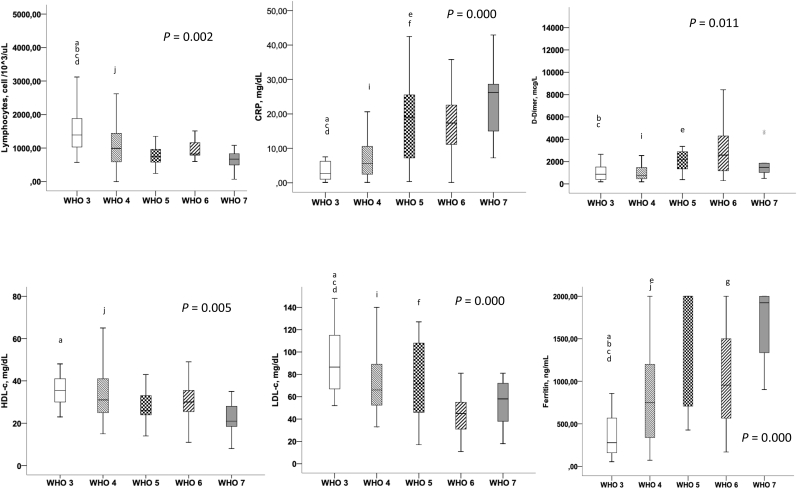
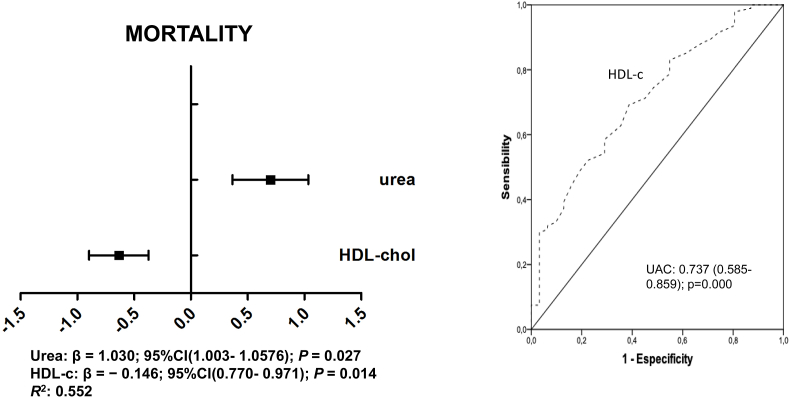
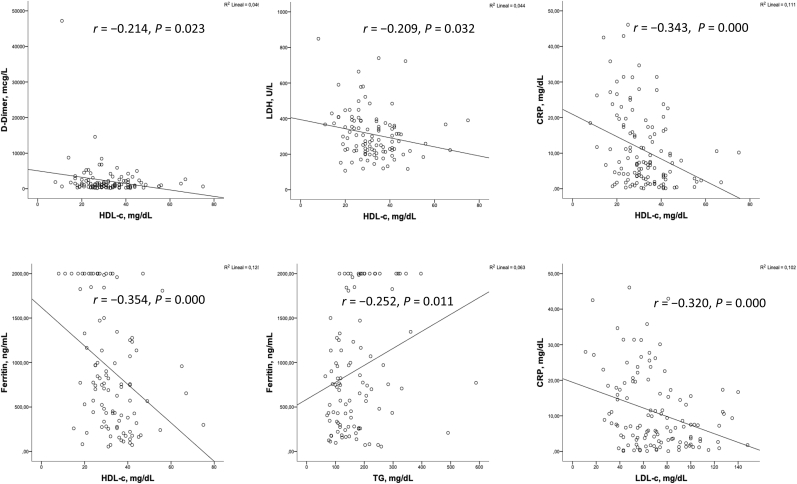
Seventy-seven patients (61.2%) were men, with a mean age of 66.3 (15.6) years. 54.1% had bilateral pneumonia. The all-cause mortality rate during hospitalization was 20.8%. We found a direct association between more severe disease assessed by the WHO classification, admission to the ICU and death with more pronounced lymphopenia, higher levels of CRP, ferritin ( < 0.001), D-dímer and lactate dehydrogenase (LDH) all statistically significant. Lower leves of HDL-c and LDL-c were also associated with a worse WHO classification, ICU admission, and death,. HDL-c levels were inversely correlated with inflammatory markers CRP ( = -0.333; < 0.001), ferritin ( = -0.354; < 0.001), D-dímer ( = -0.214; < 0.001), LDH ( = -0.209; < 0.001. LDL-c levels were significantly associated with CRP ( = -0.320; < 0.001) and LDH ( = -0.269; < 0.001). ROC curves showed that HDL [AUC = 0.737(0.586-0.887), = 0.005] and lymphocytes [AUC = 0.672(0.497-0.847], < 0.043] had the best prognostic accuracy to predict death. In a multivariate analysis, HDL-c (β = -0.146(0.770-0.971), = 0.014) and urea (β = 0.029(1.003-1.057), = 0.027) predicted mortality.
Hypolipidemia including HDL levels at admission identifies patients with a higher risk of death and worse clinical manifestations who may require more intensive care.
高密度脂蛋白(HDL)颗粒可能起到缓冲宿主细胞免受过多炎症介质影响的作用。本研究旨在调查血脂谱是否可为2019冠状病毒病(COVID-19)的预后提供生物标志物。
这是一项前瞻性研究,对125例成年COVID-19患者入院当天进行血脂谱检测,并分析其临床结局。
77例(61.2%)为男性,平均年龄66.3(15.6)岁。54.1%的患者患有双侧肺炎。住院期间的全因死亡率为20.8%。我们发现,根据世界卫生组织(WHO)分类评估的更严重疾病、入住重症监护病房(ICU)以及死亡与更明显的淋巴细胞减少、更高水平的C反应蛋白(CRP)、铁蛋白(<0.001)、D-二聚体和乳酸脱氢酶(LDH)之间存在直接关联,所有这些在统计学上均有显著意义。较低水平的高密度脂蛋白胆固醇(HDL-c)和低密度脂蛋白胆固醇(LDL-c)也与更差的WHO分类、入住ICU及死亡相关。HDL-c水平与炎症标志物CRP(r = -0.333;<0.001)、铁蛋白(r = -0.354;<0.001)、D-二聚体(r = -0.214;<0.001)、LDH(r = -0.209;<0.001)呈负相关。LDL-c水平与CRP(r = -0.320;<0.001)和LDH(r = -0.269;<0.001)显著相关。ROC曲线显示,HDL [曲线下面积(AUC)= 0.737(0.586 - 0.887),P = 0.005]和淋巴细胞[AUC = 0.672(0.497 - 0.847),P < 0.043]在预测死亡方面具有最佳的预后准确性。在多变量分析中,HDL-c(β = -0.146(0.770 - 0.971),P = 0.014)和尿素(β = 0.029(1.003 - 1.057),P = 0.027)可预测死亡率。
入院时包括HDL水平在内的低脂血症可识别出死亡风险较高且临床表现较差、可能需要更强化治疗的患者。