Ansari Shaghaf Mobin, Khanum Ghazala, Bhat Muneer-Ul-Shafi, Rizvi Masood Ahmad, Reshi Noor U Din, Ganie Majid Ahmad, Javed Saleem, Shah Bhahwal Ali
Academy of Scientific and Innovative Research (AcSIR), Ghaziabad 201002, India.
Research Management, Business Development, and Information Sciences and Technology Division, CSIR-Indian Institute of Integrative Medicine, Jammu 180001, India.
J Mol Struct. 2023 Jul 5;1283:135256. doi: 10.1016/j.molstruc.2023.135256. Epub 2023 Mar 1.
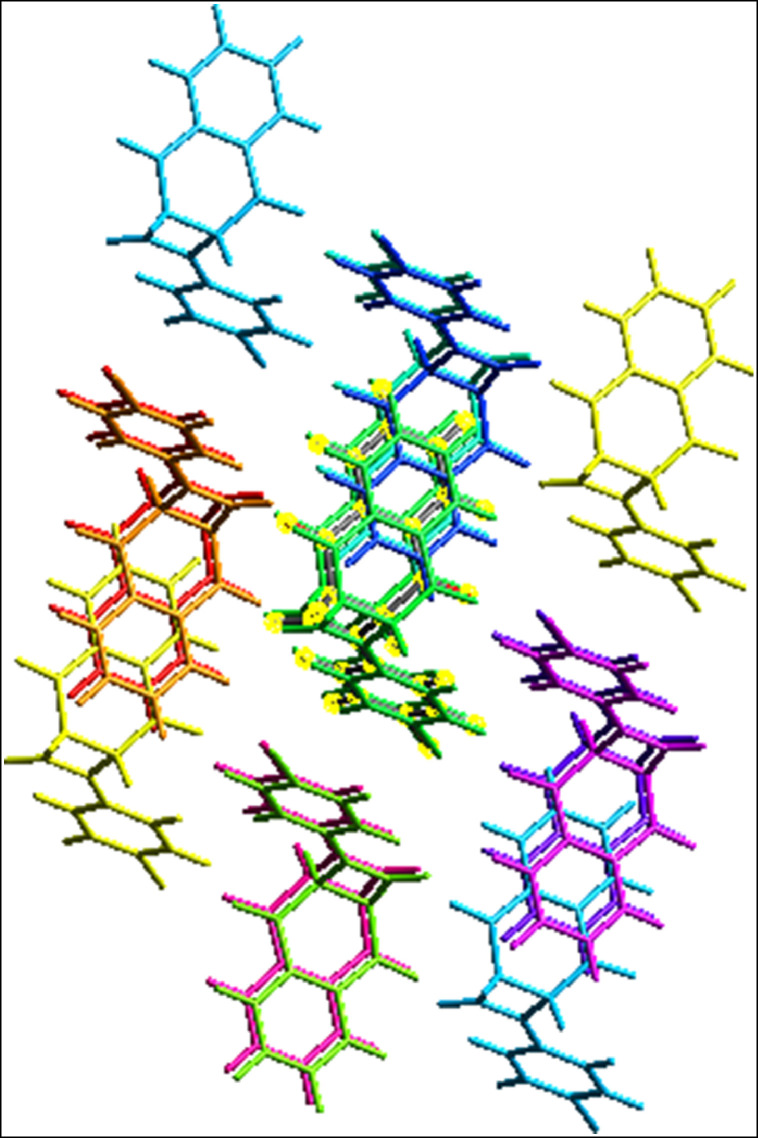
In this work, 1-(4-bromophenyl)-2a,8a-dihydrocyclobuta[]naphthalene-3,8‑dione (1-(4-BP)DHCBN-3,8-D) has been characterized by single crystal X-ray to get it's crystal structure with R(all data) - R1 = 0.0569, wR2 = 0.0824, C and HNMR, as well as UV-Vis and IR spectroscopy. Quantum chemical calculations via DFT were used to predict the compound structural, electronic, and vibrational properties. The molecular geometry of 1-(4-BP)DHCBN-3,8-Dwas optimized utilizing the B3LYP functional at the 6-311++(d,p) level of theory. The Infrared spectrum has been recorded in the range of 4000-550 cm. The Potential Energy Distribution (PED) assignments of the vibrational modes were used to determine the geometrical dimensions, energies, and wavenumbers, and to assign basic vibrations. The UV-Vis spectra of the titled compound were recorded in the range of 200-800 nm in ACN and DMSO solvents. Additionally, the highest occupied molecular orbital (HOMO) and lowest unoccupied molecular orbital (LUMO) energy gap and electronic transitions were determined using TD-DFT calculations, which also simulate the UV-Vis absorption spectrum. Natural Bond Orbital (NBO) analysis can be used to investigate electronic interactions and transfer reactions between donor and acceptor molecules. Temperature-dependent thermodynamic properties were also calculated. To identify the interactions in the crystal structure, Hirshfeld Surface Analysis was also assessed. The Molecular Electrostatic Potential (MEP) and Fukui functions were used to determine the nucleophilic and electrophilic sites. Additionally, the biological activities of 1-(4-BP)DHCBN-3,8-D were done using molecular docking. These results demonstrate a significant therapeutic potential for 1-(4-BP)DHCBN-3,8-D in the management of Covid-19 disorders. Molecular Dynamics Simulation was used to look at the stability of biomolecules.
在本研究中,通过单晶X射线对1-(4-溴苯基)-2a,8a-二氢环丁烷并萘-3,8-二酮(1-(4-BP)DHCBN-3,8-D)进行了表征,以获得其晶体结构,其R(所有数据)-R1 = 0.0569,wR2 = 0.0824,并通过碳氢核磁共振、紫外可见光谱和红外光谱进行了分析。通过密度泛函理论(DFT)进行量子化学计算,以预测该化合物的结构、电子和振动性质。利用B3LYP泛函在6-311++(d,p)理论水平上对1-(4-BP)DHCBN-3,8-D的分子几何结构进行了优化。红外光谱记录范围为4000-550 cm。振动模式的势能分布(PED)归属用于确定几何尺寸、能量和波数,并归属基本振动。在乙腈和二甲基亚砜溶剂中,在200-800 nm范围内记录了该标题化合物的紫外可见光谱。此外,使用含时密度泛函理论(TD-DFT)计算确定了最高占据分子轨道(HOMO)和最低未占据分子轨道(LUMO)的能隙以及电子跃迁,该计算还模拟了紫外可见吸收光谱。自然键轨道(NBO)分析可用于研究供体和受体分子之间的电子相互作用和转移反应。还计算了温度相关的热力学性质。为了确定晶体结构中的相互作用,还进行了 Hirshfeld 表面分析。利用分子静电势(MEP)和福井函数确定亲核和亲电位点。此外,通过分子对接研究了1-(4-BP)DHCBN-3,8-D的生物活性。这些结果表明1-(4-BP)DHCBN-3,8-D在治疗新冠病毒疾病方面具有巨大的治疗潜力。使用分子动力学模拟研究生物分子的稳定性。