Huang Xiangyu, Hadi Pejman, Joshi Ritika, Alhamzani Abdulrahman G, Hsiao Benjamin S
Department of Chemistry, Stony Brook University, 100 Nicolls Road, Stony Brook, New York 11794, United States.
Department of Chemistry, Imam Mohammad Ibn Saud Islamic University, Riyadh 11623, Saudi Arabia.
ACS Omega. 2023 Feb 23;8(9):8634-8649. doi: 10.1021/acsomega.2c07839. eCollection 2023 Mar 7.
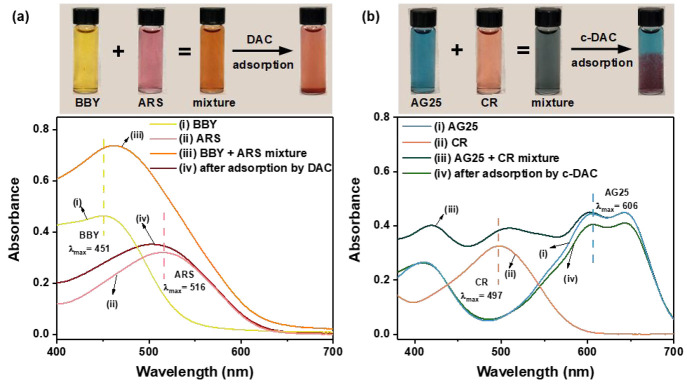
In this study, anionic dialdehyde cellulose (DAC) and cationic dialdehyde cellulose (c-DAC) nanofibrous adsorbents were prepared via a two-step reaction from bamboo pulp, using sodium periodate and Girard's reagent T as oxidizing and cationizing agents, respectively. The performance of DAC and c-DAC for selective dye adsorption and separation was evaluated by six different organic dyes (with varying charge properties) and certain binary mixtures. Both adsorbents could remove the dyes but with different capability, where DAC exhibited high adsorption efficiency against cationic dyes (e.g., the maximum adsorption capacity for Bismarck brown Y was 552.1 mg/g) and c-DAC exhibited high adsorption efficiency against anionic dyes (e.g., the maximum adsorption capacity for Congo red was 540.3 mg/g). To investigate the adsorption mechanism for these adsorbents, effects of contact time, initial pH value, initial dye concentration, and ionic strength on the adsorption activity against Congo red were investigated. The adsorption equilibrium data of DAC were found to fit best with the Langmuir isotherm model, whereas that of c-DAC were found to fit best with the Freundlich model. Both DAC and c-DAC adsorption kinetic data could be described by the pseudo-second-order kinetic model, and these adsorbents possessed stable adsorption efficiency in the pH range of 4-10. Furthermore, their dye adsorption capabilities were found to increase with increasing ionic strength (salt concentration). The distinctive complementary features of DAC and c-DAC will allow them to remove a wide range of organic dyes from industrial wastewater.
在本研究中,以竹浆为原料,分别使用高碘酸钠和吉拉德试剂T作为氧化剂和阳离子化剂,通过两步反应制备了阴离子二醛纤维素(DAC)和阳离子二醛纤维素(c-DAC)纳米纤维吸附剂。通过六种不同的有机染料(具有不同的电荷性质)和某些二元混合物评估了DAC和c-DAC对染料的选择性吸附和分离性能。两种吸附剂都能去除染料,但能力不同,其中DAC对阳离子染料表现出高吸附效率(例如,俾斯麦棕Y的最大吸附容量为552.1 mg/g),而c-DAC对阴离子染料表现出高吸附效率(例如,刚果红的最大吸附容量为540.3 mg/g)。为了研究这些吸附剂的吸附机理,研究了接触时间、初始pH值、初始染料浓度和离子强度对刚果红吸附活性的影响。发现DAC的吸附平衡数据最符合朗缪尔等温线模型,而c-DAC的吸附平衡数据最符合弗伦德里希模型。DAC和c-DAC的吸附动力学数据都可以用伪二级动力学模型来描述,并且这些吸附剂在4-10的pH范围内具有稳定的吸附效率。此外,发现它们对染料的吸附能力随着离子强度(盐浓度)的增加而增加。DAC和c-DAC独特的互补特性将使它们能够从工业废水中去除多种有机染料。