Tihtih Mohammed, Ibrahim Jamal Eldin F M, Basyooni Mohamed A, En-Nadir Redouane, Belaid Walid, Hussainova Irina, Kocserha István
Institute of Ceramic and Polymer Engineering, University of Miskolc, Egyetemvaros, Miskolc H-3515, Hungary.
Department of Nanotechnology and Advanced Materials, Graduate School of Applied and Natural Science, Selçuk University, Konya 42030, Turkey.
ACS Omega. 2023 Feb 22;8(9):8448-8460. doi: 10.1021/acsomega.2c07497. eCollection 2023 Mar 7.
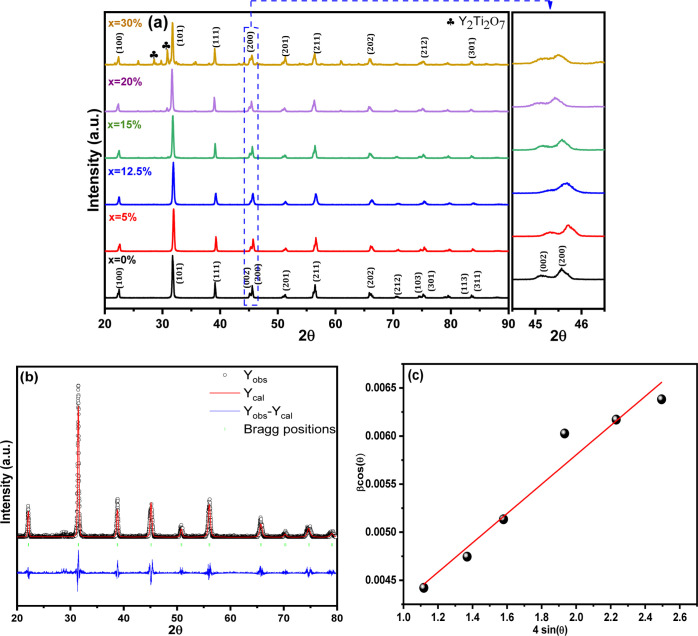
The use of electronic devices that incorporate multilayer ceramic capacitors (MLCCs) is on the rise, requiring materials with good electrical properties and a narrow band gap. This study synthesized yttrium-substituted barium titanate (Ba Y TiO, BYT) using a sol-gel process at 950 °C with varying concentrations of yttrium (0 ≤ ≤ 0.3). X-ray diffraction analysis showed that the tetragonal phase became less pronounced as the yttrium content increased. The samples had varying grain sizes and porosity, with the BY30%T sample having the narrowest band gap at 2.21 eV. The BYT ceramic with 30% yttrium had a thermal conductivity of up to 7 W/m K and an electrical conductivity down to 0.002 (Ω cm) at 180 °C. The current-voltage characteristics of the BYT MLCC were also studied, showing potential use in next-generation high-capacity MLCCs. This work presents BYT as a promising material for these types of capacitors.
包含多层陶瓷电容器(MLCC)的电子设备的使用正在增加,这就需要具有良好电性能和窄带隙的材料。本研究采用溶胶 - 凝胶法在950℃下合成了不同钇浓度(0≤ ≤0.3)的钇取代钛酸钡(Ba Y TiO,BYT)。X射线衍射分析表明,随着钇含量的增加,四方相变得不那么明显。样品具有不同的晶粒尺寸和孔隙率,其中BY30%T样品的带隙最窄,为2.21 eV。含30%钇的BYT陶瓷在180℃时的热导率高达7 W/m K,电导率低至0.002(Ω·cm)。还研究了BYT MLCC的电流 - 电压特性,表明其在下一代高容量MLCC中有潜在应用。这项工作表明BYT是这类电容器的一种有前景的材料。