Department of Obstetrics and Gynecology, School of Medical Sciences, University of Campinas, Campinas, São Paulo, Brazil.
PLoS One. 2023 Mar 13;18(3):e0282605. doi: 10.1371/journal.pone.0282605. eCollection 2023.
Abnormal uterine bleeding (AUB) is the main cause of demand for gynecological care during the reproductive period, with negative consequences on women's lives. In Brazil, data on the prevalence of AUB is scarce and does not reflect the national reality.
To evaluate the prevalence of AUB and associated factors in Brazil.
Multicenter cross-sectional study, including 8 centers representing the 5 official geographic regions of Brazil. It included postmenarchal women who answered a sociodemographic questionnaire, with socioeconomic stratum and data related to uterine bleeding (self-perception of AUB and objective data).
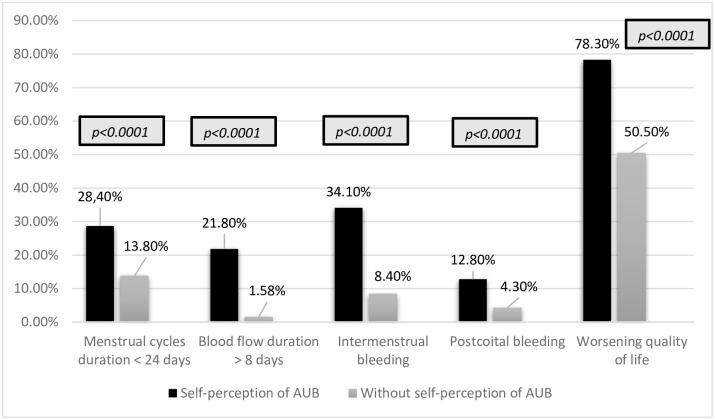
1928 women were included, with 35.5±12.5 years of age, 167 postmenopausal. The 1761 women in their reproductive period, had a menstrual cycle duration of 29.2±20.6 days, with bleeding for 5.6±4.0 days. In these, the prevalence of AUB, considering self-perception by the women, was 31.4%. Only among women who considered their bleeding abnormal, the menstrual cycle lasted less than 24 days in 28.4%, bleeding lasted longer than 8 days in 21.8%, 34.1% reported intermenstrual bleeding and 12.8% reported postcoital bleeding. Also, regarding these women, 47% reported a previous diagnosis of anemia, with 6% requiring intravenous treatment (iron or blood transfusion). Half of the women mentioned that the menstrual period had a negative impact on quality of life, while this worsening occurs in about 80% of those with self-perception of AUB.
In Brazil, the prevalence of AUB is 31.4%, assessed by self-perception, in agreement with objective AUB parameters. The menstrual period has a negative impact on the quality of life of 8 out of 10 women with AUB.
异常子宫出血(AUB)是生殖期女性寻求妇科保健的主要原因,对女性生活质量产生负面影响。在巴西,AUB 的患病率数据稀缺,无法反映全国实际情况。
评估巴西 AUB 的流行情况及相关因素。
多中心横断面研究,包括代表巴西 5 个官方地理区域的 8 个中心。纳入初潮后的女性,她们回答了一个社会人口学问卷,包括社会经济阶层和与子宫出血相关的数据(自我感知的 AUB 和客观数据)。
共纳入 1928 名女性,年龄为 35.5±12.5 岁,167 名绝经后女性。1761 名处于生育期的女性月经周期持续 29.2±20.6 天,出血持续 5.6±4.0 天。在这些女性中,考虑到女性的自我感知,AUB 的患病率为 31.4%。仅在那些认为自己出血异常的女性中,28.4%的人月经周期少于 24 天,21.8%的人出血时间超过 8 天,34.1%的人报告有间期出血,12.8%的人报告有性交后出血。此外,这些女性中有 47%曾被诊断为贫血,6%需要静脉治疗(铁剂或输血)。一半的女性表示月经对生活质量有负面影响,而在自我感知有 AUB 的女性中,约 80%的人生活质量恶化。
在巴西,通过自我感知评估 AUB 的患病率为 31.4%,与客观 AUB 参数一致。AUB 患者中,80%的人认为月经对生活质量有负面影响。