Zhang Yue, Luo Zhou, Jia Yingxian, Zhao Yunxiu, Huang Yizhou, Ruan Fei, Ying Qian, Ma Linjuan, Luo Jie, Zhou Jianhong
Women's Hospital, Zhejiang University School of Medicine, Hangzhou, 310006, Zhejiang, China.
Zhejiang Provincial Clinical Research Center for Obstetrics and Gynecology, Zhejiang, China.
BMC Womens Health. 2023 Oct 12;23(1):536. doi: 10.1186/s12905-023-02589-5.
Abnormal uterine bleeding associated with ovulatory dysfunction (AUB-O) is a typical gynecological disease that can affect women of various ages. Being able to identify women at risk of AUB-O could allow physicians to take timely action. This study aimed to identify the influencing factors of AUB-O in Chinese women, and then develop and validate a predictive model.
In this multicenter case-control study, 391 women with AUB-O and 838 controls who came from nine hospitals in Zhejiang province were recruited between April 2019 and January 2022. All the participants completed a structured questionnaire including general characteristics, lifestyle and habits, menstrual and reproductive history, and previous diseases. The predictive model was developed on a group of 822 women and validated on a group of 407 women. Logistic regression was adopted to investigate the influencing factors and develop the model, and validation was then performed.
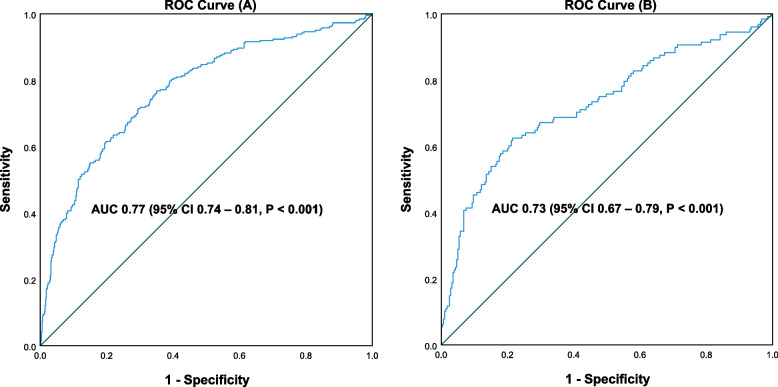
The independent predictive factors of AUB-O were age (OR 1.073, 95% CI 1.046-1.102, P < 0.001), body mass index (OR 1.081, 95% CI 1.016-1.151, P = 0.015), systolic blood pressure (OR 1.016, 95% CI 1.002-1.029, P = 0.023), residence (OR 2.451, 95% CI 1.727-3.478, P < 0.001), plant-based diet (OR 2.306, 95% CI 1.415-3.759, P < 0.001), fruits eating (OR 1.887, 95% CI 1.282-2.776, P = 0.001), daily sleep duration (OR 0.819; 95% CI 0.708-0.946, P = 0.007), multiparous (parity = 1, OR 0.424, 95% CI 0.239-0.752, P = 0.003; parity > 1, OR 0.450, 95% CI 0.247-0.822, P = 0.009), and history of ovarian cyst (OR 1.880, 95% CI 1.305-2.710, P < 0.001). The predictive ability (area under the curve) in the development group was 0.77 (95% CI 0.74-0.81), while in the validation group it was 0.73 (95% CI 0.67-0.79). The calibration curve was in high coincidence with the standard curve in the development group, and similar to the validation group. A tool for AUB-O risk calculation was created.
Nine influencing factors and a predictive model were proposed in this study, which could identify women who are at high risk of developing AUB-O. This finding highlights the importance of early screening and the lifelong management of ovulatory disorders for women.
排卵功能障碍相关异常子宫出血(AUB - O)是一种典型的妇科疾病,可影响各年龄段女性。能够识别有AUB - O风险的女性可使医生及时采取行动。本研究旨在确定中国女性AUB - O的影响因素,进而开发并验证一个预测模型。
在这项多中心病例对照研究中,2019年4月至2022年1月期间招募了来自浙江省9家医院的391例AUB - O女性患者和838例对照。所有参与者均完成了一份结构化问卷,内容包括一般特征、生活方式和习惯、月经和生殖史以及既往疾病。预测模型在一组822名女性中开发,并在一组407名女性中进行验证。采用逻辑回归分析影响因素并建立模型,随后进行验证。
AUB - O的独立预测因素为年龄(OR 1.073,95%CI 1.046 - 1.102,P < 0.001)、体重指数(OR 1.081,95%CI 1.016 - 1.151,P = 0.015)、收缩压(OR 1.016,95%CI 1.002 - 1.029,P = 0.023)、居住地(OR 2.451,95%CI 1.727 - 3.478,P < 0.001)、植物性饮食(OR 2.306,95%CI 1.415 - 3.759,P < 0.001)、水果摄入(OR 1.887,95%CI 1.282 - 2.776,P = 0.001)、每日睡眠时间(OR 0.819;95%CI 0.708 - 0.946,P = 0.007)、多产(产次 = 1,OR 0.424,95%CI 0.239 - 0.752,P = 0.003;产次 > 1,OR 0.450,95%CI 0.247 - 0.822,P = 0.009)以及卵巢囊肿病史(OR 1.880,95%CI 1.305 - 2.710,P < 0.001)。开发组的预测能力(曲线下面积)为0.77(95%CI 0.74 - 0.81),而验证组为0.73(95%CI 0.67 - 0.79)。校准曲线在开发组中与标准曲线高度吻合,在验证组中情况类似。创建了一个AUB - O风险计算工具。
本研究提出了九个影响因素和一个预测模型,可识别有发展为AUB - O高风险的女性。这一发现凸显了女性排卵障碍早期筛查及终身管理的重要性。