Zhang Lipeng, Cao Zebin, Zartman Robert E, Li Congying, Sun Saijun, Liu Lijun, Sun Weidong
Center of Deep Sea Research, Institute of Oceanology, Chinese Academy of Sciences, Qingdao 266071, China.
Laboratory for Marine Geology, Laoshan Laboratory, Qingdao 266237, China.
Innovation (Camb). 2023 Feb 22;4(2):100404. doi: 10.1016/j.xinn.2023.100404. eCollection 2023 Mar 13.
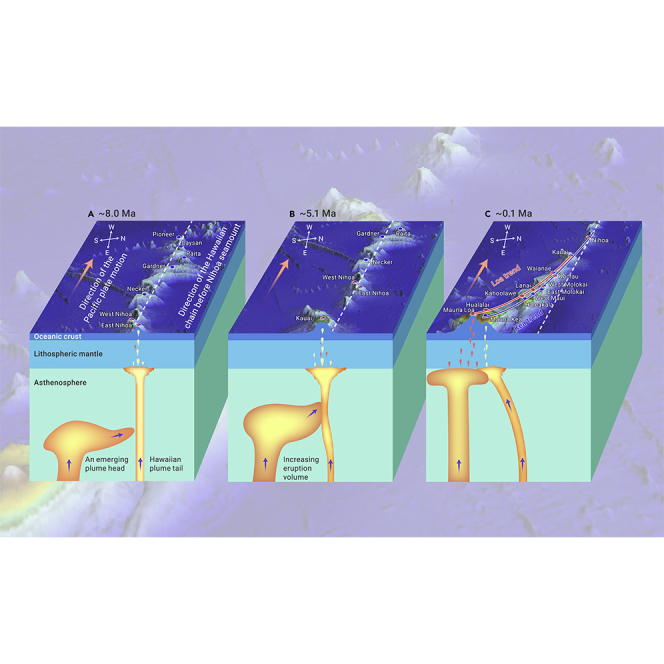
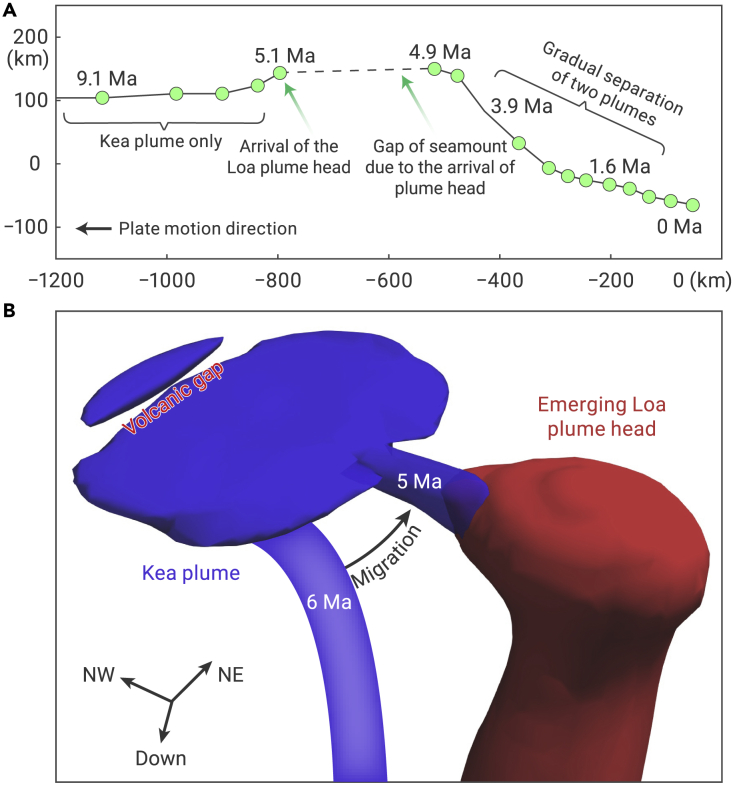
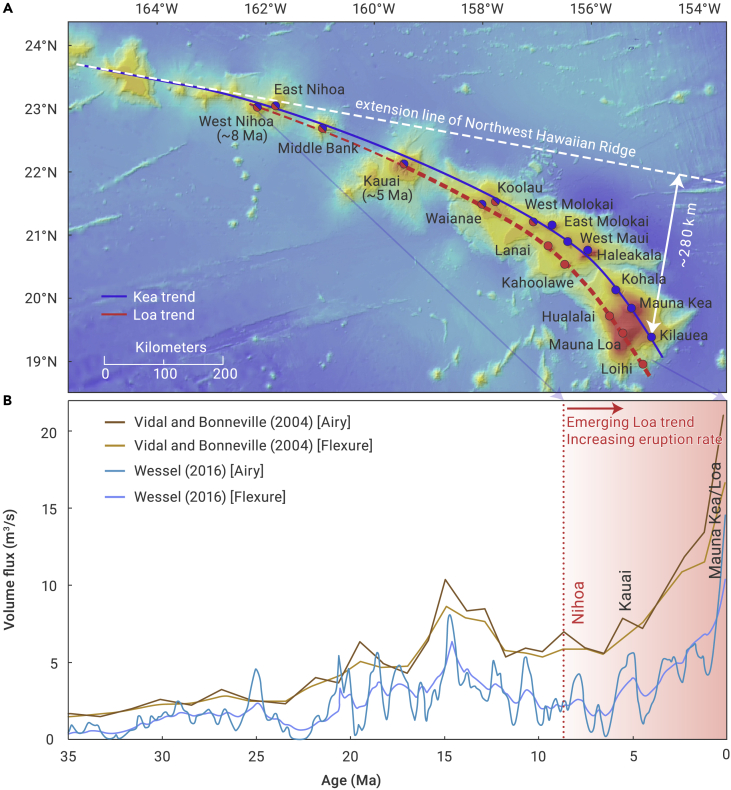
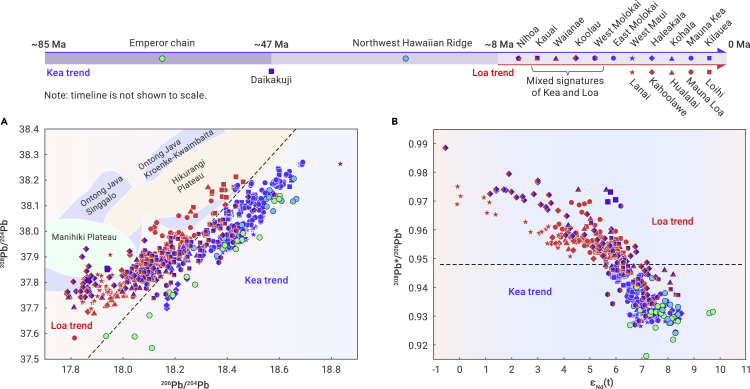
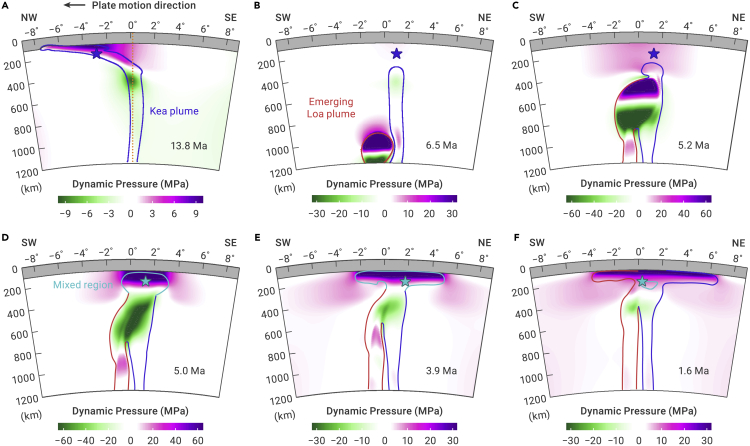
The Hawaiian-Emperor seamount chain has shown two subparallel geographical and geochemical volcanic trends, Loa and Kea, since ∼5 Ma, for which numerous models have been proposed that usually involve a single mantle plume sampling different compositional sources of the deep or shallow mantle. However, both the dramatically increased eruption rate of the Hawaiian hotspot since ∼5 Ma and the nearly simultaneous southward bending of the Hawaiian chain remain unexplained. Here, we propose a plume-plume interaction model where the compositionally depleted Kea trend represents the original Hawaiian plume tail and the relatively enriched Loa trend represents an emerging plume head southeast of the Hawaiian plume tail. Geodynamic modeling further suggests that the interaction between the existing Hawaiian plume tail and the emerging Loa plume head is responsible for the southward bending of the Hawaiian chain. We show that the arrival of the new plume head also dramatically increases the eruption rate along the hotspot track. We suggest that this double-plume scenario may also represent an important mechanism for the formation of other hotspot tracks in the Pacific plate, likely reflecting a dynamic reorganization of the lowermost mantle.
自约500万年前以来,夏威夷-天皇海山链呈现出两个近乎平行的地理和地球化学火山趋势,即洛阿(Loa)和凯阿(Kea),针对这一现象已经提出了众多模型,这些模型通常涉及单个地幔柱从深部或浅部地幔的不同成分源中取样。然而,约500万年前以来夏威夷热点显著增加的喷发速率以及夏威夷海山链几乎同时向南弯曲的现象仍无法得到解释。在此,我们提出一个地幔柱-地幔柱相互作用模型,其中成分亏损的凯阿趋势代表原始的夏威夷地幔柱尾部,而相对富集的洛阿趋势代表在夏威夷地幔柱尾部东南部出现的新地幔柱头。地球动力学模拟进一步表明,现有的夏威夷地幔柱尾部与新出现的洛阿地幔柱头之间的相互作用导致了夏威夷海山链的向南弯曲。我们表明,新地幔柱头的到来也显著增加了沿热点轨迹的喷发速率。我们认为,这种双地幔柱情形可能也是太平洋板块其他热点轨迹形成的一个重要机制,很可能反映了下地幔的动态重组。