Department of Gastrointestinal Surgery, Graduate School of Medicine, The University of Tokyo, Tokyo, Japan.
Departments of Intensive Care Unit.
Int J Surg. 2023 Apr 1;109(4):936-945. doi: 10.1097/JS9.0000000000000269.
Postoperative mortality is an important indicator for evaluating surgical safety. Postoperative mortality is influenced by hospital volume; however, this association is not fully understood. This study aimed to investigate the volume-outcome association between the hospital surgical case volume for gastrectomies per year (hospital volume) and the risk of postoperative mortality in patients undergoing a gastrectomy for gastric cancer.
Studies assessing the association between hospital volume and the postoperative mortality in patients who underwent gastrectomy for gastric cancer were searched for eligibility. Odds ratios were pooled for the highest versus lowest categories of hospital volume using a random-effects model. The volume-outcome association between hospital volume and the risk of postoperative mortality was analyzed. The study protocol was registered with Prospective Register of Systematic Reviews (PROSPERO).
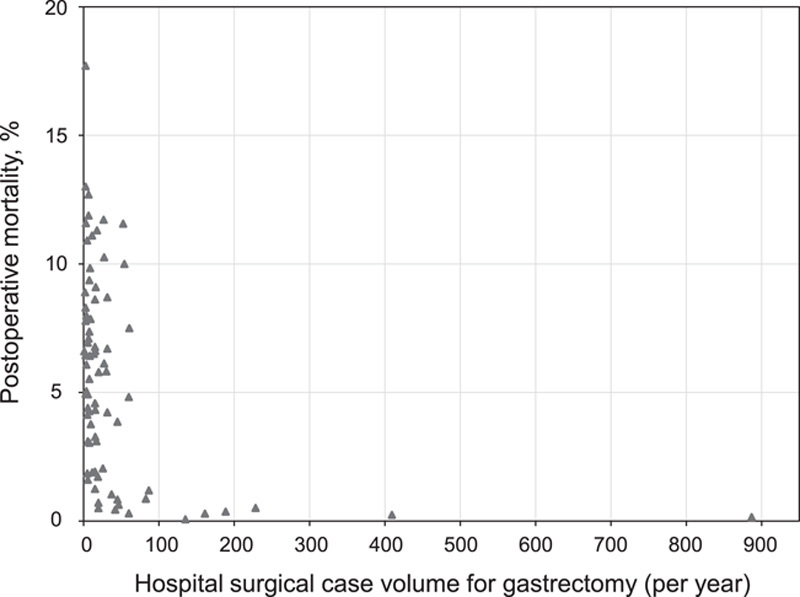
Thirty studies including 586 993 participants were included. The risk of postgastrectomy mortality in patients with gastric cancer was 35% lower in hospitals with higher surgical case volumes than in their lower-volume counterparts (odds ratio: 0.65; 95% CI: 0.56-0.76; P <0.001). This relationship was consistent and robust in most subgroup analyses. Volume-outcome analysis found that the postgastrectomy mortality rate remained stable or was reduced after the hospital volume reached a plateau of 100 gastrectomy cases per year.
The current findings suggest that a higher-volume hospital can reduce the risk of postgastrectomy mortality in patients with gastric cancer, and that greater than or equal to 100 gastrectomies for gastric cancer per year may be defined as a high hospital surgical case volume.
术后死亡率是评估手术安全性的一个重要指标。术后死亡率受医院手术量的影响,但这种关联尚未完全被理解。本研究旨在探讨每年胃切除术手术量(医院手术量)与胃癌患者胃切除术后死亡率风险之间的量效关系。
检索评估医院手术量与胃癌患者胃切除术术后死亡率之间关联的研究,评估其纳入标准。采用随机效应模型对医院手术量最高和最低组别的比值比进行汇总。分析医院手术量与术后死亡率风险之间的量效关系。本研究方案在系统评价前瞻性注册库(PROSPERO)中进行了注册。
共纳入 30 项研究,包含 586993 名参与者。与低手术量医院相比,高手术量医院的胃癌患者胃切除术后死亡风险降低 35%(比值比:0.65;95%可信区间:0.56-0.76;P<0.001)。这一关系在大多数亚组分析中是一致且稳健的。量效分析发现,当医院手术量达到每年 100 例胃切除术的平台后,胃切除术后死亡率保持稳定或降低。
目前的研究结果表明,高手术量医院可以降低胃癌患者胃切除术后的死亡风险,每年进行 100 例以上的胃癌胃切除术可定义为高医院手术量。