Lineberger Comprehensive Cancer Center.
Department of Microbiology and Immunology.
J Clin Invest. 2023 Mar 15;133(6):e167925. doi: 10.1172/JCI167925.
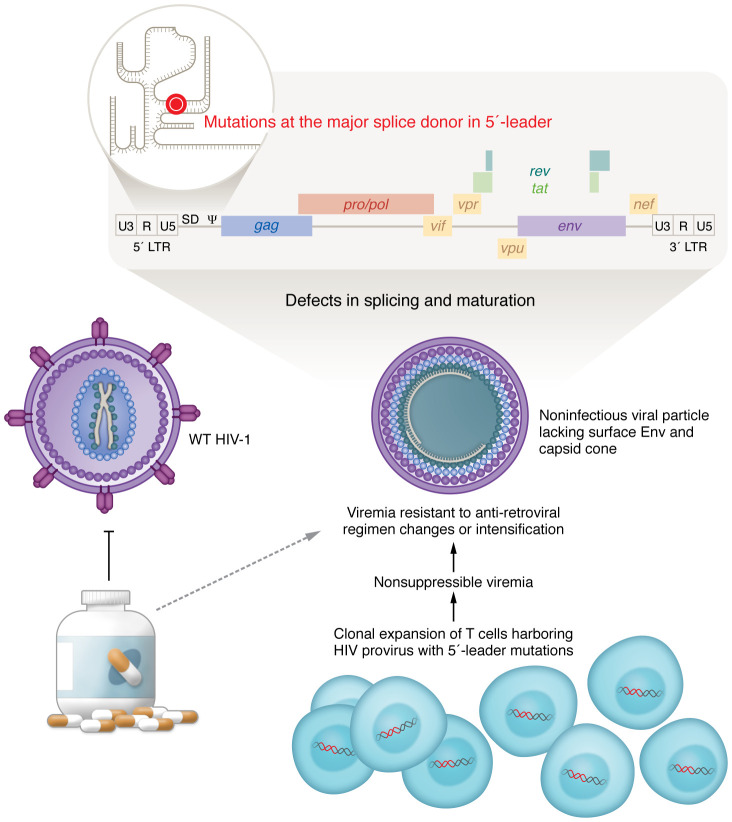
HIV-1 replication can be suppressed with antiretroviral therapy (ART), but individuals who stop taking ART soon become viremic again. Some people experience extended times of detectable viremia despite optimal adherence to ART. In this issue of the JCI, White, Wu, and coauthors elucidate a source of nonsuppressible viremia (NSV) in treatment-adherent patients - clonally expanded T cells harboring HIV-1 proviruses with small deletions or mutations in the 5'-leader, the UTR that includes the major splice donor site of viral RNA. These mutations altered viral RNA-splicing efficiency and RNA dimerization and packaging, yet still allowed production of detectable levels of noninfectious virus particles. These particles lacked the HIV-1 Env surface protein required for cell entry and failed to form the mature capsid cone required for infectivity. These studies improve our understanding of NSV and the regulation of viral functions in the 5'-leader with implications for rationalized care in individuals with NSV.
HIV-1 的复制可以通过抗逆转录病毒疗法 (ART) 来抑制,但是停止服用 ART 的个体很快又会出现病毒血症。尽管有些人对 ART 的依从性很好,但仍会出现可检测到的病毒血症持续时间延长的情况。在本期 JCI 中,White、Wu 及其同事阐明了治疗依从性患者中不可抑制的病毒血症 (NSV) 的一个来源——具有 HIV-1 前病毒小缺失或突变的克隆扩增 T 细胞,这些突变位于 5'-UTR 中,包括病毒 RNA 的主要剪接受体位点。这些突变改变了病毒 RNA 剪接效率和 RNA 二聚体化和包装,但仍允许产生可检测水平的无感染性病毒颗粒。这些颗粒缺乏 HIV-1 Env 表面蛋白,该蛋白是细胞进入所必需的,也不能形成成熟的衣壳锥体,从而导致感染性丧失。这些研究提高了我们对 NSV 以及 5'-UTR 中病毒功能调节的理解,为 NSV 个体的合理化护理提供了依据。