Rassler Samantha, Ramirez Roberto, Khoury Nadeen, Skowron Gail, Sahu Gautam K
HIV Biology and Persistence Laboratory, Division of Infectious Diseases, Roger Williams Medical Center, 825 Chalkstone Ave, Providence, 02908, RI, USA.
Present address: University of Massachusetts-Boston campus, 100 Morrissey Blvd, Boston, 02125, MA, USA.
Virol J. 2016 Sep 21;13(1):157. doi: 10.1186/s12985-016-0617-0.
Cell-free residual HIV-1 virions (RVs) persist in plasma below 20-50 vRNA copies/ml in most patients on suppressive antiretroviral therapy (ART). How RVs are produced in the body during therapy is not fully clear. In this study, we have attempted to characterize these viruses of an ART-treated patient in vitro in order to gain insights into the mechanism of their production in vivo.
We have reconstructed almost the entire genomes of RVs as DNA forms using the patient's residual plasma vRNA by an overlapping RT-nested PCR method, and then sequence-analyzed the cloned genomes and tested them for their biological activities in vitro.
We found that the reconstructed molecular clones of RVs lacked antiretroviral drug-resistant mutations, as well as G-to-A hypermutations. The vDNA clones, when transfected into TZM-bl cells, released HIV-p24 into the culture media at extremely low levels. This low-level virus production was found to be due to the presence of a unique mutation (GU-to-GC) in the conserved 5'-major splice donor (MSD) motif of the corresponding vRNAs. We found that the incorporation of this point mutation by itself could cause defects in the replication of a standard HIV strain (JRCSF) in vitro. However, this novel viral variant was intermittently detected at 5 of 7 time-points in the patient's plasma over a period of 39 months during therapy.
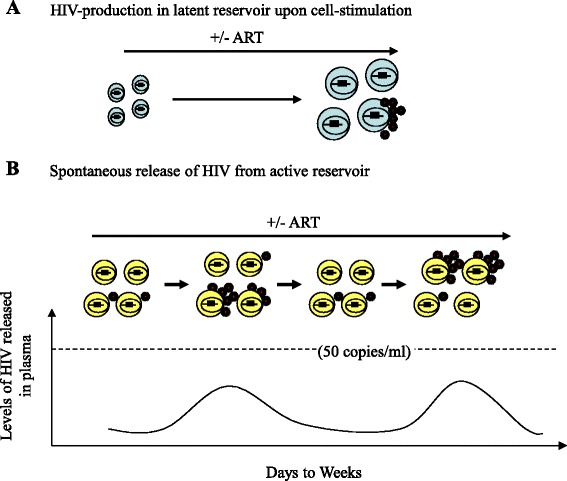
This is the first identification of a natural point mutation (GU-to-GC) in the conserved 5'-MSD motif of HIV genomic RNA. The intermittent but prolonged detection of this replication-defective HIV variant in the patient's plasma among other viral populations strongly suggests that this variant is released from highly stable productively infected cells present in vivo during therapy. The potential implication of this observation is that the elimination of such productively infected cells that contribute to residual viremia during suppressive therapy could be an important first step towards achieving a cure for HIV.
在接受抑制性抗逆转录病毒疗法(ART)的大多数患者中,无细胞残留HIV-1病毒颗粒(RVs)持续存在于血浆中,病毒RNA(vRNA)拷贝数低于20 - 50拷贝/毫升。在治疗期间,RVs在体内是如何产生的尚不完全清楚。在本研究中,我们试图在体外对一名接受ART治疗患者的这些病毒进行特征分析,以便深入了解其在体内的产生机制。
我们使用患者残留血浆vRNA,通过重叠逆转录巢式聚合酶链反应(RT - 巢式PCR)方法将RVs的几乎整个基因组重建为DNA形式,然后对克隆的基因组进行序列分析,并在体外测试它们的生物学活性。
我们发现重建的RVs分子克隆缺乏抗逆转录病毒药物耐药性突变以及G到A的超突变。当将vDNA克隆转染到TZM - bl细胞中时,HIV - p24以极低水平释放到培养基中。发现这种低水平病毒产生是由于相应vRNAs的保守5' - 主要剪接供体(MSD)基序中存在独特突变(GU到GC)。我们发现,单独引入这个点突变会导致标准HIV毒株(JRCSF)在体外复制出现缺陷。然而,在治疗期间的39个月内,在患者血浆的7个时间点中的5个时间点间歇性地检测到了这种新型病毒变体。
这是首次在HIV基因组RNA的保守5' - MSD基序中鉴定出自然点突变(GU到GC)。在患者血浆中,在其他病毒群体中间歇性但长期检测到这种复制缺陷型HIV变体,强烈表明该变体是从治疗期间体内存在的高度稳定的高效感染细胞中释放出来的。这一观察结果的潜在意义在于,消除在抑制性治疗期间导致残留病毒血症的此类高效感染细胞可能是实现治愈HIV的重要第一步。