Department of Medicine, Dartmouth-Hitchcock Medical Center, Lebanon, New Hampshire.
Space Medicine Innovations Laboratory, Geisel School of Medicine at Dartmouth, Hanover, New Hampshire.
JAMA Netw Open. 2023 Mar 1;6(3):e233061. doi: 10.1001/jamanetworkopen.2023.3061.
Despite normal audiometry, adults living with HIV have lower distortion product otoacoustic emissions (DPOAEs) compared with HIV-negative controls, but the degree of these differences in children living with HIV is unknown. If subclinical auditory deficits are present, results could affect developmental outcomes in children living with HIV (CLWH).
To compare DPOAEs and auditory brainstem responses (ABR) between 2 age- and sex-matched groups of younger children with normal audiometry, 1 infected with HIV and the other uninfected.
DESIGN, SETTING, AND PARTICIPANTS: Cohort study in an infectious disease center in Dar es Salaam, Tanzania. Participants included 340 Tanzanian children aged 3 to 9 years with clinically normal hearing, type A tympanograms bilaterally, and air-conduction thresholds of 20 dB HL or less from 0.5 to 8 kHz. Participants in the cohort repeated testing approximately every 6 months (approximately 2.2 sessions per participant) for a total of 744 total observations. Data were analyzed from March 2020 to January 2022.
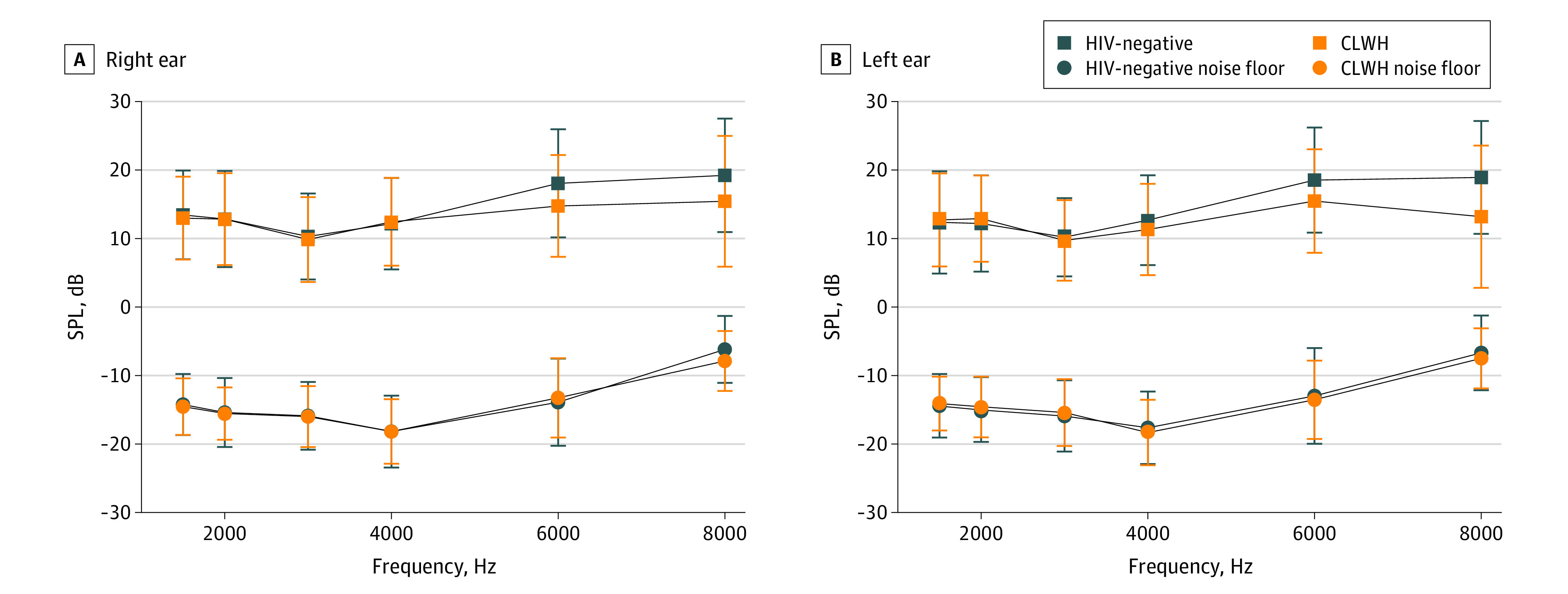
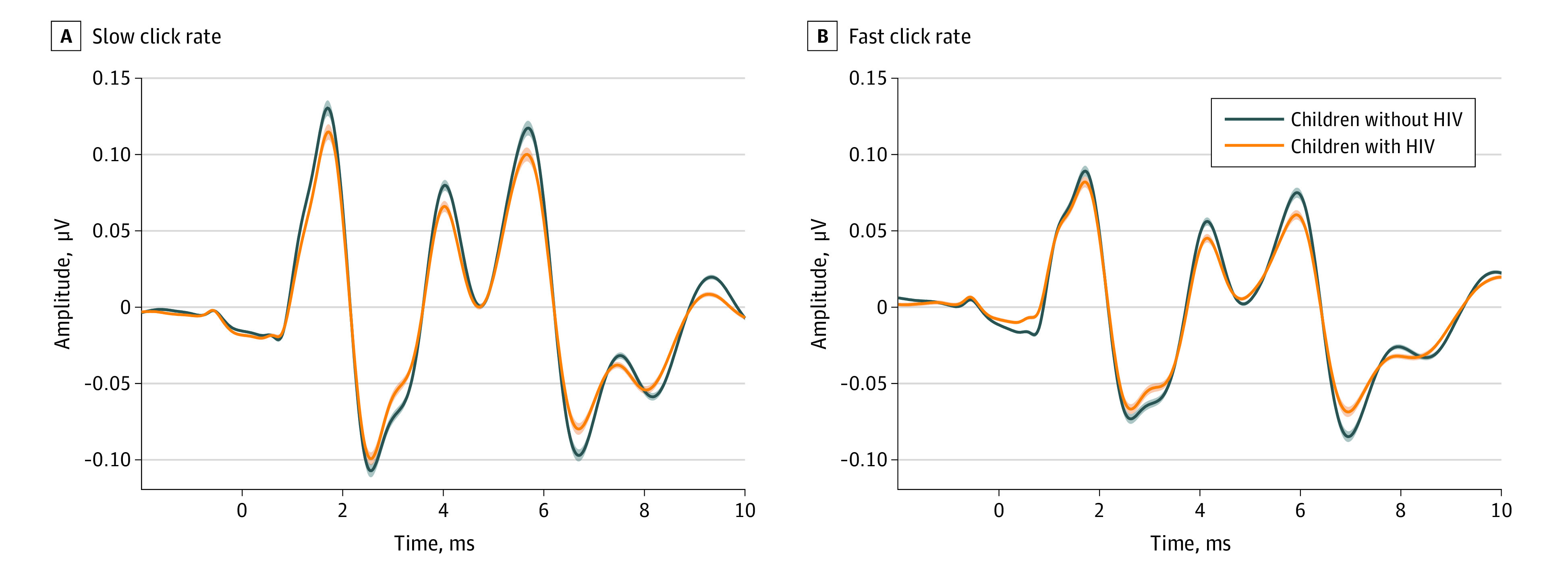
DPOAE amplitudes from 1.5 to 8 kHz using an f2 to f1 ratio of 1.2 and L1/L2 values of 65/55 dB sound pressure level and click-evoked ABR using a slow (21.1/s) and fast (61.1/s) click rate.
A total of 141 CLWH (70 female participants [49.3%]; mean [SD] age, 7.24 [1.67] years) and 199 HIV-negative individuals (99 female participants [49.7%]; mean [SD] age, 7.26 [1.44] years) participated in the study. The groups did not differ significantly in age, static immittance, or air-conduction thresholds. HIV status was independently associated with approximately 1.4 dB (95% CI, -3.28 to 0.30 dB) to 3.8 dB (95% CI, 6.03 to -1.99 dB) lower DPOAE amplitudes at 6 and 8 kHz bilaterally and 0.28 μV (95% CI, 0.01 to 0.33 μV) lower ABR wave V amplitudes in the right ear.
Consistent with previous findings in young adults, CLWH had slightly, but reliably, lower DPOAEs and ABR wave V amplitudes than HIV-negative controls. The magnitude of these differences was small, but results suggest an early and consistent association between HIV infection or treatment and outer hair cell and auditory brainstem responses in children as young as 3 years. These subclinical changes suggest tracking both auditory function and development outcomes in CLWH is warranted.
尽管听力测试正常,与 HIV 阴性对照相比,HIV 感染者的畸变产物耳声发射(DPOAE)水平较低,但尚不清楚儿童 HIV 感染者的差异程度。如果存在亚临床听力缺陷,结果可能会影响 HIV 感染者(CLWH)儿童的发育结局。
比较两组年龄和性别匹配的听力正常的年幼儿童的 DPOAE 和听性脑干反应(ABR),一组感染 HIV,另一组未感染。
设计、地点和参与者:这是在坦桑尼亚达累斯萨拉姆的一个传染病中心进行的队列研究。参与者包括 340 名坦桑尼亚儿童,年龄在 3 至 9 岁之间,双侧鼓室图为 A 型,0.5 至 8 kHz 之间的空气传导阈值为 20 dB HL 或更低。队列中的参与者每 6 个月左右重复测试一次(每个参与者约 2.2 次),共进行了 744 次总观察。数据于 2020 年 3 月至 2022 年 1 月进行分析。
使用 f2 到 f1 的比值为 1.2,L1/L2 值为 65/55 dB 声压级的 1.5 至 8 kHz 的 DPOAE 幅度,以及使用慢(21.1/s)和快(61.1/s) click 率的 click-evoked ABR。
共有 141 名 CLWH(70 名女性参与者[49.3%];平均[标准差]年龄,7.24[1.67]岁)和 199 名 HIV 阴性个体(99 名女性参与者[49.7%];平均[标准差]年龄,7.26[1.44]岁)参加了研究。两组在年龄、静态传入性和空气传导阈值方面无显著差异。HIV 状态与双侧 6 和 8 kHz 的 DPOAE 幅度平均降低 1.4 dB(95%CI,-3.28 至 0.30 dB)至 3.8 dB(95%CI,6.03 至-1.99 dB),右耳 ABR 波 V 幅度降低 0.28 μV(95%CI,0.01 至 0.33 μV)有关。
与之前在年轻成年人中的发现一致,CLWH 的 DPOAE 和 ABR 波 V 幅度比 HIV 阴性对照略低,但具有统计学意义。这些差异的幅度很小,但结果表明,HIV 感染或治疗与儿童的外毛细胞和听觉脑干反应之间存在早期且一致的关联,儿童年龄低至 3 岁。这些亚临床变化表明,有必要对 CLWH 进行听觉功能和发育结局的跟踪监测。