Centre d'Estudis Superiors de l'Aviació (CESDA), Reus, Catalonia, Spain.
ARGET Research Group, Faculty of Education Sciences and Psychology, Universitat Rovira i Virgili, Tarragona, Catalonia, Spain.
PLoS One. 2023 Mar 15;18(3):e0280604. doi: 10.1371/journal.pone.0280604. eCollection 2023.
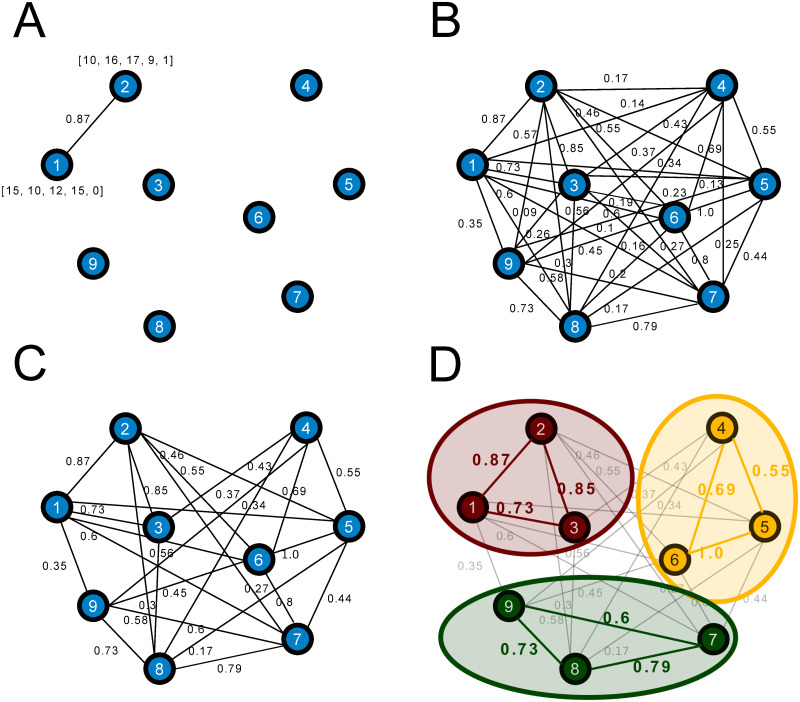
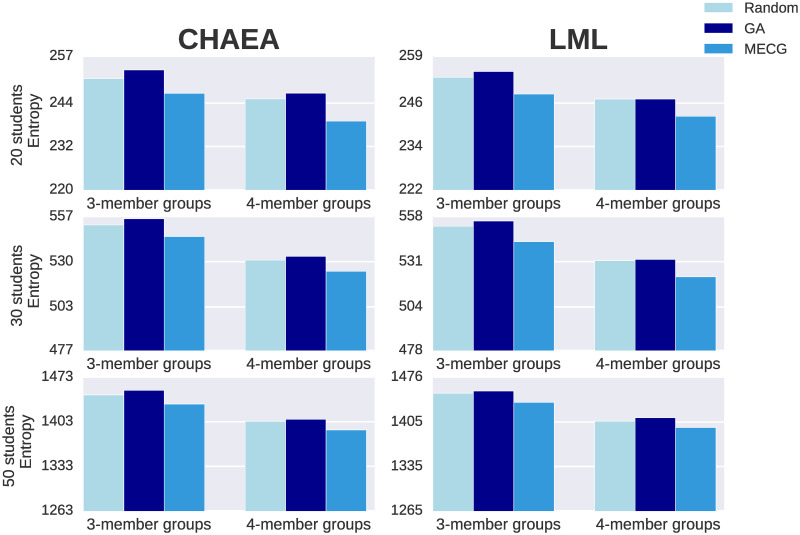
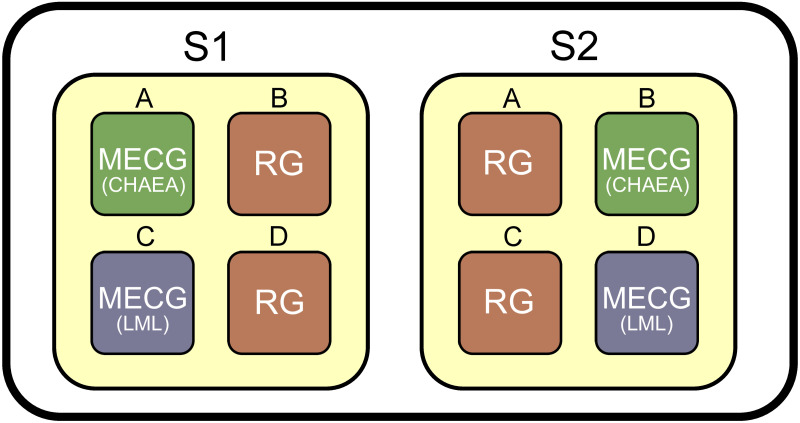
For some decades now, theories on learning methodologies have advocated collaborative learning due to its good results in terms of effectiveness and learning types and its promotion of educational and social values. This means that teachers need to be able to apply different criteria when forming heterogeneous groups of students and to use automated techniques to assist them. In this study, we have created an approach based on complex network theory to design an algorithm called Minimum Entropy Collaborative Groupings (MECG) in order to form these heterogeneous groups more effectively. The algorithm was tested firstly under a synthetic framework and secondly in a real situation. In the first case, we generated 30 synthetic classrooms of different sizes and compared our approach with a genetic algorithm and a random grouping. In the latter case, the approach was tested on a group of 200 students on two subjects of a master's degree in teacher training. For each subject there were 4 large groups of 50 students each, in which collaborative groups of 4 students were created. Two of these large groups were used as random groups, another group used the CHAEA test and the fourth group used the LML test. The results showed that the groups created with MECG were more effective, had less uncertainty and were more interrelated and mature. It was observed that the randomized groups did not obtain significantly better LML results and that this cannot be related to any emotional or motivational effect because the students performed the test as a placebo measure. In terms of learning styles, the results were significantly better with LML than with CHAEA, whereas no significant difference was observed in the randomized groups.
几十年来,学习方法理论一直提倡协作学习,因为它在效果和学习类型方面有很好的效果,并且促进了教育和社会价值。这意味着教师需要能够在形成异质学生群体时应用不同的标准,并使用自动化技术来辅助他们。在这项研究中,我们基于复杂网络理论创建了一种方法,设计了一种称为最小熵协作分组(MECG)的算法,以便更有效地形成这些异质群体。该算法首先在合成框架下进行测试,然后在实际情况下进行测试。在第一种情况下,我们生成了 30 个不同大小的合成教室,并将我们的方法与遗传算法和随机分组进行了比较。在第二种情况下,该方法在一个 200 名学生的硕士研究生培训课程的两个科目中进行了测试。对于每个科目,有 4 个 50 名学生的大组,在其中创建了 4 名学生的协作组。其中两个大组作为随机组,另一个组使用 CHAEA 测试,第四个组使用 LML 测试。结果表明,使用 MECG 创建的小组更有效,不确定性更小,相互关联更紧密,更成熟。观察到随机分组并没有获得明显更好的 LML 结果,并且这不能与任何情感或动机效果相关联,因为学生将测试作为安慰剂措施进行。在学习风格方面,LML 的结果明显优于 CHAEA,而随机分组则没有明显差异。