Department of Education and Psychology, Clinical Psychology and Psychotherapy, Freie Universität Berlin, Berlin, Germany.
Department of Clinical Psychology and Neuropsychology, Institute of Psychology, Johannes Gutenberg-University Mainz, Mainz, Germany.
PLoS One. 2023 Mar 15;18(3):e0281387. doi: 10.1371/journal.pone.0281387. eCollection 2023.
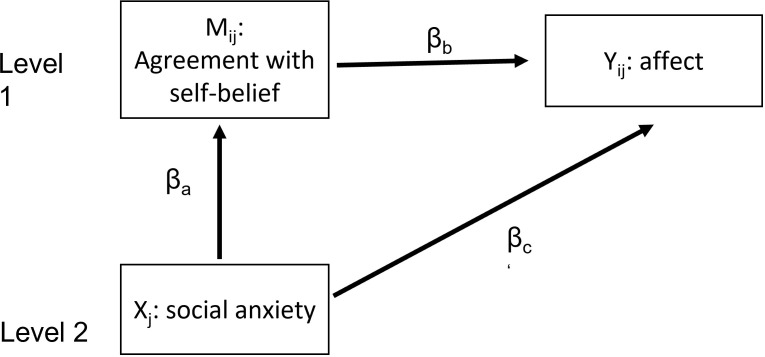
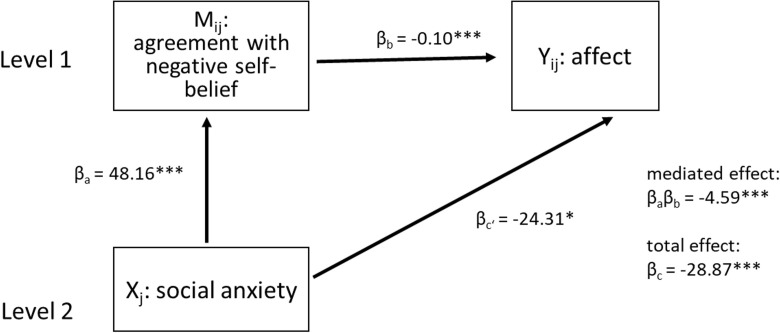
Current cognitive models of social anxiety disorder (SAD) propose that individual, situation-specific self-beliefs are central to SAD. However, the role of differences in the degree to which individuals with social anxiety are convinced of self-beliefs, in particular positive ones, is still not fully understood. We compared how much high and low socially anxious individuals agree with their own negative and positive self-beliefs. Furthermore, we investigated whether agreeing with one's self-belief can explain the relation between negative affect in response to self-beliefs and social anxiety. Specifically, we were interested whether social anxiety increases negative affect in response to self-beliefs through an increase in agreement.
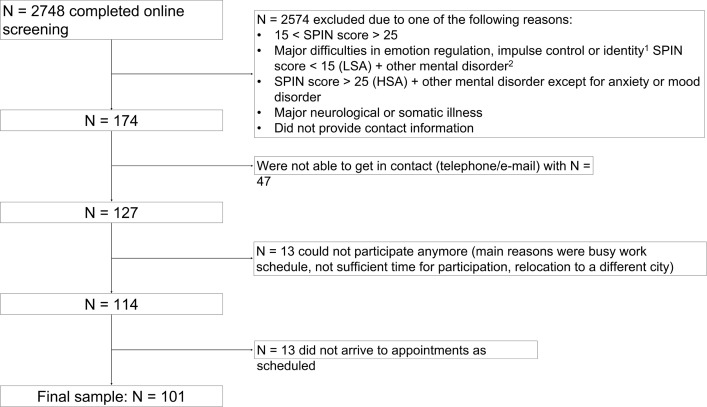
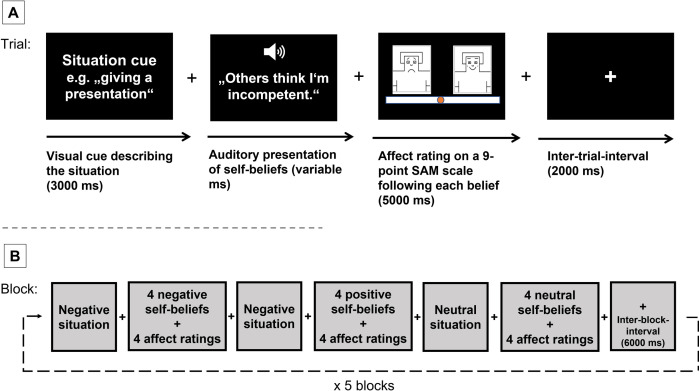
We developed a new experimental self-belief task containing positive and negative semi-idiosyncratic, situation specific self-beliefs typical of high social anxiety and included a direct measure of agreement with these beliefs. Using extreme group sampling, we a-priori selected high (n = 51) and low (n = 50) socially anxious individuals. By multi-level mediation analysis, we analyzed agreement with self-beliefs in both groups and its association with affect.
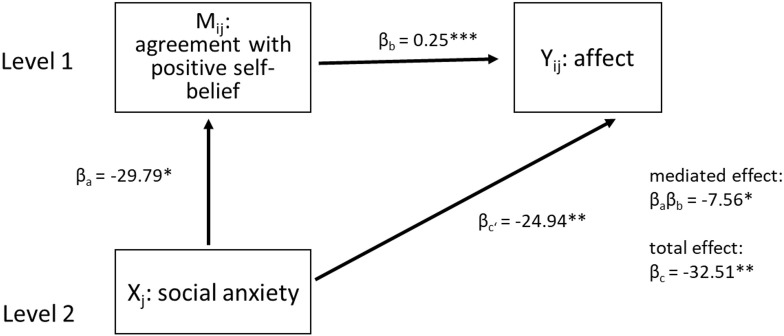
High and low socially anxious individuals chose similar self-beliefs. However, high socially anxious individuals (HSA) agreed more with negative self-beliefs and less with positive self-beliefs compared to low socially anxious individuals (LSA). HSA individuals reported increased negative affect after both, exposition to negative and positive self-beliefs compared to LSA. We found that social anxiety increases affective responses towards negative-self beliefs through an increase in agreeing with these self-beliefs.
These findings suggest that cognitive models of social anxiety can be improved by including not only the content of a self-belief but also the strength of such a belief. In addition, they emphasize the relevance of positive self-beliefs in social anxiety, which has frequently been overlooked.
当前社交焦虑障碍(SAD)的认知模型提出,个体的、特定情境的自我信念是 SAD 的核心。然而,个体对社交焦虑相关自我信念,特别是积极自我信念的置信程度的差异的作用仍不完全清楚。我们比较了高社交焦虑和低社交焦虑个体对其消极和积极自我信念的认同程度。此外,我们还研究了对自我信念的认同是否可以解释对自我信念的消极影响与社交焦虑之间的关系。具体来说,我们感兴趣的是社交焦虑是否通过对自我信念的认同度的增加来增加对自我信念的消极影响。
我们开发了一种新的实验性自我信念任务,其中包含高社交焦虑症患者特有的积极和消极的、半特质的、特定情境的自我信念,并包括对这些信念的直接认同度的测量。通过极端分组抽样,我们先验地选择了高社交焦虑组(n=51)和低社交焦虑组(n=50)。通过多层次中介分析,我们分析了两组对自我信念的认同度及其与情感的关系。
高社交焦虑和低社交焦虑个体选择了相似的自我信念。然而,高社交焦虑个体(HSA)对消极自我信念的认同度更高,对积极自我信念的认同度更低,与低社交焦虑个体(LSA)相比。与 LSA 相比,HSA 个体在暴露于消极和积极自我信念后报告了更多的消极情绪。我们发现,社交焦虑通过增加对这些自我信念的认同度,增加了对消极自我信念的情感反应。
这些发现表明,社交焦虑的认知模型可以通过包括自我信念的内容和信念的强度来得到改进。此外,它们强调了积极自我信念在社交焦虑中的相关性,这一点经常被忽视。