CORAL, Indian Institute of Technology Kharagpur, Kharagpur, West Bengal, 721302, India.
Indian National Centre for Ocean Information Services, Ministry of Earth Sciences, Hyderabad, India.
Sci Rep. 2023 Mar 15;13(1):4314. doi: 10.1038/s41598-023-31468-0.
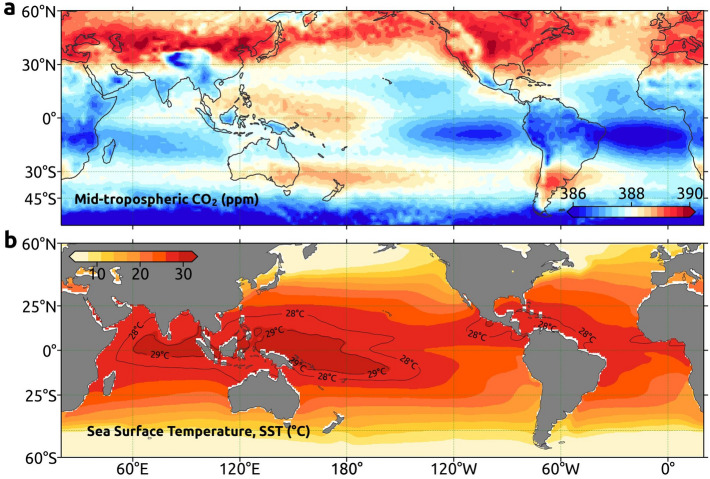
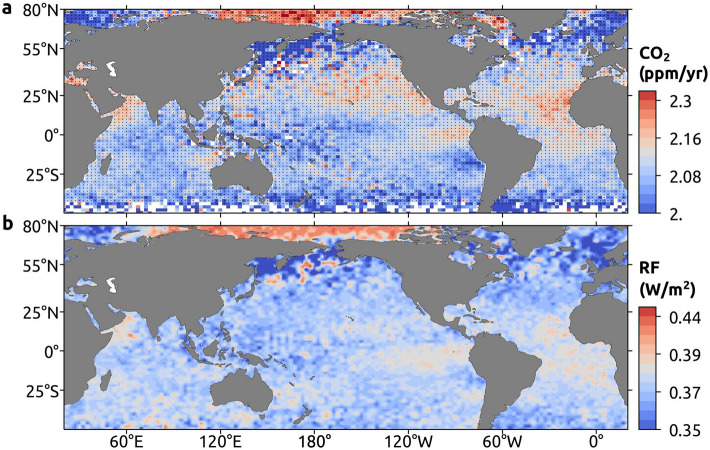
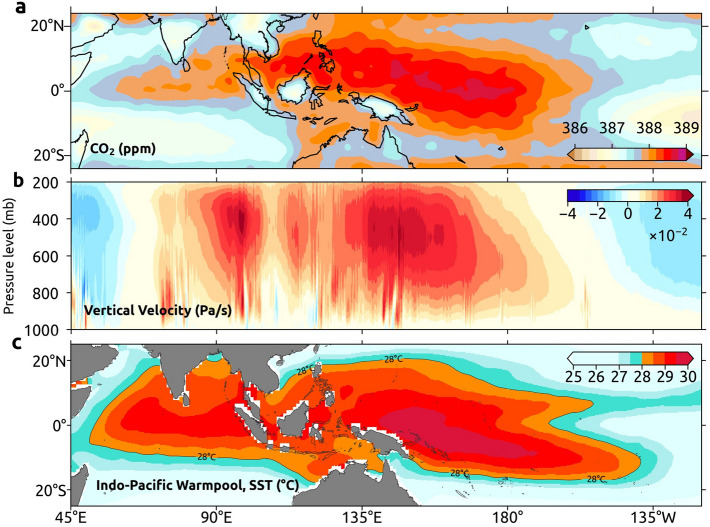
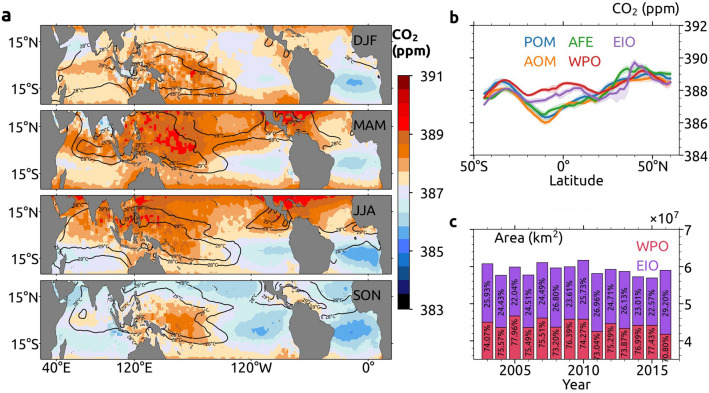
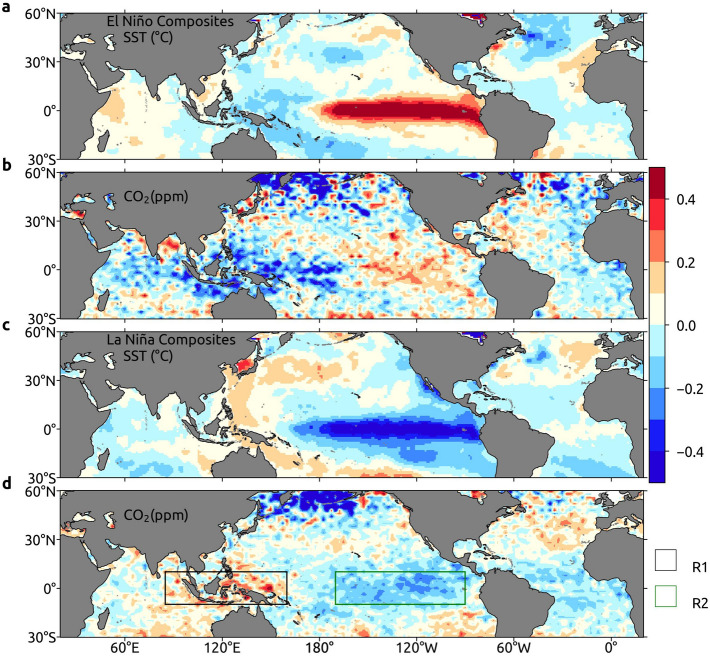
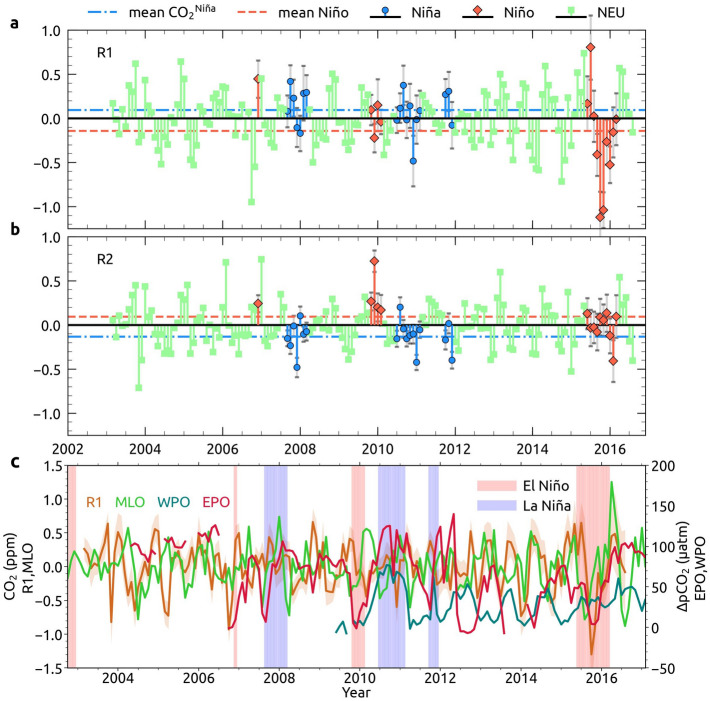
Anthropogenic emissions have produced significant amount of carbon dioxide (CO) in the atmosphere since the beginning of the industrial revolution. High levels of atmospheric CO increases global temperature as CO absorbs outgoing longwave radiation and re-emits. Though a well-mixed greenhouse gas, CO concentration is not uniform in the atmosphere across different altitudes and latitudes. Here, we uncover a region of high CO concentration (i.e. CO pool) in the middle troposphere (500-300 hPa) over the Indo-Pacific Warm Pool (IPWP, 40° E-140° W, 25° S-25° N), in which the CO concentration is higher than that of other regions in the same latitude band (20° N-20° S), by using CO satellite measurements for the period 2002-2017. This CO pool extends from the western Pacific to the eastern Indian Ocean. Much of the CO pool is over the western Pacific Ocean (74.87%), and the remaining lies over the eastern Indian Ocean (25.13%). The rising branch of Walker circulation acts as a "CO Chimney" that constantly transports CO released from the natural, human-induced and ocean outgassing processes to the middle and upper troposphere. The CO pool evolves throughout the year with an average annual trend of about 2.17 ppm yr, as estimated for the period 2003-2016. Our analysis further reveals that La Niña (El Niño) events strengthen (weaken) the CO pool in the mid-troposphere. The radiative forcing for the CO pool suggests more warming in the region and is a grave concern for global warming and climate change.
自工业革命以来,人为排放已经在大气中产生了大量的二氧化碳(CO)。大气中 CO 含量的增加会导致全球气温升高,因为 CO 会吸收长波辐射并重新发射。尽管 CO 是一种混合均匀的温室气体,但它在不同的海拔和纬度的大气中浓度并不均匀。在这里,我们在中对流层(500-300 hPa)发现了一个高 CO 浓度区域(即 CO 汇),该区域位于印度-太平洋暖池(IPWP,40°E-140°W,25°S-25°N)上空,其 CO 浓度高于同纬度带(20°N-20°S)的其他地区,这是通过使用 CO 卫星测量在 2002-2017 年期间得出的。这个 CO 汇从西太平洋延伸到东印度洋。大部分 CO 汇位于西太平洋(74.87%),其余部分位于东印度洋(25.13%)。沃克环流的上升支充当了一个“CO 烟囱”,不断地将自然、人为和海洋排放过程中释放的 CO 输送到中高层大气。CO 汇在整个一年中演变,如 2003-2016 年期间的平均年趋势约为 2.17 ppm yr。我们的分析进一步表明,拉尼娜(厄尔尼诺)事件会加强(减弱)中对流层的 CO 汇。CO 汇的辐射强迫表明该地区有更多的变暖,这是对全球变暖与气候变化的严重关切。