Sawatraksa Nateetip, Banterng Poramate, Jogloy Sanun, Vorasoot Nimitr, Hoogenboom Gerrit
Department of Agronomy, Faculty of Agriculture, Khon Kaen University, Khon Kaen, 40002, Thailand.
Faculty of Science and Agricultural Technology, Rajamangala University of Technology Lanna Lampang, Lampang, 52000, Thailand.
Heliyon. 2023 Feb 28;9(3):e14201. doi: 10.1016/j.heliyon.2023.e14201. eCollection 2023 Mar.
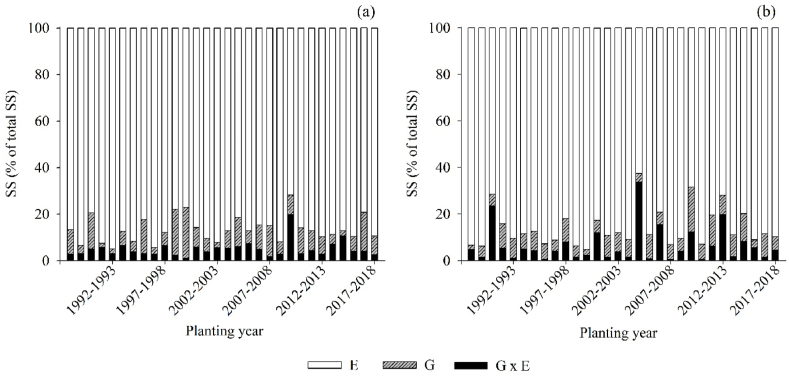
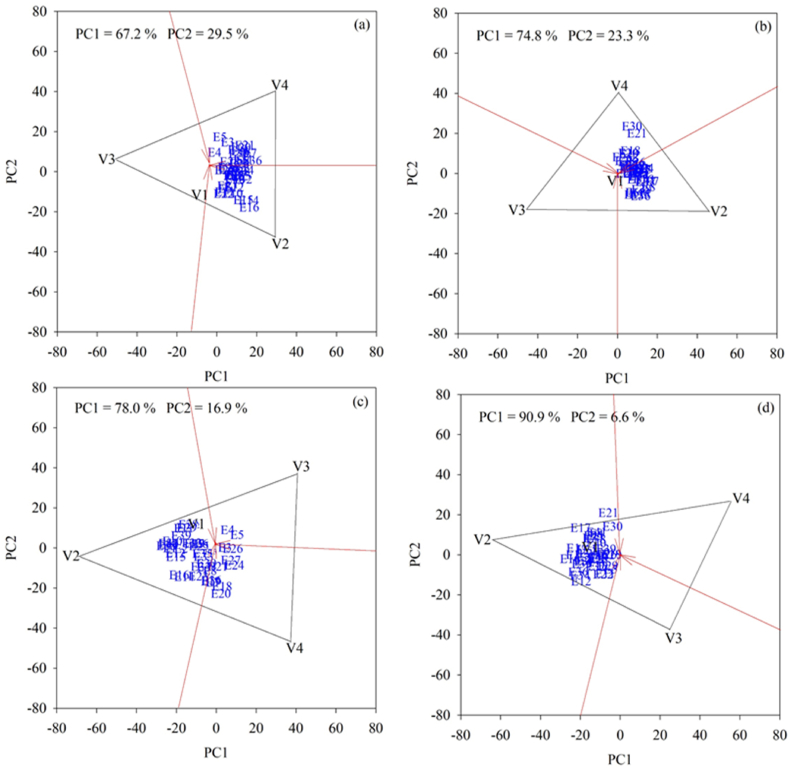
The Cropping System Model (CSM)-MANIHOT-Cassava provides the opportunity to determine target environments for cassava ( Crantz) yield trials by simulating growth and yield data for various environments. The aim of this research was to investigate whether cassava production on paddy fields in Northeast, Thailand could be grouped into mega-environments using the model. Simulations for four different cassava genotypes grown on paddy field following rice harvest was conducted for various soil types and the weather data from 1988 to 2017. The genotype main effect plus genotype by environment interaction (GGE biplot) technique was used to group the mega-environments. The analyses of yearly data showed inconsistent results across years for environment grouping and for the winning genotypes of the individual environment group. An analysis using GGE biplot with the average value of the simulated storage root dry weight (SDW) for 30 years indicated that all 41 environments were grouped into two different mega-environments. This study demonstrated the ability of the CSM-MANIHOT-Cassava to help identify the mega-environments for cassava yield trials on paddy field during off-season of rice that could help reduce both time and resources.
作物种植系统模型(CSM)-木薯-木薯提供了一个机会,通过模拟各种环境下的生长和产量数据来确定木薯(Crantz)产量试验的目标环境。本研究的目的是调查使用该模型能否将泰国东北部稻田的木薯生产归为大环境。针对水稻收获后在稻田种植的四种不同木薯基因型,结合不同土壤类型以及1988年至2017年的气象数据进行了模拟。采用基因型主效应加基因型与环境互作(GGE双标图)技术对大环境进行分组。年度数据分析表明,在环境分组以及各个环境组的优势基因型方面,多年来结果不一致。使用GGE双标图对30年模拟贮藏根干重(SDW)的平均值进行分析表明,所有41个环境被归为两个不同的大环境。本研究证明了CSM-木薯-木薯模型能够帮助识别水稻淡季稻田木薯产量试验的大环境,这有助于减少时间和资源。