Guo Junwei, Xiao Yi
Department of Respiratory and Critical Care Medicine, Peking Union Medical College Hospital, Chinese Academy of Medical Sciences & Peking Union Medical College, Beijing, People's Republic of China.
Nat Sci Sleep. 2023 Mar 9;15:69-77. doi: 10.2147/NSS.S400048. eCollection 2023.
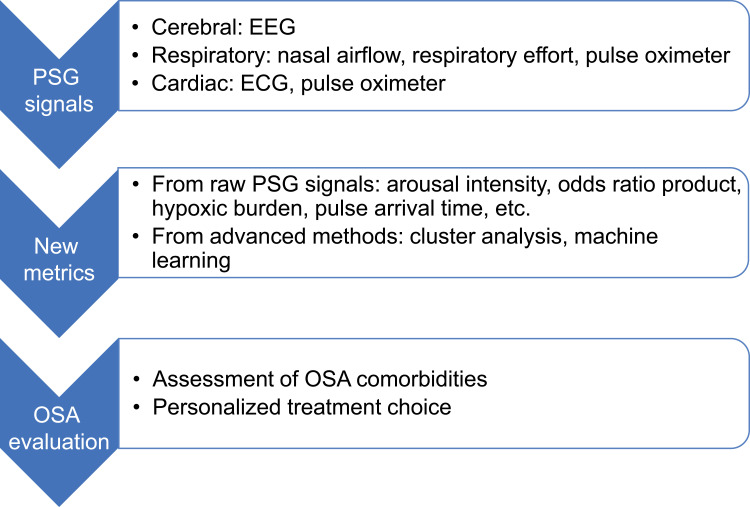
Obstructive sleep apnea (OSA) is a highly preventable disease accompanied by multiple comorbid conditions. Despite the well-established cardiovascular and neurocognitive sequelae with OSA, the optimal metric for assessing the OSA severity and response to therapy remains controversial. Although overnight polysomnography (PSG) is the golden standard for OSA diagnosis, the abundant information is not fully exploited. With the development of deep learning and the era of big data, new metrics derived from PSG have been validated in some OSA consequences and personalized treatment. In this review, these metrics are introduced based on the pathophysiological mechanisms of OSA and new technologies. Emphasis is laid on the advantages and the prognostic value against apnea-hypopnea index. New classification criteria should be established based on these metrics and other clinical characters for precision medicine.
阻塞性睡眠呼吸暂停(OSA)是一种高度可预防的疾病,伴有多种合并症。尽管OSA与心血管和神经认知后遗症之间的关系已得到充分证实,但评估OSA严重程度和治疗反应的最佳指标仍存在争议。虽然夜间多导睡眠图(PSG)是OSA诊断的金标准,但其中丰富的信息并未得到充分利用。随着深度学习的发展和大数据时代的到来,从PSG中衍生出的新指标已在一些OSA后果和个性化治疗中得到验证。在这篇综述中,这些指标是基于OSA的病理生理机制和新技术引入的。重点介绍了这些指标相对于呼吸暂停低通气指数的优势和预后价值。应基于这些指标和其他临床特征建立新的分类标准,以实现精准医疗。