Ramos-Loyo Julieta, Olguín-Rodríguez Paola V, Espinosa-Denenea Sara E, Llamas-Alonso Luis A, Rivera-Tello Sergio, Müller Markus F
Instituto de Neurociencias, Universidad de Guadalajara, Guadalajara, Jalisco, México.
Instituto de Ciencias Nucleares, Universidad Nacional Autónoma de México, Ciudad de México, México.
Front Netw Physiol. 2022 Oct 13;2:890906. doi: 10.3389/fnetp.2022.890906. eCollection 2022.
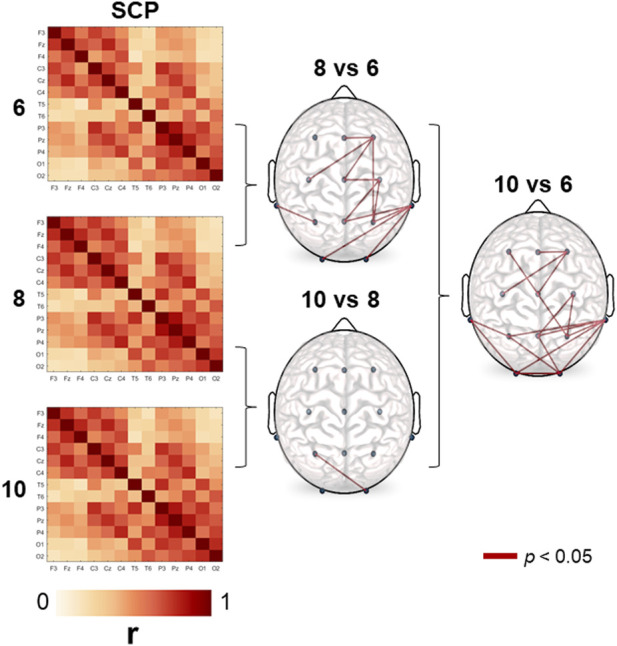
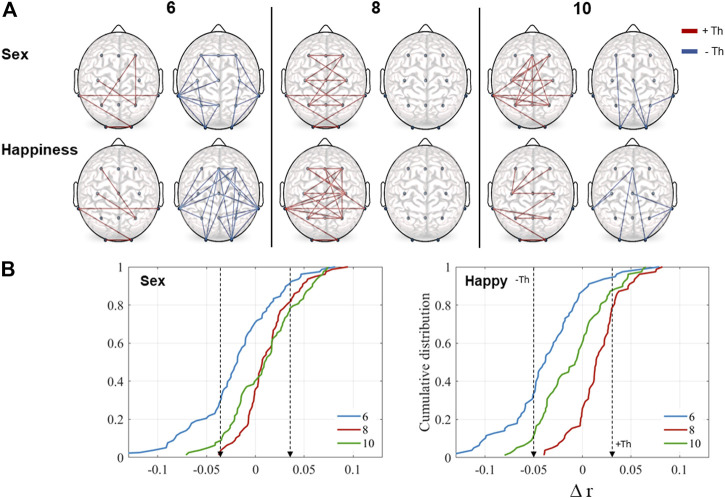
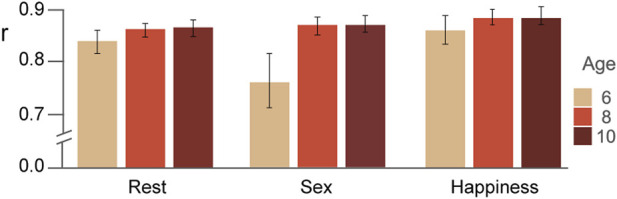
Studying functional connectivity may generate clues to the maturational changes that occur in children, expressed by the dynamical organization of the functional network assessed by electroencephalographic recordings (EEG). In the present study, we compared the EEG functional connectivity pattern estimated by linear cross-correlations of the electrical brain activity of three groups of children (6, 8, and 10 years of age) while performing tasks containing facial stimuli that are chosen considering their importance in socioemotional contexts in everyday life. On the first task, the children were asked to identify the sex of faces, on the second, the instruction was to identify the happy expressions of the faces. We estimated the stable correlation pattern (SCP) by the average cross-correlation matrix obtained separately for the resting state and the task conditions and quantified the similarity of these average matrices comparing the different conditions. The accuracy improved with higher age. Although the topology of the SCPs showed high similarity across all ages, the two older groups showed a higher correlation between regions associated with the attentional and face processing networks compared to the youngest group. Only in the youngest group, the similarity metric decreased during the sex condition. In general, correlation values strengthened with age and during task performance compared to rest. Our findings indicate that there is a spatially extended stable brain network organization in children like that reported in adults. Lower similarity scores between several regions in the youngest children might indicate a lesser ability to cope with tasks. The brain regions associated with the attention and face networks presented higher synchronization across regions with increasing age, modulated by task demands.
研究功能连接性可能会为儿童身上发生的成熟变化提供线索,这些变化通过脑电图记录(EEG)评估的功能网络的动态组织来体现。在本研究中,我们比较了三组儿童(6岁、8岁和10岁)在执行包含面部刺激的任务时,通过脑电活动的线性互相关估计的EEG功能连接模式,这些面部刺激是根据它们在日常生活社会情感背景中的重要性来选择的。在第一个任务中,要求儿童识别面孔的性别,在第二个任务中,指令是识别面孔的快乐表情。我们通过分别针对静息状态和任务条件获得的平均互相关矩阵估计稳定相关模式(SCP),并通过比较不同条件下这些平均矩阵来量化它们的相似性。准确性随着年龄增长而提高。尽管SCP的拓扑结构在所有年龄段都显示出高度相似性,但与最年幼的组相比,两个年龄较大的组在与注意力和面部处理网络相关的区域之间显示出更高的相关性。仅在最年幼的组中,在性别任务条件下相似性度量降低。总体而言,与静息状态相比,相关性值在年龄增长和任务执行期间增强。我们的研究结果表明,儿童中存在一种空间扩展的稳定脑网络组织,类似于在成人中报道的那样。最年幼儿童的几个区域之间较低的相似性得分可能表明应对任务的能力较弱。与注意力和面部网络相关的脑区随着年龄增长在区域间呈现出更高的同步性,并受到任务需求的调节。