Willegaignon José, Fernandes Samantha Cristina Pereira, Pelissoni Rogério Alexandre, Coura-Filho George Barbério, Sapienza Marcelo Tatit, Buchpiguel Carlos Alberto
Instituto do Câncer do Estado de São Paulo (Icesp), Hospital das Clínicas da Faculdade de Medicina da Universidade de São Paulo (HC-FMUSP), São Paulo, SP, Brazil.
Departamento de Radiologia, Faculdade de Medicina da Universidade de São Paulo (FMUSP), São Paulo, SP, Brazil.
Radiol Bras. 2023 Jan-Feb;56(1):13-20. doi: 10.1590/0100-3984.2022.0064.
To measure the potential radiation dose emitted by patients who have recently undergone diagnostic nuclear medicine procedures, in order to establish optimal radiation safety measures for such procedures.
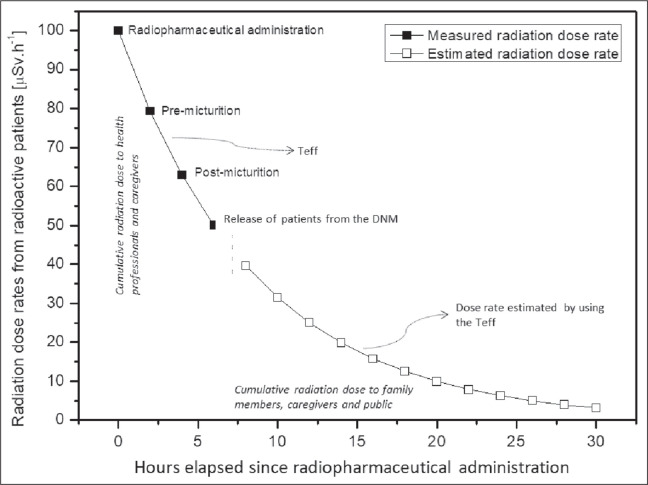
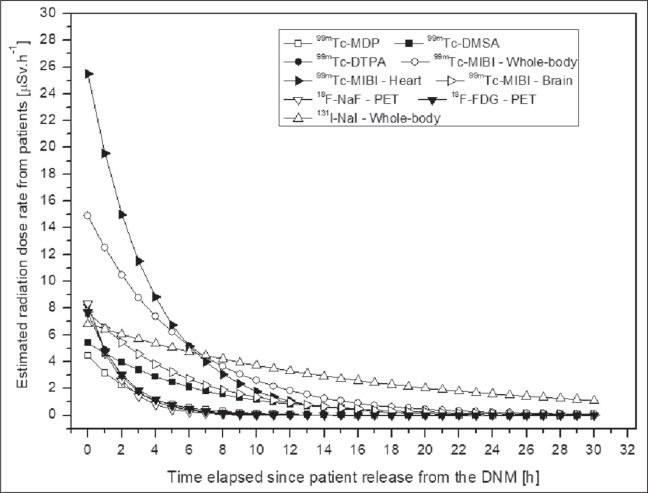
We evaluated the radiation doses emitted by 175 adult patients in whom technetium-99m, iodine-131, and fluorine-18 radionuclides were administered for bone, kidney, heart, brain, and whole-body scans, as measured with a radiation detector. Those values served as the basis for evaluating whole-body radiopharmaceutical clearance, as well as the risk for the exposure of others to radiation, depending on the time elapsed since administration of the radiopharmaceutical.
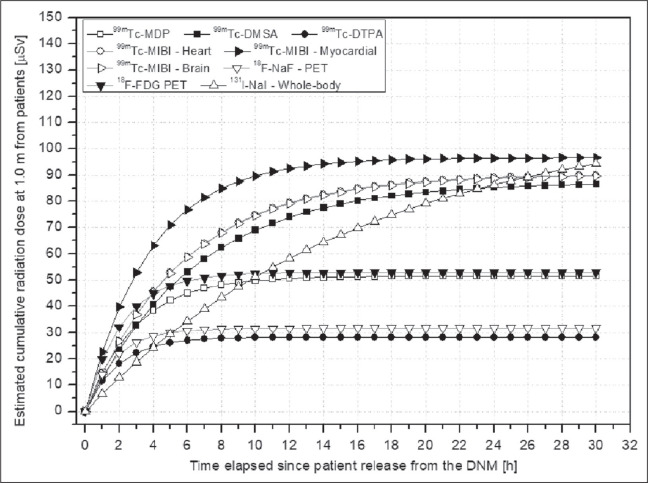
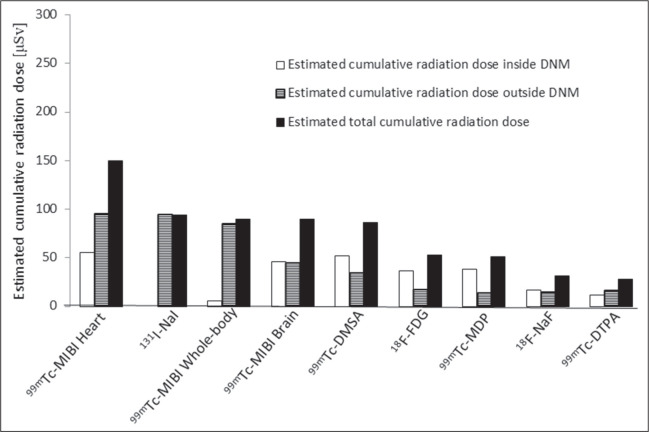
The mean time to clearance of the radiopharmaceuticals administered, expressed as the effective half-life, ranged from 1.18 ± 0.30 h to 11.41 ± 0.02 h, and the mean maximum cumulative radiation dose at 1.0 m from the patients was 149.74 ± 56.72 µSv. Even at a distance of 0.5 m, the cumulative dose was found to be only half and one tenth of the limits established for exposure of the general public and family members/caregivers (1.0 mSv and 5.0 mSv per episode, respectively).
Cumulative radiation doses emitted by patients immediately after diagnostic nuclear medicine procedures are considerably lower than the limits established by the International Commission on Radiological Protection and the International Atomic Energy Agency, and precautionary measures to avoid radiation exposure are therefore not required after such procedures.
测量近期接受诊断性核医学检查的患者所发出的潜在辐射剂量,以便为此类检查制定最佳辐射安全措施。
我们评估了175例成年患者的辐射剂量,这些患者接受了锝-99m、碘-131和氟-18放射性核素用于骨、肾、心、脑和全身扫描,并用辐射探测器进行测量。这些数值作为评估全身放射性药物清除情况以及他人因放射性药物给药后经过的时间而受到辐射暴露风险的依据。
以有效半衰期表示的所给药放射性药物的平均清除时间为1.18±0.30小时至11.41±0.02小时,患者1.0米处的平均最大累积辐射剂量为149.74±56.72微希沃特。即使在0.5米的距离处,累积剂量也仅为为公众和家庭成员/护理人员规定的暴露限值(每次分别为1.0毫希沃特和5.0毫希沃特)的一半和十分之一。
诊断性核医学检查后患者立即发出的累积辐射剂量远低于国际放射防护委员会和国际原子能机构规定的限值,因此此类检查后无需采取避免辐射暴露的预防措施。