Division of birth cohort study, Fujian maternity and children health hospital, Fuzhou, China.
Fujian Children's Hospital (Fujian Branch of Shanghai Children's Medical Center), College of Clinical Medicine for Obstetrics & Gynecology and Pediatrics, Fujian Medical University, Fuzhou, China.
Ital J Pediatr. 2023 Mar 16;49(1):31. doi: 10.1186/s13052-023-01437-4.
Recurrent wheezing is a common clinical problem in early childhood, which is associated with significant morbidity. There is no international consensus on the management and prevention of recurrent wheezing; therefore, identifying the risk factors associated with recurrent wheezing is crucial to prevent episodes of wheezing in young children.
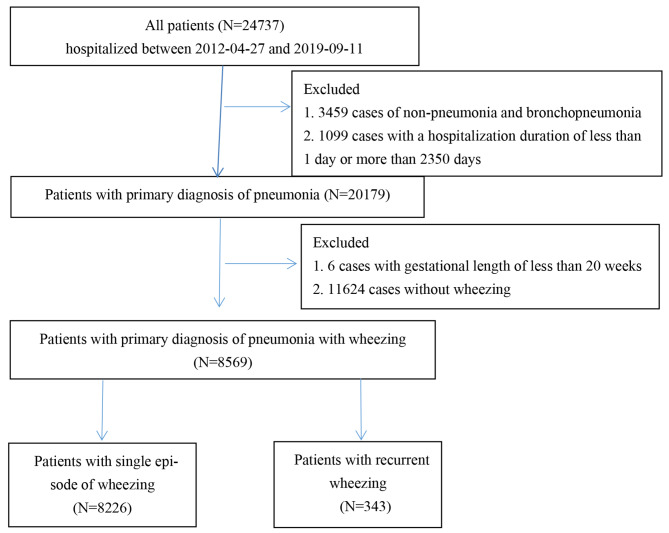
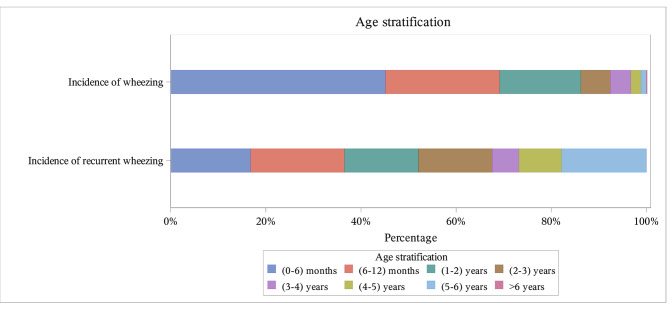
In this retrospective study, we collected the data of 24,737 patients who were admitted to our hospital between 27th April 2012 and 11th September 2019. After screening for patients with wheezing, we identified 8572 patients with a primary diagnosis of pneumonia with wheezing. Patients' clinical data were collected from the hospital medical records. Patients were stratified for age in the groups of < 6 months, 6-12 months, and > 12 months.
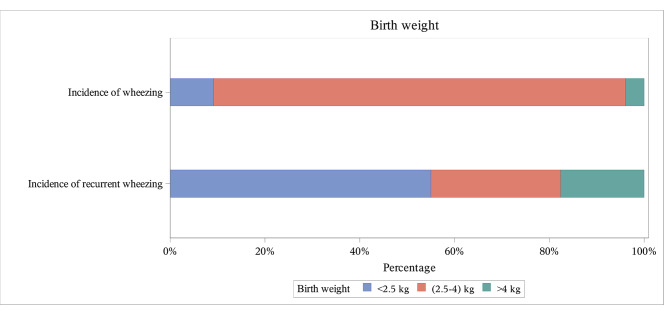
Among the 8569 pediatric pneumonia patients with wheezing, there were 343 patients with recurrent wheezing. Most enrolled patients were under 6 months of age (45.17%) and had a normal birth weight (86.95%). Winter was the most common onset season for the first episode of wheezing, while spring was the most common season for the second episode of wheezing for those with recurrent wheezing. The univariate and multivariate logistic regression analysis for the risk factor associated with recurrent wheezing showed that male gender, past history of respiratory and cardiovascular diseases, low birth weight, development of severe pneumonia, and PICU admission were significantly associated with recurrent wheezing.
Male gender, past history of respiratory and cardiovascular diseases, low birth weight, severe pneumonia, and PICU admission are independent risk factors of recurrent wheezing in the pediatric population.
反复喘息是儿童早期常见的临床问题,与较高的发病率相关。目前国际上对于反复喘息的管理和预防尚无共识,因此,明确与反复喘息相关的危险因素对于预防儿童喘息发作至关重要。
在这项回顾性研究中,我们收集了 2012 年 4 月 27 日至 2019 年 9 月 11 日期间在我院住院的 24737 例患者的数据。在筛选出有喘息症状的患者后,我们确定了 8572 例以喘息为主要诊断的肺炎患儿。从医院病历中收集了患者的临床数据。患者按年龄分为<6 个月、6-12 个月和>12 个月三个亚组。
在 8569 例患有喘息性肺炎的儿科患者中,有 343 例患有反复喘息。大多数入组患者年龄<6 个月(45.17%),出生体重正常(86.95%)。首次喘息发作最常见的发病季节为冬季,而复发性喘息患者的第二次喘息发作最常见的发病季节为春季。单因素和多因素 logistic 回归分析显示,男性、既往有呼吸和心血管疾病史、低出生体重、发生重症肺炎和入住 PICU 与反复喘息显著相关。
男性、既往有呼吸和心血管疾病史、低出生体重、重症肺炎和入住 PICU 是儿科人群反复喘息的独立危险因素。