Zhang Zhen, Chen Fei, Wan Jingjing, Liu Xia
Department of Clinical Pharmacy, School of Pharmacy, Second Military Medical University, No. 325 Guohe Road, Yangpu District, Shanghai, 200082, China.
Chin Med. 2023 Mar 17;18(1):28. doi: 10.1186/s13020-023-00732-w.
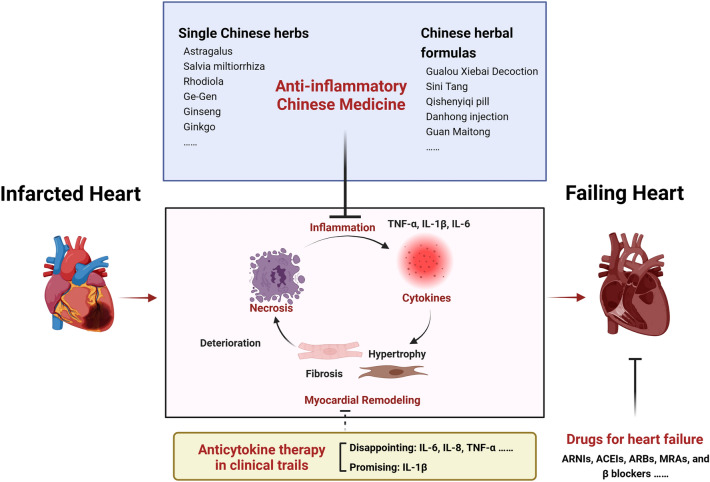
Inflammation plays an important role in the development of heart failure (HF) after myocardial infarction (MI). Suppression of post-infarction inflammatory cascade has become a new strategy to delay or block the progression of HF. At present, there are no approved anti-inflammatory drugs used to prevent HF following MI. Traditional Chinese medicine (TCM) has been used clinically for cardiovascular disease for a long time. Here, we summarized the recent progress about some TCM which could both improve cardiac function and inhibit inflammation in patients or experimental models with MI or HF, in order to provide evidence for their potential application in reducing the onset of HF following MI. Among them, single Chinese medicinal herbs (eg. Astragalus and Salvia miltiorrhiza) and Chinese herbal formulas (eg. Gualou Xiebai Decoction and Sini Tang) are discussed separately. The main targets for their anti-inflammation effect are mainly involved the TLR4/NF-κB signaling, as well as pro-inflammatory cytokines IL-1β, IL-6 or TNF-α. It is worthy of further evaluating their potential, experimentally or clinically, in the prevention or delay of HF following MI.
炎症在心肌梗死(MI)后心力衰竭(HF)的发展过程中起着重要作用。抑制梗死后炎症级联反应已成为延缓或阻止HF进展的新策略。目前,尚无获批用于预防MI后HF的抗炎药物。中药长期以来一直被临床用于治疗心血管疾病。在此,我们总结了一些中药在MI或HF患者或实验模型中既能改善心功能又能抑制炎症的最新进展,以便为其在降低MI后HF发病风险方面的潜在应用提供依据。其中,分别讨论了单味中药(如黄芪和丹参)和中药方剂(如瓜蒌薤白汤和四逆汤)。它们抗炎作用的主要靶点主要涉及Toll样受体4/核因子κB信号通路,以及促炎细胞因子白细胞介素-1β、白细胞介素-6或肿瘤坏死因子-α。在预防或延缓MI后HF方面,对它们的潜力进行实验或临床进一步评估是值得的。