Guangdong Key Laboratory of Medicine, Department of Medical Statistics, Center for Health Information Research, School of Public Health, Sun Yat-sen University, Guangzhou, Guangdong, China.
Guangzhou Center for Disease Control and Prevention, Guangzhou, Guangdong, China.
Front Public Health. 2023 Mar 2;11:1117948. doi: 10.3389/fpubh.2023.1117948. eCollection 2023.
Injuries during work are often exogenous and can be easily influenced by environmental factors, especially weather conditions. Precipitation, a crucial weather factor, has been linked to unintentional injuries, yet evidence of its effect on work-related injuries is limited. Therefore, we aimed to clarify the impact of precipitation on injuries during work as well as its variation across numerous vulnerability features.
Records on the work-related injury during 2016-2020 were obtained from four sentinel hospitals in Guangzhou, China, and were matched with the daily weather data during the same period. We applied a time-stratified case-crossover design followed by a conditional logistic regression to evaluate the association between precipitation and work-related injuries. Covariates included wind speed, sunlight, temperature, , , and . Results were also stratified by multiple factors to identify the most vulnerable subgroups.
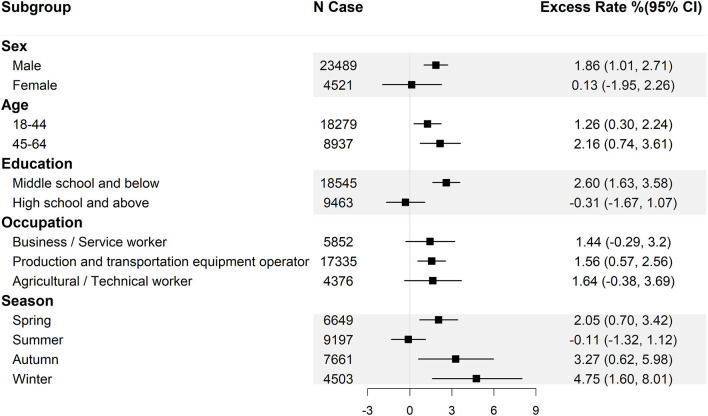
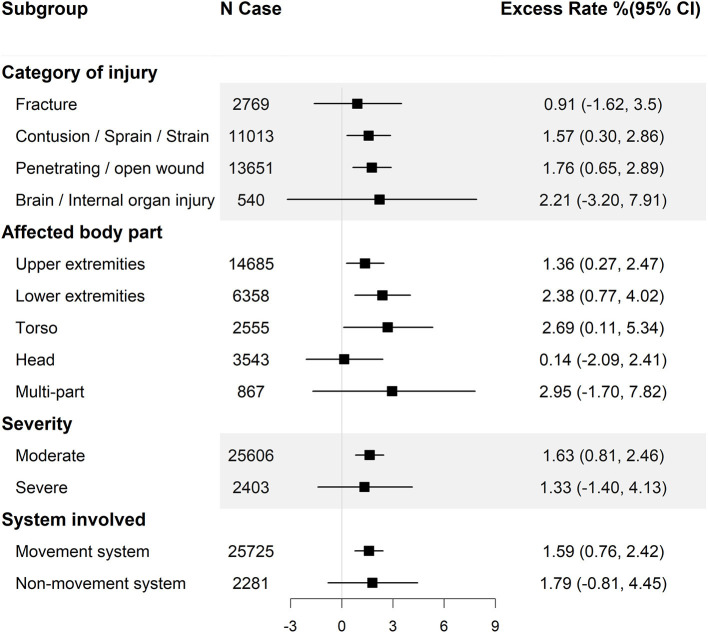
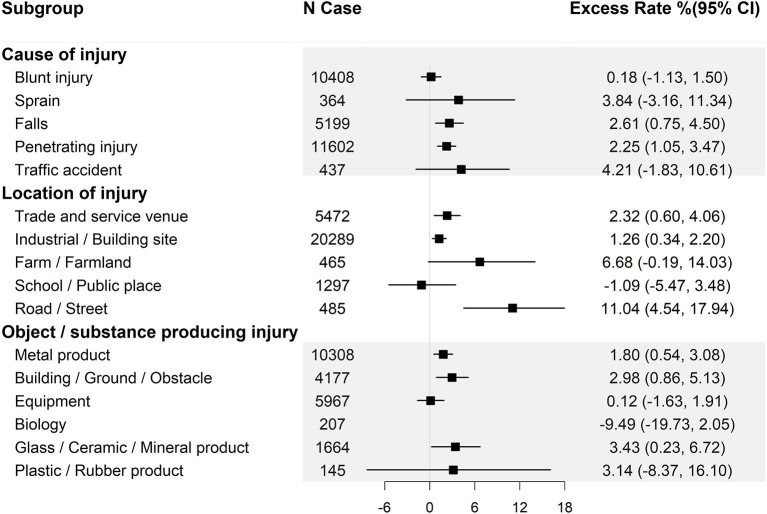
Daily precipitation was a positive predictor of work-related injuries, with each 10 mm increase in precipitation being associated with an increase of 1.57% in the rate of injuries on the same day and 1.47-1.14% increase of injuries on subsequent 3 days. The results revealed that precipitation had a higher effect on work-related injuries in winter (4.92%; 95%CI: 1.77-8.17%). The elderly (2.07%; 95%CI: 0.64-3.51%), male (1.81%; 95%CI: 0.96-2.66%) workers or those with lower educational levels (2.58%; 95%CI: 1.59-3.54%) were more likely to suffer from injuries on rainy days. There was a higher risk for work-related injuries caused by falls (2.63%; 95%CI: 0.78-4.52%) or the use of glass products (1.75%; 95%CI: 0.49-3.02%) on rainy days.
Precipitation was a prominent risk factor for work-related injury, and its adverse effect might endure for 3 days. Certain sub-groups of workers were more vulnerable to injuries in the rain.
工作中的伤害通常是外源性的,很容易受到环境因素的影响,尤其是天气条件。降水作为一个重要的天气因素,与非故意伤害有关,但关于其对与工作相关的伤害的影响的证据有限。因此,我们旨在阐明降水对工作相关伤害的影响,以及其在众多脆弱性特征方面的变化。
从中国广州的四家哨点医院获取 2016-2020 年期间与工作相关的伤害记录,并与同期的每日天气数据相匹配。我们应用时间分层病例交叉设计,随后进行条件逻辑回归,以评估降水与工作相关伤害之间的关联。协变量包括风速、阳光、温度、、、和。结果还按多个因素进行分层,以确定最脆弱的亚组。
每日降水是工作相关伤害的一个正预测因子,降水每增加 10 毫米,当天的伤害率就会增加 1.57%,随后 3 天的伤害率会增加 1.47%-1.14%。结果表明,降水对冬季的工作相关伤害有更高的影响(4.92%;95%CI:1.77-8.17%)。老年人(2.07%;95%CI:0.64-3.51%)、男性(1.81%;95%CI:0.96-2.66%)或受教育程度较低的工人(2.58%;95%CI:1.59-3.54%)在雨天更容易受伤。在雨天,因跌倒(2.63%;95%CI:0.78-4.52%)或使用玻璃制品(1.75%;95%CI:0.49-3.02%)导致的工作相关伤害风险更高。
降水是工作相关伤害的一个显著危险因素,其不良影响可能持续 3 天。某些工人亚组在雨天更容易受伤。