University of Central Florida, School of Kinesiology and Rehabilitation Sciences, College of Health Professions and Sciences, Orlando, FL, USA.
Musculoskeletal Research Lab, Institute of Exercise Physiology and Rehabilitation Science, University of Central Florida, Orlando, FL, USA.
Pain Res Manag. 2023 Mar 10;2023:5326261. doi: 10.1155/2023/5326261. eCollection 2023.
Individuals with low back pain (LBP) may be classified based on mechanistic descriptors, such as a nociplastic pain presentation (NPP). The purpose of this secondary analysis was to examine the frequency and characteristics of patients with a NPP referred to physical therapy with LBP. Additionally, we characterized patients with LBP meeting the criteria for NPP by demographic, clinical, psychological, and pain sensitivity variables. Finally, we examined short- and long-term clinical outcomes in patients with a NPP compared to those without a NPP.
Patients referred to physical therapy for LBP completed the Patient Self-report Survey for the Assessment of Fibromyalgia. Participants were categorized as "LBP with NPP" or "LBP without NPP" based on the threshold established in this measure. A rank sum test examined for differences in pain-related psychological factors and pressure-pain threshold between groups. Next, a Friedman test examined if LBP intensity and disability trajectories differed by groups at one and six months after initiation of physical therapy.
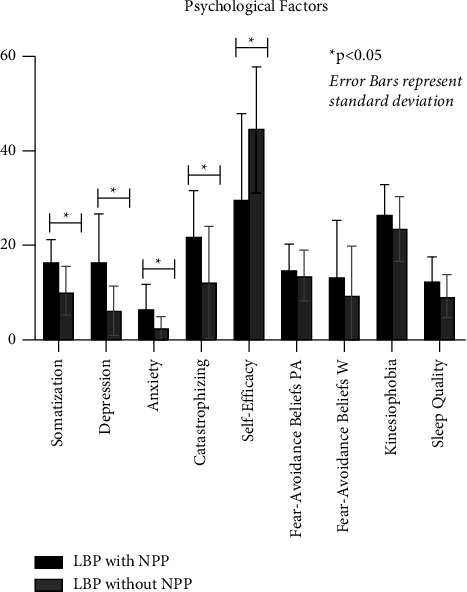
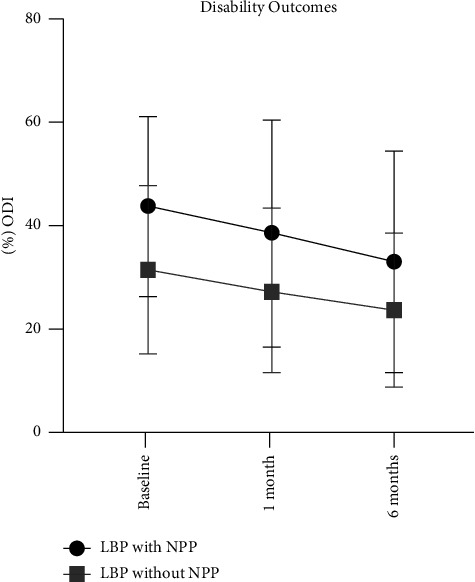
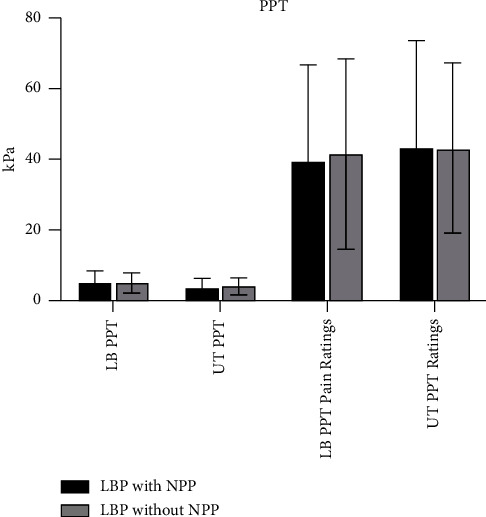
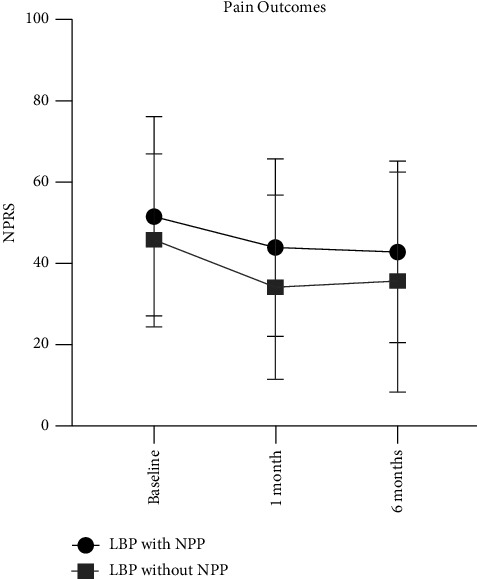
22.2% of patients referred to physical therapy for LBP met the criteria for a NPP. Patients with a NPP reported significantly greater disability, pain catastrophizing, depression, anxiety, and somatization compared to individuals without a NPP ( < 0.05). Pressure-pain threshold did not differ between groups ( > 0.05). Individuals with LBP with a NPP demonstrated nonsignificant, small to medium reductions in pain and disability at one and six months. Individuals experiencing LBP without a NPP demonstrated significant reductions in pain and disability in the short- and long term.
Patients with LBP with a NPP displayed greater negative pain-related psychological factors but similar pain sensitivity compared to LBP without NPP.
患有下背痛(LBP)的个体可能基于机械描述符进行分类,例如痛觉过敏疼痛表现(NPP)。本二次分析的目的是检查患有 NPP 并转诊至物理治疗的 LBP 患者的频率和特征。此外,我们通过人口统计学、临床、心理和疼痛敏感性变量来描述符合 NPP 标准的 LBP 患者。最后,我们比较了患有 NPP 和不患有 NPP 的患者的短期和长期临床结果。
患有 LBP 并转诊至物理治疗的患者完成了用于评估纤维肌痛的患者自我报告调查。根据该测量标准确定的阈值,将参与者分为“LBP 伴 NPP”或“LBP 无 NPP”。秩和检验用于检验两组之间与疼痛相关的心理因素和压力疼痛阈值的差异。接下来,弗里德曼检验检验了在物理治疗开始后一个月和六个月,LBP 强度和残疾轨迹是否因组而异。
22.2%的因 LBP 转诊至物理治疗的患者符合 NPP 标准。与不伴 NPP 的患者相比,患有 NPP 的患者报告的残疾、疼痛灾难化、抑郁、焦虑和躯体化程度显著更高(<0.05)。两组之间的压力疼痛阈值无差异(>0.05)。患有 NPP 的 LBP 患者在一个月和六个月时疼痛和残疾程度呈无显著意义的小到中度降低。不伴有 NPP 的 LBP 患者在短期和长期内均表现出疼痛和残疾的显著降低。
患有 LBP 伴 NPP 的患者表现出更大的负性疼痛相关心理因素,但与不伴 NPP 的 LBP 患者相比,疼痛敏感性相似。