Pascari Xenia, Weigel Stefan, Marin Sonia, Sanchis Vicente, Maul Ronald
Applied Mycology Unit, Food Technology Department, University of Lleida, UTPV-XaRTA, Agrotecnio, Av. Rovira Roure 191, 25198 Lleida, Spain.
Department Safety in the Food Chain, BfR German Federal Institute for Risk Assessment, Max-Dohrn-Str. 8-10, 10589 Berlin, Germany.
J Food Sci Technol. 2023 Apr;60(4):1367-1375. doi: 10.1007/s13197-023-05683-6. Epub 2023 Feb 15.
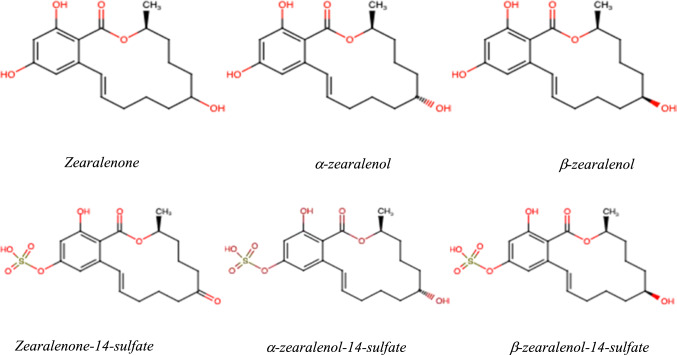
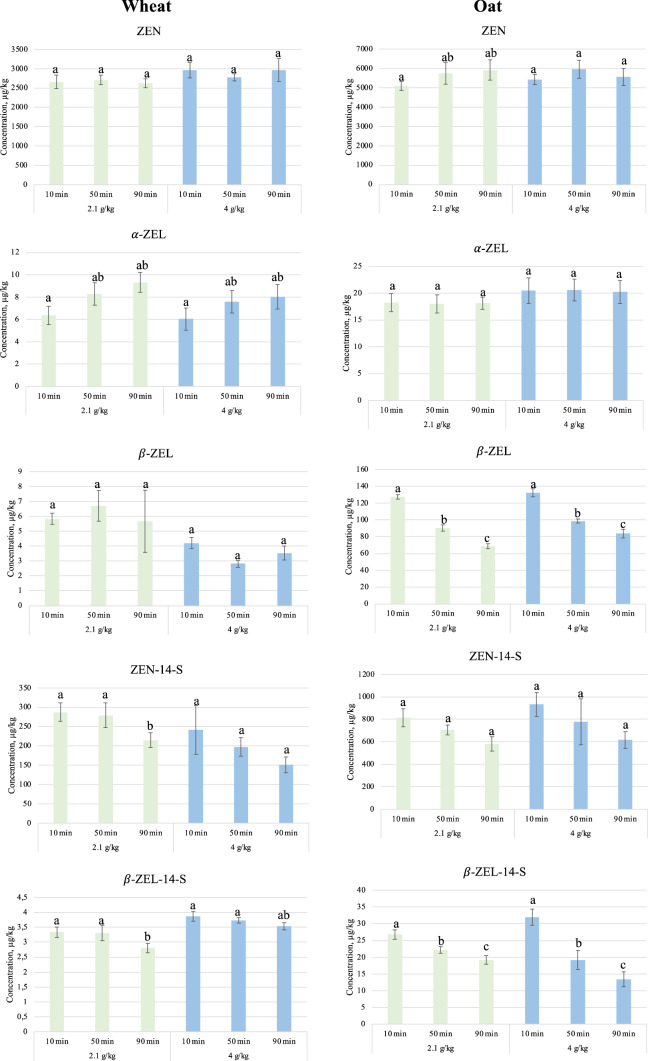
An analytical method for the analysis of the mycotoxin zearalenone (ZEN) and its modified forms was developed. Sample preparation was performed based on a modified QuEChERS method combined with liquid chromatography coupled to a triple quadrupole mass spectrometry detection. The method was tested for linearity, precision, limits of detection and quantification and recoveries. The evaluation of the above-mentioned parameters was performed on oat flour. The method was applied to oat and wheat flours that were submitted to an amylolytic treatment (α-amylase and amyloglucosidase), similar to the one used in the cereal-based baby food production process. A decrease in β-zearalenol (β-ZEL) and β-ZEL-14-sulfate of approximately 40% after 90 min incubation was observed, the other analytes did not show any significant changes. To our knowledge, this is the first method that approaches the identification and assessment of ZEN-sulfate derivates in a cereal matrix.
The online version contains supplementary material available at 10.1007/s13197-023-05683-6.
开发了一种用于分析霉菌毒素玉米赤霉烯酮(ZEN)及其修饰形式的分析方法。基于改进的QuEChERS方法结合液相色谱-三重四极杆质谱检测进行样品制备。对该方法进行了线性、精密度、检测限和定量限以及回收率测试。上述参数的评估在燕麦粉上进行。该方法应用于经过淀粉分解处理(α-淀粉酶和糖化酶)的燕麦粉和小麦粉,该处理类似于谷物基婴儿食品生产过程中使用的处理。孵育90分钟后,观察到β-玉米赤霉醇(β-ZEL)和β-ZEL-14-硫酸盐减少了约40%,其他分析物未显示任何显著变化。据我们所知,这是第一种用于鉴定和评估谷物基质中ZEN-硫酸盐衍生物的方法。
在线版本包含可在10.1007/s13197-023-05683-6获取的补充材料。