Inoue Kosuke, Figueroa Jose F, Kondo Naoki, Tsugawa Yusuke
Department of Social Epidemiology, Kyoto University, Kyoto, Japan.
Department of Health Policy and Management, Harvard School of Public Health, Harvard University, Cambridge, MA, USA.
BMJ Med. 2022 Sep 6;1(1):e000219. doi: 10.1136/bmjmed-2022-000219. eCollection 2022.
To determine changes in industry marketing payments to physicians due to the covid-19 pandemic.
Quasi experimental, difference-in-difference study.
US nationwide database of licensed physicians, the National Plan and Provider Enumeration System, which was linked to a database of industry marketing payments made to physicians, Open Payments.
All licensed US physicians from 2018 to 2020 and those who received payments from industry.
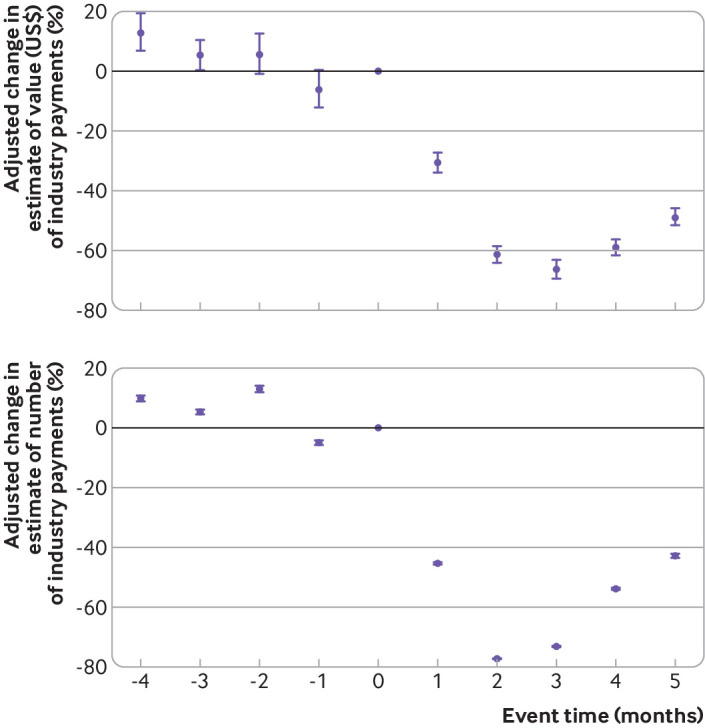
Changes in the value and the number of monthly industry payments physician received before (January-February 2020) and during the pandemic (April-December 2020) were assessed, adjusting for physicians' characteristics (gender and specialty). As the control, data for the same months in 2019 were used. Industry payments by type of payments (eg, meals, travel, consulting fees, speaker compensation, honorariums), were also examined.
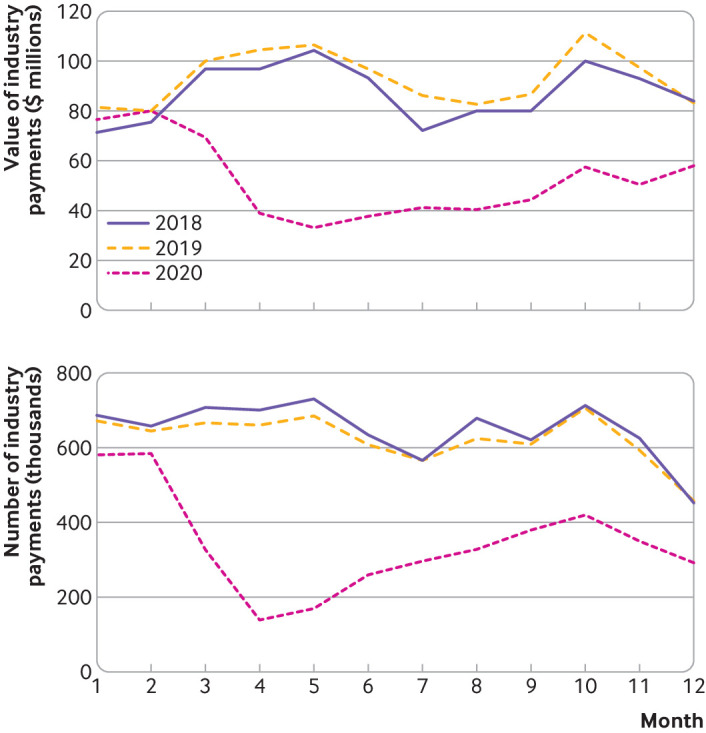
Among 880 589 US physicians included in this study, 267 463 (30.4%) physicians received a total of 4 117 482 non-research payments with $626 million ($710 per physician; £610; €708) in 2020 (40-44% decrease from $1047m in 2018 and $1115m in 2019). Industry payments decreased significantly in the months of the covid-19 pandemic (adjusted change in the value of -48.4%; 95% confidence interval -50.6 to -46.2; P<0.001; and adjusted change in the number of -47.4%, 95% confidence interval -47.7 to -47.1; P<0.001), particularly for meals and travel fees. No evidence was seen of a decrease in the number of industry payments for consulting and honorariums. A similar pattern was observed across physicians' gender and specialty.
Industry payments to physicians, particularly those involving physical interactions such as meals and travel, substantially decreased during the pandemic. How such changes affect prescription practices and the quality of clinical practice in the long term should be investigated.
确定因新冠疫情导致行业向医生支付的营销费用的变化情况。
准实验性的差分研究。
美国全国执业医师数据库,即国家计划与提供者枚举系统,该系统与向医生支付行业营销费用的数据库“开放支付”相链接。
2018年至2020年所有美国执业医师以及那些接受行业支付的医生。
评估医生在疫情前(2020年1月至2月)和疫情期间(2020年4月至12月)每月收到的行业支付的价值和数量变化,并对医生的特征(性别和专业)进行调整。作为对照,使用了2019年相同月份的数据。还研究了按支付类型(如餐饮、差旅、咨询费、演讲报酬、酬金)划分的行业支付情况。
在本研究纳入的880589名美国医生中,267463名(30.4%)医生在2020年共收到4117482笔非研究支付,金额为6.26亿美元(每位医生710美元;610英镑;708欧元)(比2018年的10.47亿美元和2019年的11.15亿美元减少了40 - 44%)。在新冠疫情期间,行业支付显著减少(支付价值的调整变化为 - 48.4%;95%置信区间为 - 50.6至 - 46.2;P<0.001;支付数量的调整变化为 - 47.4%,95%置信区间为 - 47.7至 - 47.1;P<0.001),尤其是餐饮和差旅费用。未发现咨询和酬金方面的行业支付数量减少的证据。在医生的性别和专业方面观察到类似模式。
在疫情期间,行业向医生的支付,尤其是那些涉及如餐饮和差旅等身体接触的支付大幅减少。这种变化如何长期影响处方行为和临床实践质量值得研究。