Mabila Sithembile, Patel Deven, Fan Michael, Stahlman Shauna, Seliga Nicholas, Nowak Gosia, Wells Natalie
Defense Health Agency, Public Health Directorate, Armed Forces Health Surveillance Division, Epidemiology and Analysis Division, USA.
Defense Health Agency, Defense Centers for Public Health-Portsmouth, EpiData Center, USA.
Int J Cardiol Cardiovasc Risk Prev. 2023 Jun;17:200183. doi: 10.1016/j.ijcrp.2023.200183. Epub 2023 Mar 15.
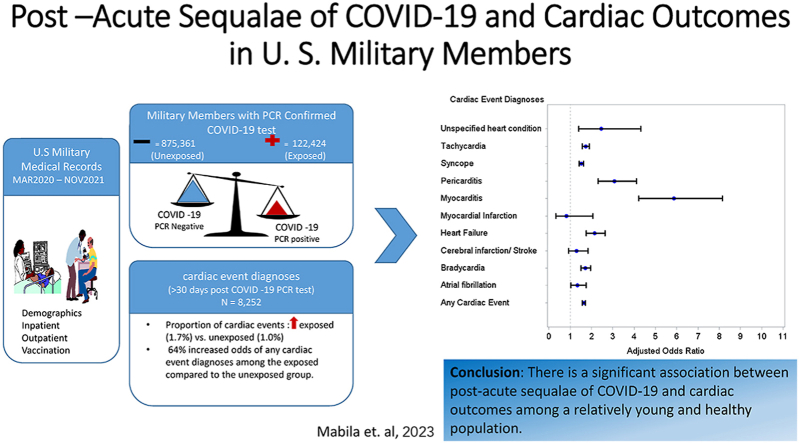
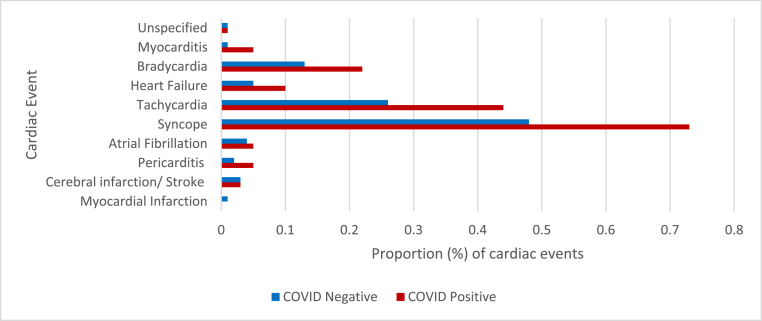
Post -acute sequalae of COVID-19 (PASC) among U.S. military members remains unexplored. A cohort study of U. S. military members who had a COVID-19 test result, with the specimen collected between March 1, 2020 and November 30, 2021 was conducted. Demographic, inpatient and outpatient data including cardiac event diagnoses were extracted from electronic medical records and compared COVID-19 test-positive and COVID-19 test-negative service members. We used univariate and multivariable logistic regression methods to determine the effect PASC on select cardiac events. Among 997,785 service members, 15,779 (1.6%) were diagnosed with a cardiac event. In fully adjusted models, PASC was significantly associated with increased odds of any cardiac event [OR =1.64 (95% CI: 1.57, 1.71]. PASC was associated with increased odds of myocarditis [OR = 5.86 (95% CI: 4.22, 8.15)], pericarditis [OR =3.08 (95% CI: 2.31, 4.11)], syncope [OR =1.52 (95% CI: 1.41, 1.63)], tachycardia [OR =1.72 (95% CI: 1.56, 1.89)], heart failure [OR =2.15 (95% CI: 1.76, 2.63)], bradycardia [OR =1.71 (95% CI: 1.50, 1.96)], and atrial fibrillation [OR =1.33(95% CI: 1.02, 1.74)] in fully adjusted models. In a sensitivity analysis of military members with no history of cardiac events, PASC was still significantly associated with increased odds of any cardiac event [OR =1.75 (95% CI: 1.67, 1.84)]. In conclusion, we observed a significant association between PASC and cardiac outcomes including; myocarditis, pericarditis, and heart failure. These associations were observed in a relatively young and healthy population and among those without pre-existing cardiac diagnoses.
美国军人中新冠病毒感染后急性后遗症(PASC)的情况仍未得到充分研究。我们对2020年3月1日至2021年11月30日期间接受新冠病毒检测的美国军人进行了一项队列研究。从电子病历中提取了人口统计学、住院和门诊数据,包括心脏事件诊断信息,并对新冠病毒检测呈阳性和检测呈阴性的军人进行了比较。我们使用单变量和多变量逻辑回归方法来确定PASC对特定心脏事件的影响。在997,785名军人中,15,779人(1.6%)被诊断出患有心脏事件。在完全调整模型中,PASC与任何心脏事件的发生几率增加显著相关[比值比(OR)=1.64(95%置信区间:1.57,1.71)]。PASC与心肌炎[OR = 5.86(95%置信区间:4.22,8.15)]、心包炎[OR = 3.08(95%置信区间:2.31,4.11)]、晕厥[OR = 1.52(95%置信区间:1.41,1.63)]、心动过速[OR = 1.72(95%置信区间:1.56,1.89)]、心力衰竭[OR = 2.15(95%置信区间:1.76,2.63)]、心动过缓[OR = 1.71(95%置信区间:1.50,1.96)]和心房颤动[OR = 1.33(95%置信区间:1.02,1.74)]的发生几率增加相关。在对无心脏事件病史的军人进行的敏感性分析中,PASC仍与任何心脏事件的发生几率增加显著相关[OR = 1.75(95%置信区间:1.67,1.84)]。总之,我们观察到PASC与包括心肌炎、心包炎和心力衰竭在内的心脏结局之间存在显著关联。这些关联在相对年轻且健康的人群以及无既往心脏诊断的人群中被观察到。